


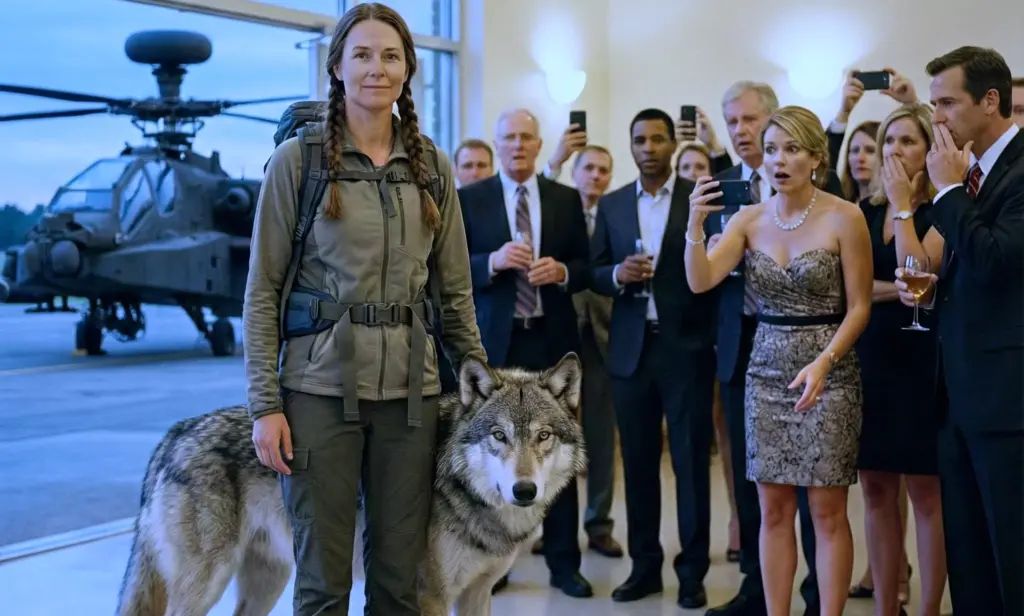
The heavy double doors swung inward, and the chatter in the room was severed as cleanly as if cut by a knife. The first figure to cross the threshold was a wolf—a massive creature of grey and white fur, weighing in at a solid 120 pounds. His amber eyes swept across the Red Mesa Community Center with the calculated focus of a trained sentinel. Every movement the animal made was fluid, predatory, and undeniably commanding.
Following close behind him was a young woman dressed in dusty hiking gear. Her dark hair was plaited in a single braid down her spine, and a weather-beaten leather satchel was slung across her chest. A collective gasp rippled through the gathered crowd. Chairs screeched against the linoleum floor as people instinctively recoiled.
somewhere in the room, a wineglass slipped from nervous fingers and shattered, sending a puddle of red liquid spreading across the tiles. Kaya Thompson went pale, the color draining from her face in an instant. Marcus Sullivan, who had been mid-sentence at the podium, froze completely, his carefully rehearsed speech evaporating from his mind.
Beyond the windows, the Arizona desert sprawled out toward the horizon, dyed a deep crimson by the fading twilight. It was a stark, silent reminder of just how isolated they were out here. The wolf’s gaze didn’t waver; he wasn’t threatening anyone, but he was certainly assessing them.
The name Ayana meant «eternal blossom» in Navajo. It was the name her mother had whispered over her newborn form twenty years ago—a desperate prayer for resilience. But that mother was gone now, buried in the hard earth for eight years. She had chosen to succumb to her despair rather than witness her daughter endure another day of suffering.
The young woman standing in the doorway had grown up right here in Red Mesa, Arizona. It was a town fractured down the middle, divided between the white families who held the deeds to the land and the Native families who carried the memory of when it had been theirs.
Her mother had been the school janitor, a woman who scrubbed floors while the teachers stepped around her, pretending she was invisible. They had lived in a dilapidated trailer on the eastern fringe of town, right where the pavement surrendered to the dust of the desert. From the age of five, Ayana had possessed an uncanny ability to read animals the way other children read fairy tales.
She understood the subtle tilt of a dog’s head, the hidden tension in a cat’s shoulders, the specific warning in the call of a crow. When she was eight, she had been discovered in the schoolyard, murmuring softly to an injured bird, explaining gently how she intended to splint its broken wing. The other children had pointed and jeered, branding her with names like «animal freak,» «dirty Indian,» and «wild girl.»
By the time she turned ten, the teasing had calcified into genuine cruelty. A group of students had once locked her in a dark storage closet for two full hours, taunting her through the door that she smelled like the reservation. Her mother had eventually found her, scooping her up and carrying her home while Ayana wept into the fabric of her shirt.
And then, abruptly, Ayana had vanished from Red Mesa without a trace.
Marcus Sullivan stood paralyzed on the makeshift stage. He was twenty years old now, retaining the broad shoulders of a high school quarterback, but his internal confidence was in ruins. His father had passed away six months prior, leaving behind a confession that had dismantled everything Marcus thought he understood about his own life.
This reunion had been Marcus’s concept from the start. It was intended to be a public apology, a desperate grasp at redemption.
Kaya Thompson gripped her husband Derek’s arm with white-knuckled intensity. She was three months pregnant, though she hadn’t yet realized it. Once, she had been Ayana’s closest friend, before jealousy had soured that bond into something hateful.
Her father, Mr. Thompson, stood near the punch bowl, looking older than his years. He was the former biology teacher, a man who carried the heavy knowledge that he had failed to protect the one student he had admired most.
It was Grandmother Naomi who had encouraged Ayana to show up tonight. At seventy-two, Naomi was a woman of tradition and steel. She was the one who had sent the letter eight years ago that altered the course of Ayana’s life: Your mother is gone. She couldn’t wait anymore.
Makiya, the wolf, pressed his flank firmly against Ayana’s left leg. He was a five-year-old male who had learned the danger of humans long before a thirteen-year-old girl had pried him loose from a hunter’s trap.
Three days before this night, Ayana’s battered pickup truck had crunched up the gravel of her grandmother’s driveway. It had been a decade since she last navigated these roads. Initially, Makiya had refused to leave the truck bed, his nerves frayed by the proximity to human settlements, his amber eyes tracking every dust mote in the air.
Grandmother Naomi had stepped out of her small adobe house. Her face was a map of time and grief, yet etched with a softness that endured. She simply opened her arms.
Ayana had walked into that embrace and felt, for the first time in ten years, that she might actually have a place in the world.
«You came back,» Naomi had whispered in Navajo.
«I don’t know why,» Ayana had confessed.
They had sat on the porch as the evening purpled the sky, sipping strong, dark coffee. The reunion invitation lay on the weathered table between them, Marcus Sullivan’s handwriting looping across the envelope.
«Please come, there’s something important I need to say.»
«You think it’s a trap,» Naomi said. It wasn’t a question. «They locked me in there once. They don’t want me there now except to humiliate me again.»
«Perhaps,» Naomi mused, tracing the rim of her cup. «Or perhaps people change. You don’t go for them, granddaughter. You go to close the door on that chapter of your life. You’ve been running for ten years.»
«Running doesn’t end until you turn around.» Ayana tapped the leather satchel she had carried from the truck. «I still have her ashes.»
Naomi’s eyes welled with tears. «Your mother’s last words were: Tell her I’m sorry I wasn’t strong enough.«
The coffee suddenly tasted bitter in Ayana’s mouth.
The following morning, Ayana drove to the town cemetery alone. She hadn’t visited since she fled. She couldn’t bear the thought of seeing her mother’s name chiseled into granite, making permanent something that should have been impossible.
The marker was modest: Sarah Whitefeather, Beloved Mother, 1975–2017.
Makiya accompanied her this time, sensing the spike in her distress. He leaned his weight against her legs as she knelt in the dry, brittle grass.
«I got your letter,» Ayana whispered to the cold stone. «Grandmother sent it to me in Flagstaff, at that relative’s house. I was twelve.»
The memory washed over her: reading those words, grasping that her mother had chosen to leave rather than endure the pain any longer. Ayana had run away that very night, stealing money for a bus ticket north, vanishing into the Kaibab National Forest with nothing but a backpack and a burning rage. For those first few months, she had survived on pure instinct.
Grandmother Naomi had found her eventually. She had brought supplies in secret, never forcing the girl to return to civilization. And when Ayana turned thirteen, standing on a cliff’s edge and ready to follow her mother into the dark, Makiya had emerged from the shadows.
He was a young wolf caught in the jaws of a trap, his leg shattered, his eyes wild with desperation. Saving him had been the act that saved her.
«I’m going to the reunion,» Ayana told the grave. «I don’t know why. Maybe to show them they didn’t break me. Maybe to prove I survived in spite of everything.»
She placed a hand on the marble. «I’m angry at you for leaving. And I miss you so much I can barely breathe sometimes.»
Makiya whined low in his throat and rested his heavy head on her knee. The decision solidified in her chest. She would go.
Back at her grandmother’s house, Ayana made no effort to dress up. She stuck to her field gear: practical cargo pants, scuffed hiking boots, and a simple cotton shirt the color of rust. These were the clothes she had lived in for seven years, her uniform of survival.
She looked at the invitation again. Ten-Year Reunion, Red Mesa High Class of 2015.
They had been children then. They were supposed to be adults now, but Ayana had learned the hard way that age didn’t guarantee growth. Sometimes, people just aged into harder versions of their worst selves.
«Some of them might have changed,» Grandmother warned as she watched her granddaughter pack. «Some haven’t.»
«I’m not going to forgive them,» Ayana said, her voice flat. «I’m going to show them I survived despite them. That’s all.»
«And that’s enough,» Naomi replied. «Sometimes, simply bearing witness to your own survival is the greatest revenge.»
The leather satchel went into the truck, her mother’s ashes still waiting for release. She had carried them for eight years, unable to let go, unable to move forward. Perhaps tonight would shift that. Perhaps not.
Makiya hopped into the passenger seat without needing a command. He had learned her moods and knew exactly when she needed him close.
«Ready, sir?» she asked him.
His amber eyes met hers with steady devotion. Always ready, always loyal—unlike any human she had ever known.
The Red Mesa Community Center was decked out in streamers of blue and gold—their old school colors—now faded, much like the memories they were attempting to celebrate. A banner strung across the room read: Class of 2015, 10 Years Later.
Even though it had only been ten years since they started high school together, not since graduation, someone had meticulously assembled a photo collage on the far wall. Yearbook pictures smiled out with the oblivious cruelty of children who had never been taught that actions have consequences.
Roughly thirty people occupied the room. Soft music from their teenage years drifted through the air—pop songs that had once seemed profound. A punchbowl sat on a folding table, flanked by store-bought cookies and the sound of nervous laughter.
Ayana scanned the faces with methodical precision. Marcus Sullivan was standing near a makeshift podium, papers trembling visibly in his hands. Kaya Thompson was leaning against the refreshment table, her body language defensive before Ayana had even stepped inside.
Mr. Thompson, the biology teacher, stood in a corner with the careful stillness of a man burdened by unbearable guilt. Jessica Rodriguez, who had been Ayana’s friend before fear turned her into a bystander, was staring intently at her shoes.