


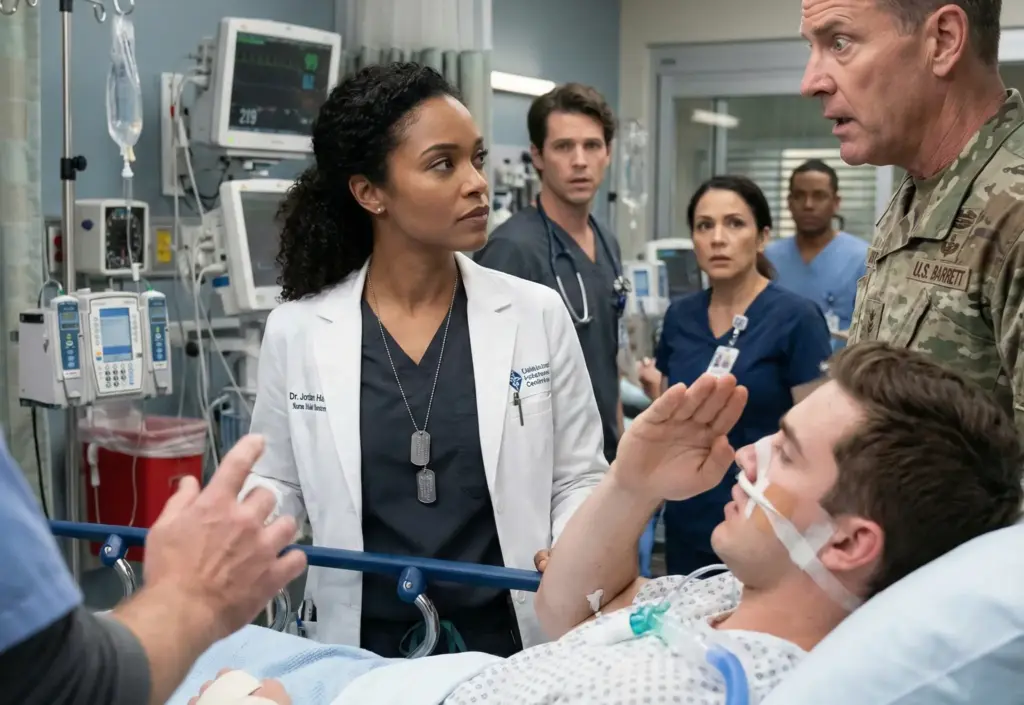
At a quarter to six, the emergency department at Alamo Heights Medical Center looked like it had never gone to sleep. Fluorescent lights hummed above scuffed linoleum, washing everything in the same thin white. The air smelled of antiseptic and burned coffee.
Dr. Jordan Hale stood at the nurse station with a cardboard cup between her hands, eyes on the bedboard. The coffee was already cooling, she drank it anyway. Her badge read, Trauma Surgery Attending, in small black letters that no one seemed to notice.
When she shifted her grip, her sleeve slid back. A loop of dull metal showed at her wrist chain links and a small rectangular plate pressed to her skin. The letters stamped into it were softened from wear.
She pulled the fabric down again. Across the counter, Dr. Ethan Ward told a story. So this guy rolls in pressure in the 70s belly hard.
He said one hand sketching the curve of an abdomen. Radiology wants a CT. I tell them if we wait 10 minutes, we lose him.
Straight to the OR. Spleen in pieces. Clamp pack, done.
He’s probably arguing about the food by now. A couple of nurses smiled. A first year shook his head, impressed.
Rick Halpern, chief resident, glanced up from his tablet, just long enough to smirk. That why you look like hell, Rick asked. Ethan tilted his head.
You should see the other guy. Laughter rippled around the station. It washed past Jordan.
She remembered the mottled bruise on that patient’s flank, the way she had murmured retroperitoneal bleed. He needs the OR and the quick nod Ethan had given before repeating it louder. Dr. Hale.
She turned. Halpern had stepped close her tablet, balanced in his hand. Yeah, she said.
Bed 8, he said. Forearm laceration. Needs closing.
We are short-staffed and the intern is tied up upstairs. Can you take it? Sure. Appreciate it.
His eyes were already back on his labs. It landed like a small favor he had just granted her. Carla Morales slid a chart toward Jordan as she rounded the counter.
Carla’s badge had been swiped so often the plastic was cloudy. Walk in from a job site, Carla said. Cut his arm on rebar.
Blood everywhere. I cleaned what I could. Any numbness, Jordan asked.
He says no, Carla replied. He also says he has to be back on site by 7. Jordan nodded and took the chart. The hall beyond the station was a line of curtained bays and blinking monitors.
Air from the vents brushed the back of her neck cooler near the ambulance doors. The curtain at bed 8 bowed inward. She hooked it aside with her elbow and stepped in.
The man on the gurney wore a neon yellow safety vest over a dark t-shirt. His jeans were dusted with gray powder. A hard hat sat on the chair.
His uninjured hand held a phone. His thumb did not stop moving when she entered. Morning, Jordan said.
Hey, Doc. He glanced up then back at the screen. You doing the stitches? I really need to get going.
Let me see your arm first. He sighed then held it out. The gauze clung to dried blood.
She loosened the tape and unwound it. The cut ran across the top of his forearm wide enough to gape deep enough to show the pale shine of tendon under fat. The edges were ragged.
She bent closer. One of the extensor tendons was clearly damaged. Near it a pale cord lay too close to the surface.
Any tingling, she asked. Pins and needles, numb spots. Nope, he said.
Feels normal. They just freak out when they see blood. Lift your wrist, she said.
He tried. The motion was there but weaker than it should have been. Close your eyes, she said.
Tell me if this is sharp or dull. She touched his hand and forearm with the tip of a cotton swab. His answers lagged.
A couple were wrong in a pattern she recognized. You are not going back to work today, Jordan said. His eyes opened.
Come on. It is just a cut. It is deep, she said.
You may have some nerve involvement. I’m going to call hand surgery. He laughed once.
Hand surgery? For this. The clinic by our yard does stitches all the time. I do not need a specialist.
Today you do, she said. If we do not fix this right, you could lose strength in that hand. How long you been doing this, he asked.
Long enough, she said. She laid fresh gauze over the wound, wrapped a clean dressing, and secured it. He flinched once and then watched her fingers closely.
I will have someone bring you something for the pain, she said. The hand surgeon will see you soon. She stepped out.
The curtain slid back into place. At the station, she picked up the phone and paged the on-call hand surgeon. Forearm laceration, likely tendon, and radial nerve involvement, construction worker, she said.
Would appreciate an evaluation. She hung up. Ethan’s voice drifted from the other side of the counter.
She just called a specialist on a forearm lac, he said. Cautious, Rick replied. She overcalls everything.
Carla walked past with an IV tray. Her gaze met Jordan’s for a heartbeat, then moved on. Jordan sat at the terminal, logged in, and opened the chart.
The cursor blinked on an empty field. She typed in tendon exposure weakness on extension inconsistent sensation consult placed. Her coffee waited beside the keyboard.
She took a sip. It was cold now, the taste flat and bitter. Somewhere above, a helicopter engine rose.
The vibration ran down through the ceiling tiles into the floor under her shoes. She listened for a moment, then dropped her eyes back to the screen and moved to the next name on the list. The next few hours blurred into the usual rhythm of the shift.
Labs came back, orders went in, families asked the same three questions in different voices. The board filled, emptied, filled again. By mid-morning, the whiteboard at the station had a red star next to bed three.
Carla had written motor vehicle collision chest pain, decreased breath sounds in a tight hand. Someone had circled it twice. Jordan walked toward the bay paper gown rustling against her scrubs.
Behind the curtain, a young man lay propped against the head of the bed, skin the color of paper. His t-shirt was half cut away. A bruise spread across the left side of his chest, the pattern of a steering wheel faint under the discoloration.
Dr. Aaron Lynn stood at his right side, stethoscope in his ears, brow furrowed. He was slim, dark-haired, with a face that still looked more like a student than a doctor. A senior resident hovered near the foot of the bed, arms crossed.
Breath sounds, Jordan asked. Aaron looked up startled. Diminished on the left, he said.
Trachea is midline. Some jugular distension. Pressure is 90 over 60.
He is pretty tacky. Jordan stepped closer, listening for the rasp of air watching the rise of the ribs. The left side rose less than the right.
Each inhale made the bruise darken at the edges, as if something underneath was pushing back. We are doing a chest tube, the senior said. Lynn, walk me through your landmarks.
Aaron swallowed. His gloves squeaked as he felt along the ribs counting under his breath. Mid-axillary line, he said.
Fifth intercostal space. Jordan watched his fingers stop a little too high. She could hear the helicopter again faint through the ceiling, the chopper blades a steady chop in the background.
For a moment, her body thought of another tent, another field, but she forced the thought aside. Aaron, she said, keeping her voice low. That is the fourth.
He did not look at her. I checked, he said. I am on five.
The senior resident did not intervene. He took a half step back, leaving space. Jordan frowned, fingers tightening around the bed rail.
The nurse clipped the sterile drape into place. The room contracted to a square of exposed skin and blue paper. The smell of chlorhexidine hung heavy.
Aaron made the incision. The man on the bed flinched. The first cut was fine.
Then the clamp went in, pushing through subcutaneous fat and muscle. Jordan’s gaze tracked the angle of the instrument. She saw it before it happened, the slight shift too close to the inferior edge of the rib, where the intercostal artery hugged bone.
Bright arterial blood burst up around the clamp, a sudden spray that painted Aaron’s gloves red to the wrists. Shit, he whispered. The monitor beeped faster.
The man’s pressure started to slide down, clamped Jordan said. Her hand was in the wound before anyone answered. Warmth closed around her fingers.
Bone under her knuckles, slippery tissue, the fast hammer of an artery. She pressed where the beat was strongest. The bleeding slowed, then pulsed against her fingertips.
Long hemostat, she said. The scrub nurse slapped it into her palm. Jordan followed the pulse by feel guiding the tip, closing it around the vessel.
Tie, she said. The suture brushed her glove. Two throws, three, cinched down tight.
The artery went still. You’re going to reposition your tube, she told Aaron, not looking up. Below the rib.
Higher posterior if you can. Aim for the apex. He nodded Adam’s apple bobbing.
His breathing was loud in the small space of the drape. This time he counted more carefully. The tube slid into the chest and a stream of air rushed out, followed by a slow trickle of dark blood.
The man’s chest rose more evenly. The monitor settled. Jordan stepped back and stripped off her gloves.
Blood clung to the cuff of her sleeve in a dark crescent. Next time, she said quietly to Aaron, find your landmarks twice before you cut. He stared at his hands.
I thought I had it, he said. I know, she replied. You will remember this one.
She left the bay. The noise of the hall rushed in phones ringing shoes on tile. Carla caught her eye as she passed her gaze flicking down to the stain on Jordan’s cuff.