


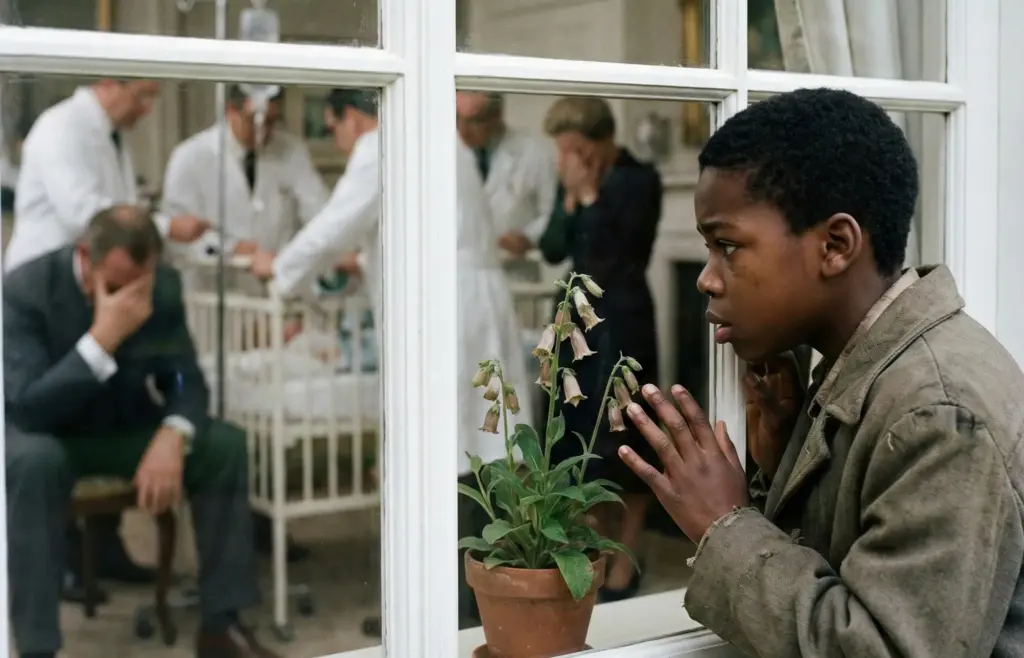
The Kensington estate had never seen chaos like this. Eighteen of the world’s most decorated physicians crowded into a nursery that cost more than most homes. Their white coats were a blur of frantic movement under crystal chandeliers.
Heart monitors screamed, and ventilators hissed. A team from Johns Hopkins barked orders at specialists flown in from Geneva, while a Nobel laureate in pediatric immunology wiped sweat from his forehead. He whispered what no one wanted to hear.
«We’re losing him.»
Baby Julian Kensington, heir to a $40 billion empire, was dying. Fifty thousand dollars an hour in medical expertise couldn’t tell anyone why. His tiny body had turned the color of twilight.
Blue lips. Blue fingertips. A strange, mottled rash creeping across his chest like an accusation. Every test came back inconclusive. Every treatment failed.
Through the servant’s entrance window, pressing his face against glass that had never been cleaned for someone like him, stood Leo. He was 14 years old, the son of the night shift housekeeper, wearing a coat three winters too thin and shoes held together with prayer.
He’d spent his whole life being invisible on this estate. He was the boy who walked the edges, who noticed everything because no one ever noticed him. Right now, he was staring at the potted plant on the nursery windowsill.
It was the one that had arrived three days ago. The one that had left an oily, yellowish residue on the gardener’s gloves. Gloves that had touched the baby’s crib railing during yesterday’s cleaning. Every genius in that room had walked past it seventeen times without a second glance.
Leo’s hands trembled. He knew what it was. His grandmother, who’d healed half of Kingston’s poorest neighborhood with nothing but herbs and faith, had taught him to recognize that leaf pattern before he could read.
Digitalis. Devil’s trumpet. Angel killer.
The doctors were about to cut that baby open looking for answers. The answer was sitting in a ceramic pot, wrapped in a bow. Leo looked at the window, then at the security guard making rounds, then at his mother’s face through the kitchen door. She was the woman who’d warned him a thousand times: Stay invisible, stay safe, don’t give them a reason to throw us out.
He thought about what would happen if he was wrong. Then he thought about what would happen if he was right, and did nothing. Leo pulled his coat tight, took a breath, and ran.
Leo had learned to walk without making a sound by the time he was six years old. It wasn’t a skill anyone had taught him; it was survival. When you lived in the groundskeeper’s cottage at the edge of a billionaire’s estate, a cottage so small it could fit inside the Kensington family’s walk-in closet, you learned quickly that your existence was tolerated, not welcomed.
You learned to move like smoke. To breathe like a secret. To become so small, so quiet, so utterly forgettable that the wealthy people floating through their marble lives never had to be inconvenienced by the reminder that you were alive.
His mother, Grace, had worked for the Kensington family for eleven years. She’d started when Leo was just three, scrubbing floors on her hands and knees while pregnant women in designer gowns stepped over her like she was part of the furniture. She’d worked through two miscarriages, a bout of pneumonia that nearly killed her, and the slow death of every dream she’d ever had for herself.
All so Leo could have a roof over his head and food in his belly.
«We are blessed,» she would tell him every night, her voice soft with exhaustion and something that might have been faith or might have been denial. «Mr. Kensington lets us live here. He pays for your schoolbooks. We are blessed, Leo. Don’t ever forget that.»
Leo never argued with her. But he also never forgot the way the Kensington children looked through him when they passed, like he was made of glass or maybe just air. He never forgot the time Arthur Kensington III had fired a gardener for making eye contact with him during a business call.
He never forgot the sign on the main house’s service entrance: Staff must use rear access. Visible presence on main grounds prohibited during family hours.
The Kensington estate sprawled across 47 acres of manicured perfection in the hills above the city. There were gardens designed by celebrity landscapers, fountains imported from Italy, and a hedge maze that had been featured in three architectural magazines. There was a tennis court, a helicopter pad, and a swimming pool shaped like the family crest.
There was a 12-car garage filled with vehicles that cost more than most people’s houses, and a wine cellar that held bottles older than Leo’s grandmother would have been if she’d lived. Leo knew every inch of it. Not because he was allowed to explore.
God, no. He knew it because he’d spent his entire life watching from the margins. From the tiny window of the groundskeeper’s cottage. From behind the rhododendron bushes when he was supposed to be walking to the bus stop.
From the shadows of the service corridor when he snuck in to bring his mother her forgotten lunch. He’d mapped the estate in his mind the way other kids mapped video game levels.
He knew which security cameras had blind spots. He knew which doors were left unlocked during the 3 p.m. shift change. He knew that the head of security, a thick-necked man named Briggs, took a 20-minute smoke break behind the pool house every afternoon at 4:15.
He knew these things because knowing them made him feel like he had some kind of power in a world that constantly reminded him he had none. But lately, Leo had been watching for a different reason.
Three months ago, Eleanor Kensington had given birth to a baby boy. Julian Arthur Kensington IV. The heir. The prince. The future of a dynasty built on tech patents and pharmaceutical acquisitions and the kind of generational wealth that most people couldn’t even conceptualize.
The baby had arrived in a flurry of magazine covers and society announcements. A professional photographer had been hired to capture his first moments. A team of night nurses rotated in eight-hour shifts. A nutritionist had been flown in from Switzerland to consult on Mrs. Kensington’s diet to ensure optimal breast milk composition.
Leo had watched it all from his usual place: the shadows. And somewhere along the way, something had shifted in his chest.
He’d started timing his walks to school so he’d pass the nursery window at sunrise, when the nurse would hold Julian up to see the morning light. He’d started lingering near the kitchen entrance when he knew the baby would be taken for his afternoon stroll through the gardens.
He’d started feeling something he couldn’t quite name. A strange, aching tenderness for this tiny person who had everything Leo would never have, but who also seemed so small, so fragile, so utterly unaware of the weight of the crown he’d been born wearing.
Maybe it was because Julian was innocent. Maybe it was because Leo remembered what his grandmother used to say: «Every child comes into this world pure, baby. What happens after, that’s on us.»
Or maybe it was because Leo understood, in some bone-deep way, that he and Julian were both prisoners of circumstances they hadn’t chosen. Julian would spend his life in a golden cage, performing for cameras and shareholders and a father who saw him as a legacy rather than a person. Leo would spend his life in the margins, invisible and uncounted, his potential measured only by how well he stayed out of the way.
Two boys. Two prisons. Same estate.
It was a Tuesday afternoon when Leo first saw the plant. He was walking back from school, taking his usual route along the service road that ran behind the mansion’s east wing. The autumn air was sharp with the smell of dying leaves and approaching rain, and Leo had his coat pulled tight against the chill.
It was the same coat he’d been wearing for three years now. The one with the fraying sleeves and the broken zipper that his mother kept promising to fix, but never had time for.
A delivery van was parked near the service entrance. This wasn’t unusual. The Kensingtons received packages constantly. Everything from rare wines to custom furniture to baby food flown in from organic farms in New Zealand.
But something about this delivery made Leo slow his steps. The delivery man was carrying a plant.
It was beautiful, Leo had to admit. About two feet tall, with dark green leaves that seemed to shimmer with an almost oily sheen. Pale, bell-shaped flowers hung in delicate clusters, white with purple streaks, like bruises on porcelain. The pot was wrapped in an elaborate gold bow, and a card was tucked among the stems.