


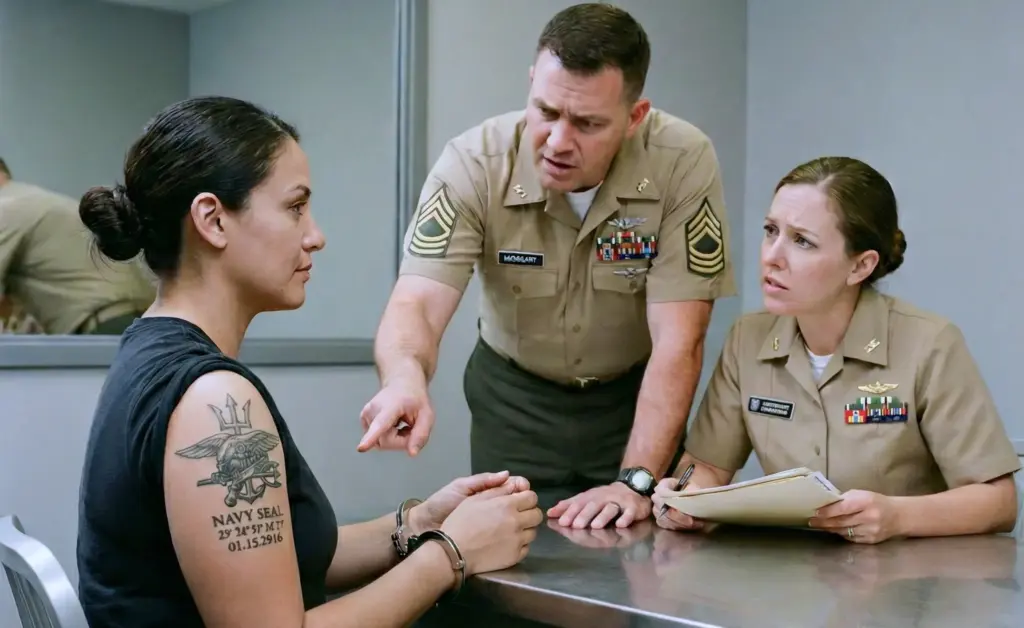
Sarah Martinez had always been different from other women her age. At 32, she carried herself with a confidence that made people take notice. Her shoulders were always straight, her walk purposeful, and her eyes held a sharpness that seemed to see everything around her.
Most people assumed she was military, though she never talked about her past. On that Tuesday morning in downtown San Diego, Sarah was running errands like any other civilian. She had stopped at the local coffee shop, the same one she visited every week.
The barista, Jenny, always smiled when she saw Sarah coming. There was something comforting about Sarah’s presence, something that made people feel safe.
“The usual?” Jenny asked, already reaching for the large black coffee.
“You know me too well,” Sarah replied with a small smile.
She paid and took her coffee to a corner table, where she could watch the street through the large windows. It was a habit she couldn’t break, always positioning herself where she could see potential exits and watch for anything unusual. As she sipped her coffee and checked her phone, Sarah noticed three men in military uniforms enter the coffee shop.
They weren’t there for coffee. Their eyes scanned the room systematically until they landed on her. Sarah’s body tensed automatically, years of training kicking in, even though she tried to live a quiet life now.
The men approached her table, and the tallest one, a sergeant with stern features, spoke first. “Ma’am, we need to see some identification.”
Sarah looked up calmly, though her heart rate had increased. “Is there a problem, officer?”
“We’ve received reports that you’ve been claiming to be a Navy SEAL,” the sergeant continued. “That’s a serious federal offense. We need you to come with us for questioning.”
The coffee shop had gone quiet. Jenny behind the counter looked confused and worried. Other customers had stopped their conversations to watch the scene unfold. Sarah felt the familiar weight of unwanted attention, something she had tried so hard to avoid in her civilian life.
“I think there’s been a misunderstanding,” Sarah said quietly. Reaching slowly for her wallet, she pulled out her driver’s license and handed it to the sergeant. “I’m Sarah Martinez. I work at the community center downtown.”
The sergeant examined her ID carefully, then looked back at her. “Mrs. Martinez, we have witnesses who say you told them you were a Navy SEAL. You were at the VA hospital last week, and several people heard you talking about SEAL operations.”
Sarah’s jaw tightened. She remembered that day clearly. She had been visiting her friend Mike, a veteran who had lost his leg in Afghanistan. Some other veterans in the waiting room had started sharing war stories.
When they asked about her service, she had been honest about her experiences. She never claimed to be something she wasn’t, but she also couldn’t deny what she had lived through.
“I was sharing experiences with other veterans,” Sarah explained. “I never impersonated anyone.”
“Ma’am, with all due respect, women cannot be Navy SEALs,” the sergeant said firmly. “It’s impossible. So either you’re lying now, or you were lying then. Either way, we need to sort this out at the base.”
Sarah felt the familiar frustration rising in her chest. This wasn’t the first time her service had been questioned, and it probably wouldn’t be the last. The military had changed a lot over the years, but some attitudes remained stuck in the past.
“Am I under arrest?” she asked, her voice steady despite the anger building inside her.
“Not yet,” the sergeant replied. “But we strongly suggest you come with us voluntarily. This can be handled quietly, or it can become a much bigger problem.”
Sarah looked around the coffee shop. Jenny looked like she might cry. The other customers were whispering among themselves, probably already forming opinions about what they were witnessing. Sarah had worked hard to build a peaceful life in this community, and now it felt like it was crashing down around her.
She stood up slowly, her movement causing the three military police officers to tense slightly. Sarah noticed their reaction and made sure to keep her hands visible and her movements deliberate and non-threatening.
“I’ll come with you,” she said. “But I want to call my lawyer.”
“You can call your lawyer from the base,” the sergeant replied. “Let’s go.”
As they walked toward the door, Jenny called out from behind the counter. “Sarah, don’t worry, everyone here knows you’re a good person.”
Sarah turned and gave Jenny a grateful smile. “Thanks, Jen. Take care of yourself.”
The walk to the military police vehicle felt like the longest walk of Sarah’s life. She could feel eyes on her from every direction. Neighbors who had always waved and smiled now watched with curiosity and suspicion. Children playing in the nearby park stopped their games to stare at the woman being escorted by military police.
Sarah climbed into the back of the vehicle, her mind racing through possible outcomes. She knew the truth would come out eventually, but the process of getting there might destroy everything she had built in her civilian life. Her job at the community center, her friendships, her reputation in the neighborhood—all of it was now at risk.
As the vehicle drove through the familiar streets of her neighborhood toward the naval base, Sarah reflected on the choices that had led her to this moment. She had always known that her past might catch up with her someday, but she had hoped for a different kind of recognition. She had hoped that when the truth came out, it would be because she chose to share it, not because she was forced to defend it.
The sergeant in the front seat was making radio calls using codes and terminology that Sarah understood perfectly. She listened carefully, gathering information about what they knew and what they suspected. It seemed like someone had made an official complaint, possibly someone who had been at the VA hospital that day.
Sarah closed her eyes and tried to prepare herself for what was coming. She knew that once they started digging into her background, everything would change. There would be no going back to her quiet life, no more anonymity, no more peace. But maybe, she thought, it was time for the truth to come out anyway.
The vehicle turned through the gates of the naval base, and Sarah felt like she was returning to a world she had tried to leave behind. The familiar sights and sounds brought back memories she had worked hard to bury. Soon, those memories would be dragged into the light, and she would have to face not just the accusations against her, but the entire complicated truth of who she really was.
The interrogation room at Naval Base San Diego was exactly as Sarah remembered. Sterile white walls, a metal table bolted to the floor, and chairs that were designed for function rather than comfort. She had been in rooms like this before, but never on this side of the questioning. The irony wasn’t lost on her.
Sergeant Williams, the man who had arrested her at the coffee shop, sat across from her with a thick file folder. Next to him was Lieutenant Commander Janet Ross, a stern woman in her 40s who looked like she had seen every kind of military fraud case imaginable. They had been questioning Sarah for two hours, and their patience was clearly wearing thin.
“Mrs. Martinez,” Lieutenant Commander Ross began, her voice sharp and professional. “Let’s go through this one more time. You claim you served in special operations, but we can’t find any record of you in any Navy SEAL databases. Your military records show you served as a hospital corpsman, nothing more.”
Sarah had been expecting this. The official records never told the whole story, especially not for people who had served in the kinds of operations she had been part of.
“My service was classified,” she said simply. “The records you’re looking at are cover stories.”
Sergeant Williams laughed, but there was no humor in it. “Ma’am, that’s what every fake SEAL says. ‘My records are classified.’ It’s always the same story.”
“Because sometimes it’s true,” Sarah replied calmly.
She understood their skepticism. She had probably investigated similar cases herself when she was on active duty. The difference was she had known which claims were real and which weren’t.
Lieutenant Commander Ross leaned forward. “Mrs. Martinez, let me explain something to you. Impersonating a military member is a federal crime. Specifically claiming to be a Navy SEAL can get you five years in federal prison and a quarter-million dollar fine. This isn’t a game.”