


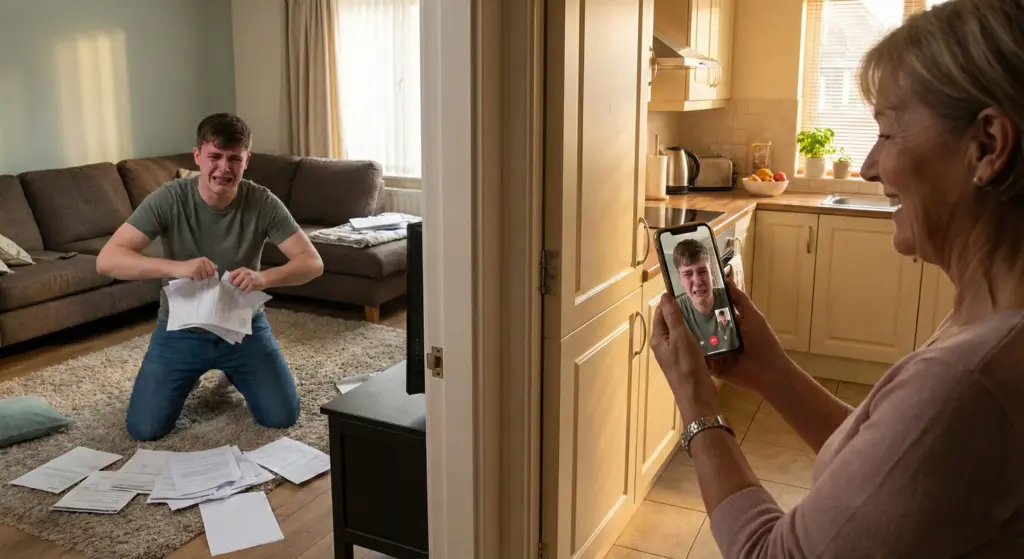
My son called me. «I’m getting married tomorrow. I withdrew all the money from your bank accounts and sold the house. Bye!»
I just laughed out loud. He didn’t know that the house he sold was actually not the one he thought it was.
I had spent 37 years building my life carefully, brick by brick. My name is Margaret Thornton, and at 62, I thought I had seen everything life could throw at me. I lived in a modest two-bedroom house in suburban Ohio, worked part-time at the local library, and enjoyed my quiet routine.
My son, Derek, was 34 and had always been ambitious—perhaps too ambitious. The first strange thing happened three months before everything fell apart.
Derek called me, asking about my bank account numbers. «Mom, I need to help you set up automatic bill payments,» he said, his voice smooth as honey. «You’re getting older, and I don’t want you to miss anything important.»
I hesitated, but he was my son, my only child. His father had died when Derek was 12, and I had raised him alone, working two jobs, sacrificing everything. Surely, I could trust him with this.
The second sign came six weeks later. Derek visited with his fiancée, Brittany. She was 26, beautiful in that sharp, calculated way that made me uneasy.
They sat in my living room, and Brittany’s eyes roamed over everything: the furniture, the paintings, the vintage clock on the mantel. «This house must be worth quite a bit now, Margaret,» she said, not even calling me Mom or Mrs. Thornton. «Real estate in this area has really appreciated.»
«It’s my home,» I replied simply. «I’m not interested in selling.»
Derek laughed, squeezing her hand. «Of course not, Mom. Brittany’s just making conversation.»
But something in his eyes made my stomach turn. Then came the banking statements. I checked my accounts online every Sunday morning with my coffee. That particular Sunday in late October, my heart stopped.
My savings account, the one with $127,000 I had accumulated through decades of careful saving, through my husband’s life insurance, through years of denying myself vacations and new clothes, showed a balance of $1,200. My checking account was empty except for $53.
My hands shook as I called the bank. The representative, a kind young woman named Ashley, pulled up my transaction history.
«Mrs. Thornton, it looks like these withdrawals were authorized through your online banking portal. The transfers were made to an account belonging to Derek Thornton.»
«Is that your son?» she asked.
I couldn’t speak. I simply hung up. I sat in my kitchen for three hours, staring at the wall. How could he? Why would he?
I had given him everything. I had sacrificed my youth, my opportunities, my relationships, and this was how he repaid me?
My phone rang the next morning. It was Derek. I almost didn’t answer, but something made me pick up.
«Hey, Mom!» His voice was cheerful, excited even. «Great news! Tomorrow, I’m getting married.»
«Brittany and I decided not to wait,» he continued. «We’re having a beautiful ceremony at the Riverside Country Club.»
My throat felt tight. «Derek, my bank accounts…»
«Oh, that!» He laughed—actually laughed. «Yeah, Mom. I withdrew the money. I needed it for the wedding and for our new start. Don’t worry. You’ll be fine with your Social Security.»
He didn’t stop there. «And here’s the other thing. I sold the house. I had power of attorney from those documents you signed last year, remember? The closing was yesterday. You have 30 days to move out.»
The world tilted. «You… sold my house?»
«I got a great price. $340,000. That money’s going toward our down payment on a condo in the city. Look, I have to go. Caterer’s calling. We’ll talk after the honeymoon. Bye, Mom.»
The line went dead. I sat there, phone in my hand, feeling the weight of betrayal crushing my chest. Then slowly, something else rose inside me.
Not anger, not yet. Something colder. Something that made my lips curve into a smile. I started laughing.
Softly at first, then louder, until tears rolled down my cheeks. Derek had no idea what he had just done. That house he sold? The one he thought was my simple suburban home worth $340,000?
He had just made the biggest mistake of his life. Because the house Derek sold wasn’t the house I actually lived in. It was the rental property I had purchased 15 years ago.
It was the one I had deliberately registered in my name for tax purposes. The one currently occupied by tenants with a lease agreement lasting another 18 months. My real home, the one I actually lived in—mortgage-free, worth nearly $600,000—was in a trust under my late husband’s mother’s estate name.
Derek didn’t even know it existed. Oh, my foolish, greedy son. What had you done?
The laughter faded, leaving behind something harder. Something that settled in my bones like ice. I sat at my kitchen table—my real kitchen table—and forced myself to think clearly.
What had I actually lost? The rental property Derek sold would create a legal nightmare for him. The buyers would discover tenants with a valid lease.
The Hendersons had lived there for three years and had 16 months remaining on their current contract. Derek would face lawsuits from the buyers for fraud, and possibly criminal charges for selling a property he didn’t have the right to sell.
The power of attorney he referenced? I had never signed such a document. Never.
My stolen savings hurt more. $127,000 represented my security, my freedom, my future medical care. That money was meant to ensure I never became a burden to anyone.
How bitterly ironic that my own son had stolen it to avoid me being a burden to him. But here was the crucial thing Derek didn’t understand: I wasn’t defenseless.
I wasn’t some confused elderly woman who would simply accept this betrayal. I had spent decades working in legal offices before becoming a librarian. I understood contracts, property law, and fraud.
More importantly, I had kept meticulous records of everything. I opened my filing cabinet and pulled out the folder labeled Rental Property, Oak Street. Inside were copies of the lease agreement with the Hendersons, proof of their security deposit, and my own deed to the property.
I had never given Derek power of attorney. Whatever documents he claimed to have were either forged or obtained through deception.
Next, I checked my real estate holdings file. My actual home, the one I sat in now, was titled under the Robert Thornton Family Trust, established by my late mother-in-law 20 years ago. I was the trustee and beneficiary, but the property wasn’t in my personal name.
Derek had grown up in this house, but apparently, he had never understood the legal structure behind it. When I had purchased the rental property years later, I had deliberately kept it simple, in my own name, for tax purposes. Derek must have assumed that modest rental was my only asset.
I made myself coffee and began listing what I needed to do. First, report the theft to the police. Second, contact my bank’s fraud department.
Third, hire a lawyer. Fourth, ensure the Hendersons were protected and informed. Fifth, gather evidence of Derek’s fraud for the property sale.
But as I wrote, my hand slowed. Did I want to send my own son to prison? The thought made me feel sick.
Despite everything, he was still the little boy I had rocked to sleep. The teenager I had helped with homework. The young man I had been so proud of when he graduated college.
Then I remembered his voice on the phone. Cheerful. Casual. «You’ll be fine with your Social Security.»
As if he had done nothing wrong. As if stealing his mother’s life savings and selling her supposed home was just a minor inconvenience for me to deal with. What kind of man had I raised?
I thought of Brittany. With her calculating eyes and her pointed comments about property values. Had she pushed him to this? Or had Derek always been capable of such cruelty and I had simply refused to see it?
My phone buzzed. A text from my neighbor, Patricia. Maggie, saw a For Sale sign go up at your rental on Oak Street yesterday, then come down this morning. Everything okay?
I texted back: Long story. Can we meet for coffee tomorrow?
Patricia had been my friend for 15 years. She was a retired paralegal. I would need allies for what was coming.
That night, I barely slept. I kept imagining Derek’s face when he realized what he had done. Would he feel remorse? Would he apologize? Or would he blame me somehow?
By morning, I had my plan. I would not go to the police immediately. Instead, I would gather every piece of evidence, document every crime, and build an irrefutable case.
Then I would confront Derek with the choice: make full restitution voluntarily, or face criminal prosecution. I would give him one chance to do the right thing. One chance to prove he was still my son and not the stranger who had laughed while robbing his mother.
I called the bank at 9 o’clock sharp. «I need to report fraud and theft from my accounts,» I told the representative. «And I need a complete record of all transactions for the past six months.»
«Of course, Mrs. Thornton, I’m so sorry this happened. We’ll start an investigation immediately.»
Next, I called Martin Green, an attorney who attended my book club. «Martin, I need your help. My son has stolen my savings and fraudulently sold a property I own.»
«I need legal representation,» I continued. «And I need it to be confidential until I’m ready to act.»
There was a pause. «Margaret, this is serious. How much are we talking about?»
«$127,000 in cash theft. Approximately $340,000 in fraudulent property sale proceeds.»
«My goodness,» he whispered. «Yes, I’ll help you. Come to my office this afternoon.»
I hung up and looked at myself in the hallway mirror. My silver hair was neat, my blue eyes clear and determined. I looked like someone’s sweet grandmother.