


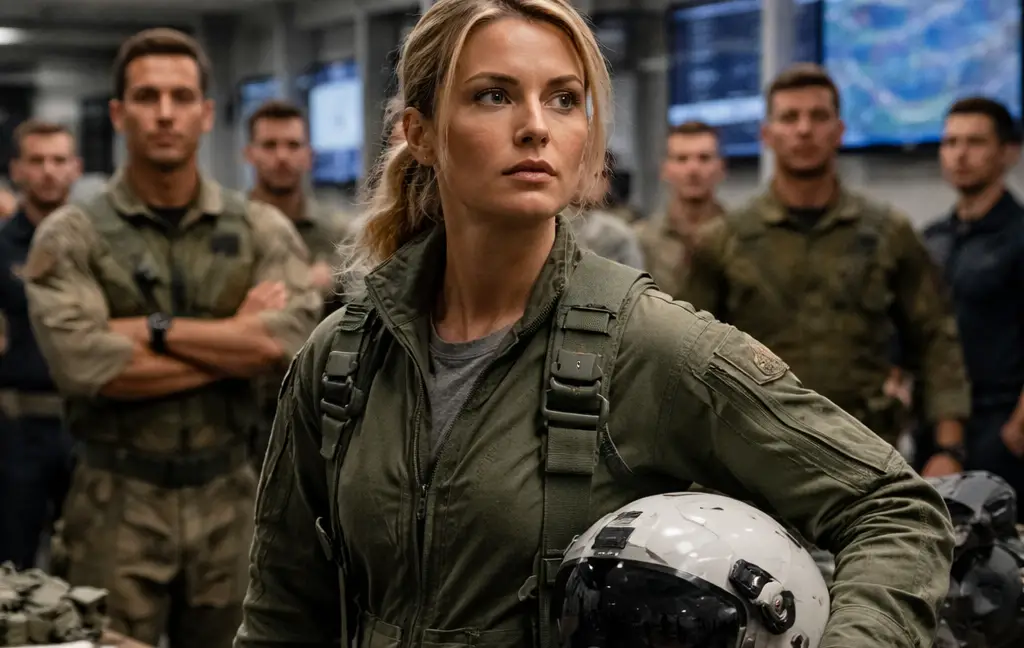
They didn’t challenge her skill; they challenged her worth. With a smirk and an audience, they ordered her into the cockpit as a joke, certain the jet would expose her, certain the moment would end in laughter. Because some systems don’t fear failure; they fear being proven wrong.
What they never considered was this: when humiliation meets quiet mastery, the result isn’t chaos, it’s a reckoning. This isn’t a story about proving them wrong. It’s about what happens when dignity flies faster than doubt.
At Naval Air Station Key West, the heat pressed down early, turning the concrete flight line into a mirror of wavering air. Jets rested in disciplined rows, their silhouettes sharp against the Florida sky. Inside the operations building, confidence traveled in louder voices than competence ever did.
Lieutenant Commander Avery Sloan moved through it quietly. Her flight suit had seen better days: sun-faded patches and a zipper that stuck if you didn’t coax it just right. The name tape on her chest was clean but unremarkable.
No one paused to read it. No one ever did. She wasn’t on the daily briefing list anymore and hadn’t been for months.
Instead, she stood near the back wall with a tablet tucked under her arm, listening as others talked about missions she once would have planned. To most of the room, she was background—a pilot technically, but not one they worried about impressing. Avery had flown the F-35 long enough to recognize that kind of dismissal.
It wasn’t loud. It didn’t announce itself. It arrived as an omission.
No questions were directed her way, no follow-ups to her notes, no invitations to weigh in. It was the kind of professional erasure that came wrapped in courtesy and left no fingerprints. She had been reassigned after a deployment review that ended without explanation.
No black mark, no official reprimand, just a subtle shift in tasking that moved her from combat-ready rotations to joint demonstrations and support coordination. Important work, they said. Necessary. But «temporary» had stretched indefinitely.
Across the room, a cluster of SEALs leaned against a table, relaxed, joking in the way people do when they know the space belongs to them. Their commander, Commander Luke Harrigan, stood at the center of it, tall, assured, wearing confidence like a second uniform. He spoke easily, laughing as he recounted a training mishap that ended with bruises and beer.
Avery watched without staring. Harrigan didn’t look her way until he needed a room to laugh.
«And who’s flying the Lightning today?» he asked, scanning the space like he already knew the answer.
A junior officer gestured vaguely. «Uh, Sloan. She’s slotted.»
Harrigan’s eyebrows lifted, amused. «Really?»
It wasn’t disbelief; it was curiosity edged with entertainment. He finally looked at her then. Avery met his gaze without expression, offering nothing for him to read.
Harrigan smiled a half-grin, the kind reserved for comments meant to land safely as jokes. «Well,» he said lightly, «guess today’s gonna be educational.»
The room chuckled—not unkindly, not cruelly, just enough to establish where everyone stood. Avery didn’t react. She didn’t stiffen, didn’t smile.
She nodded once in acknowledgement, not submission, and returned her attention to the tablet. Her notes were precise: timing windows, fuel margins, and weather patterns that would complicate the afternoon if anyone bothered to factor them in. They didn’t.
To Harrigan, she was a novelty, a name on a board, a pilot who had drifted out of relevance without making a mess on the way down. He didn’t know her hours. He didn’t know her deployments.
He certainly didn’t know why someone with her posture and calm had been pushed to the margins, and no one volunteered the information. That was how Avery Sloan had learned to survive this phase of her career: not by demanding space, but by letting silence do its work. She had learned that people who underestimated her rarely did so out of malice.
They did it because it was easier than asking questions. She gathered her gear as the meeting broke, her movement efficient and unhurried. Outside, the F-35 waited, its skin catching the sun like it always had.
To Avery, it wasn’t a symbol. It was a responsibility. Behind her, Harrigan laughed again, already telling someone else how the day might go.
No one in that room believed she mattered. They were about to find out how expensive that belief could be. The briefing room didn’t laugh out loud; that would have been too obvious.
Instead, it filled with that quieter, sharper sound: chairs shifting, breath caught in throats, a few restrained smirks that said the same thing without words. This should be interesting. She stood near the back wall, tablet held at her side, posture straight but unremarkable.
It was the kind of stance people forget to look at twice. To most of them, she was still what the roster said she was now: logistics officer, reassigned, grounded. Useful only on paper, a name associated with supply chains, not contrails.
Commander Luke Harrigan paced slowly at the front, his boots echoing against polished concrete. He had the build and presence of someone used to being obeyed without question. Years of special operations had carved certainty into him—certainty about threats, about hierarchy, about who mattered in a room.
His eyes moved across the assembled pilots, lingering on flight suits, patches, and wings. Then they stopped on her. Not because she stood out, but because she didn’t.
«Lieutenant,» Harrigan said, his voice even, almost casual.
The room stilled. She met his gaze without flinching. «Sir?»
He tilted his head slightly, as if confirming something he’d already decided. «You used to fly, correct?»
A pause. Not long, but long enough for everyone to hear it.
«Yes, sir.»
Someone near the front exhaled a quiet laugh, quickly stifled. Harrigan nodded, his lips curving into something that might have been a smile.
«Good. Then you won’t mind helping us with today’s demonstration.»
The word «demonstration» landed oddly—too light, too clean. He turned to the large display showing the flight schedule.
«We’re running a familiarization for my team. Joint Ops. I want them to see how your pilots handle the F-35.»
His finger moved down the list, past names everyone expected, then stopped. «Lieutenant,» he said again, this time louder. «You’ll take the jet up.»
The silence that followed was absolute. It wasn’t confusion; it was recognition. They understood immediately what this was: a joke dressed up as authority, a lesson disguised as an order.