


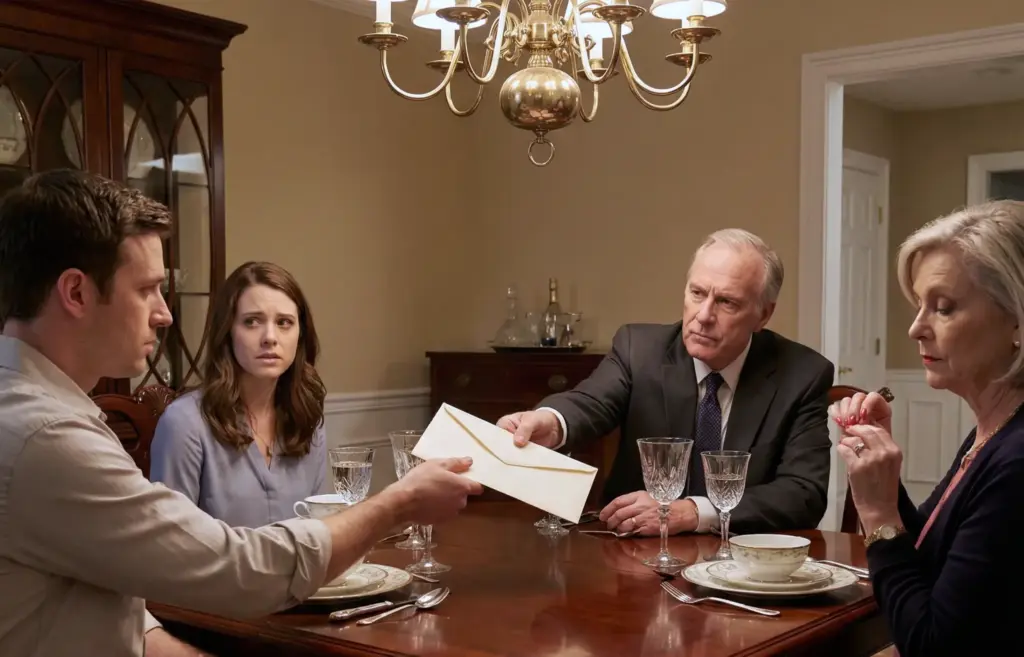
The envelope slid across the mahogany table with a sound that changed everything. Inside was a check for $500,000. Richard Hastings was smiling like he’d just solved all his problems with one signature.
What he didn’t know was that the man sitting across from him, the one he was trying to buy off like some gold-digging nobody, controlled 47% of his entire empire.
My name is Nathan Cross, and this is the story of how I watched my wife’s family try to destroy me while I held their financial future in the palm of my hand. For three years, I’d been married to Emma Hastings, the daughter of one of Chicago’s most prominent real estate developers.
For three years, I’d let her family believe I was nothing more than a struggling data analyst who’d somehow convinced their precious daughter to marry beneath her station. The truth was far more complicated.
The truth was that I owned enough shares in Hastings Development Corporation to remove Richard from his own boardroom with a single phone call. But I’d stayed silent, watching, waiting to see who these people really were when they thought no one was keeping score.
The dinner invitation came on a Tuesday morning. Emma handed me her phone over breakfast, showing me a text from her mother, Victoria.
«Mom wants us over for dinner this Friday,» Emma said, her voice tight with the kind of tension that had become normal whenever her family entered the conversation. «Just the four of us. She says it’s important.»
I knew what «important» meant in the Hastings family vocabulary. It meant Richard had decided it was time to address the embarrassment of his daughter’s marriage to someone who drove a seven-year-old Honda and rented a modest apartment in a neighborhood his gardeners wouldn’t visit.
«Should be interesting,» I said, keeping my voice neutral while I calculated exactly how interesting this dinner might become.
Emma set down her coffee cup with more force than necessary.
«Nathan, please don’t take this the wrong way, but maybe we should cancel. When my parents get that formal, it usually means they’re planning something.»
She wasn’t wrong. In the three years we’d been married, Richard and Victoria had made their disapproval crystal clear through a thousand small cuts.
The way Victoria would mention Emma’s ex-boyfriend Trevor, who now ran his own investment firm. The way Richard would talk about successful young men in his industry, always making sure I understood I wasn’t one of them. The carefully planned family gatherings where I’d be seated at the children’s table while Emma’s cousins, all properly credentialed and appropriately wealthy, discussed business with the adults.
«We’re going,» I said firmly. «I want to see what they’re planning.»
What Emma didn’t know, what nobody except my attorney and financial advisors knew, was that Nathan Cross, the unremarkable data analyst, was also N.C. Holdings. This was the anonymous investment entity that had been steadily acquiring Hastings Development Corporation stock for the past eight years.
It started when I was 24, fresh out of MIT with a degree in financial engineering and a small inheritance from my grandfather. Most people would’ve bought a nice car or taken an expensive vacation. I bought stock in a struggling real estate company run by a man named Richard Hastings.
He was drowning in debt from overambitious projects and poor timing during the 2008 crash. I’d studied Richard’s company for months before making my purchase. His fundamentals were solid, and his properties were in the right locations, but his capital structure was a disaster.
He needed money desperately, and his existing investors were losing faith. So, I started buying. I did it quietly, through layers of corporate entities that couldn’t be traced back to me.
Within three years, I owned 15% of his company. By the time I met Emma at a charity auction five years ago, I owned 31%. By the time we got married, I owned 42%.
Today, I own 47%, which makes me the single largest shareholder in Hastings Development Corporation. Richard Hastings worked for me. He just didn’t know it.
Meeting Emma hadn’t been part of any plan. I’d gone to that charity auction because a client was being honored, and I wanted to support them. Emma was there because her mother had dragged her along to some society event she had no interest in.
We’d both ended up at the bar at the same time, both trying to escape boring conversations with boring people. She made me laugh with her dead-on impression of her mother’s social voice. I made her laugh by admitting I had no idea which fork to use for the salad course.
We talked for three hours straight. When she gave me her number, she warned me.
«Fair warning, my family’s kind of intense about money and status and all that superficial stuff. If that’s going to bother you, we should probably just call this a night.»
I’d smiled and said the truest thing I could without revealing the whole truth.
«Money doesn’t define who someone is. Character does.»
Three months later, I proposed. Six months after that, we were married in a small ceremony that Victoria had tried desperately to expand into a society wedding. Emma had shut that down, choosing instead a simple celebration with 50 people who actually mattered to us.
Richard had given a toast that barely concealed his disappointment that his only daughter had married so far below her potential. I’d smiled through it, knowing that the man making jokes about my modest career was only able to pay for that wedding because of capital infusions from my investment fund.
The game I was playing was dangerous; I knew that. Every month, Emma would stress about money in ways that weren’t necessary. Our apartment was nice, but she’d grown up in a mansion.
Our vacations were domestic because I couldn’t exactly explain how we could afford European getaways on a data analyst’s salary. She’d adapted better than I’d expected, never complaining, always insisting that being together was more important than the lifestyle her parents had provided.
But I could see the strain it put on her, especially during family gatherings when Victoria would make pointed comments about Emma’s «new normal.»
«Why do you let them treat you like this?» Emma asked me once after a particularly brutal Thanksgiving dinner.
Richard had spent 20 minutes explaining to me how real estate development worked, as if I didn’t already understand every aspect of his business better than he did.
«Because your father’s opinion of me doesn’t define who I am,» I’d told her. «And because I know something he doesn’t: the most powerful people in any room are usually the ones nobody’s paying attention to.»
Friday arrived with the kind of crisp autumn weather that made Chicago feel almost civilized. Emma spent an hour getting ready, changing outfits three times before settling on something that walked the line between respecting her parents’ formality and not trying too hard.
I wore khakis and a button-down shirt, the uniform of acceptable mediocrity that Richard expected from me. The Hastings estate sat on three acres in Highland Park, a monument to wealth that always felt more like a museum than a home.
The driveway curved through carefully maintained gardens before depositing visitors at a front entrance that belonged in a European castle. Emma’s hand found mine as we approached the door.
«Whatever they’re planning,» she said quietly, «just remember that I chose you. Nothing they say changes that.»
Victoria answered the door herself, which was unusual. Normally, their housekeeper would handle such tasks.
«Emma, darling,» she said, embracing her daughter with the kind of careful affection that wouldn’t disturb her makeup. «Nathan.»
My name came out clipped, like she was acknowledging an unfortunate necessity. The dining room was set for four, but the formality of the table suggested something more than a casual family dinner.
There were crystal glasses, china that probably cost more than my rent, and enough silverware to confuse anyone who hadn’t grown up knowing which fork served which purpose. Richard was already seated at the head of the table, wearing a suit despite being in his own home.
That was Richard: always performing, always reminding everyone of his status.
«Nathan,» he said, standing to shake my hand with the firm grip of a man trying to establish dominance. «Good of you to join us.»
As if I’d been given a choice. As if this was his invitation to extend rather than a summons to answer.
The first course arrived, and conversation stayed safely neutral. Victoria asked Emma about her work at the non-profit where she managed community programs. Richard mentioned a new development project in the West Loop.
I played my role perfectly, asking just enough questions to seem engaged but not so many that I might appear actually knowledgeable about the real estate market I secretly dominated. Then, as the main course was being cleared, Richard pulled out a leather folder.
It was the kind lawyers use. The kind that meant business.
«Nathan,» he began, his voice taking on the tone he probably used in boardrooms. «Victoria and I wanted to talk to you about something important. Something that affects Emma’s future.»
Emma’s hand found mine under the table, squeezing tight. She’d seen this coming, even if she didn’t know exactly what form it would take.