


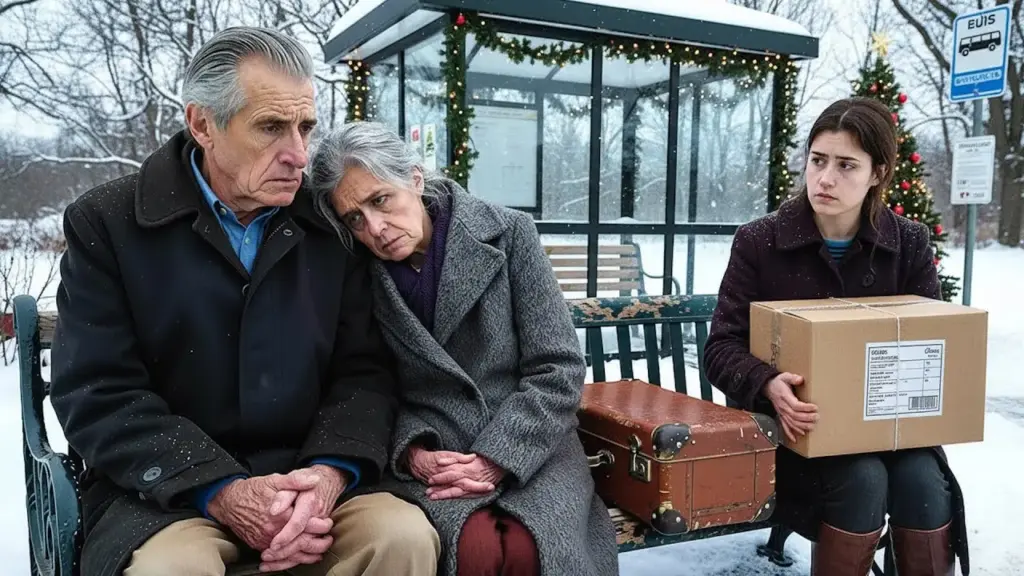
Nineteen degrees. It was Christmas Eve, and the temperature had dropped to a biting nineteen degrees. A widowed mother named Sarah stepped out of the warmth of the post office and into the biting chill, but she didn’t make it to her car. Her attention was arrested by a sight on a metal bench nearby: an elderly couple huddled together against the gray world. Frozen tears sat like jagged crystals on the woman’s cheeks, while the man beside her sat in just his flannel shirt, coatless and shivering, having draped his own jacket over his wife’s shoulders in a desperate attempt to keep her alive. They had been waiting there since 5:30 in the morning for their son.
He never came. Sarah could have done what everyone else in that busy parking lot was doing. She could have looked away, hurried toward the warmth of her vehicle, and told herself that this wasn’t her problem. But she didn’t. She couldn’t. Because the moment the woman—Dorothy—reached out with a shaking hand to grasp her husband Harold’s sleeve, Sarah saw something she couldn’t ignore. She saw two people still trying to protect each other, even after their own family had decided they were disposable.
Christmas Eve fell on a Tuesday that year. Sarah had worked the grueling weekend shift at the hospital, and she finally had Tuesday through Thursday off, her first real break in three weeks. She had spent the entire morning wrapping presents she had bought during her lunch breaks, hiding them in the closet where her late husband, Marcus, used to keep his fishing gear. Her children were currently at her sister Linda’s house, helping to bake cookies, which gave Sarah a few precious hours to finish her Santa preparations.
She was almost done when the realization hit her: she had forgotten to mail the package. Marcus’s mother, Ruth, lived in Arizona. She was eighty-three, living in an assisted living facility, and her mind was starting to fade. But she still remembered Marcus. She still asked about him every time Sarah called, forgetting each time that he was gone, forcing Sarah to tell her again and again that her son had died. It was emotional torture, but Sarah couldn’t stop calling.
Ruth was the last piece of Marcus she had left outside of her own children. Sarah had put together a thoughtful care package for her: framed photos of the kids, a soft blanket that Emma, her seven-year-old daughter, had picked out, and a bundle of Marcus’s old letters she had found in a shoebox in the garage. They were letters he had written to his mother when he was in college, long before Sarah even knew him. She thought Ruth would want them. She thought maybe they would help her remember Marcus the way he was before the sickness took everything. The package had been sitting on the kitchen counter, and the post office closed at noon on Christmas Eve.
It was 11:15. Sarah grabbed her coat, her keys, and the box, and she drove. The post office shared a cracked asphalt parking lot with the Greyhound bus station. It was one of those cramped small-town arrangements where everything was squeezed together: the post office, the bus depot, a little diner called Rosie’s that served the best pie in three counties, and a laundromat that had been «closing soon» for about fifteen years. Sarah had driven past that bus station a thousand times. But that day, something made her look.
She had just come out of the post office. The package was on its way to Ruth. Her mind was a hundred miles away, running through a mental checklist of what she still needed to do: pick up the kids, finish glazing the ham, and try to get through the evening without crying in front of Emma when she asked if Daddy was watching from heaven. And then she saw them.
An elderly couple, sitting on the metal bench outside the bus station—the kind of bench explicitly designed to be uncomfortable so homeless people wouldn’t sleep on it. They were huddled together, and even from thirty feet away, Sarah could see the woman was shivering violently. The temperature that day was nineteen degrees. Nineteen. And these two people, who had to be in their eighties, were sitting outside in it.
The man had taken off his coat—a thin, worn garment—and he had draped it over the woman’s shoulders, layering it over the coat she already wore. He was sitting there in just a flannel shirt, his arms wrapped tightly around himself, his breath coming out in visible white puffs. Sarah stopped walking. Something about the way they were sitting, the way he was trying to protect her, the way she was leaning into him like he was the only warm thing left in the world, hit her right in the chest.
That was how Marcus used to hold her. That was how he sat with her in the hospital waiting room when they got the diagnosis. Like he could shield her from the news just by putting his body between her and the world. She should have gotten in her car. She should have driven home. She had a hundred things to do, and two kids waiting for her. But her feet carried her toward that bench instead.
As she got closer, she could see more details. The woman’s coat was decent but old. Her white hair was pinned back neatly, but strands had come loose and were blowing in the biting wind. She was small, maybe five foot two, and she looked fragile in a way that made Sarah’s nurse instincts kick in immediately. Her lips had a bluish tint, one of the early signs of hypothermia. The man was tall, even sitting down, with broad shoulders that had probably been powerful once but had shrunk with age. His face was weathered, deeply lined, his hands were large, and his eyes… when he looked up at Sarah approaching, his eyes were the saddest she had ever seen.
«Excuse me,» Sarah said, her voice sounding loud in the cold air. «Are you folks okay?»
The woman looked up at her, and Sarah saw tears frozen on her cheeks. Actual frozen tears. That was how long she had been crying in the cold.
«We’re fine,» the man said. His voice was gruff, defensive. It was the voice of someone who had spent his whole life handling his own problems and didn’t know how to ask for help. «Just waiting for our ride.»
«How long have you been waiting?» Sarah asked.
He didn’t answer. But the woman did. «Since this morning,» she said. Her voice was thin, wavering like a reed in the wind. «Kevin was supposed to come. He said he’d be here by ten.»
Sarah looked at her phone. It was 11:45. They were almost two hours late if the woman was telling the truth. But something in Sarah’s gut said it was longer than that.
«What time did the bus get in?» she asked.
The man’s jaw tightened. «Five-thirty.»
Five-thirty in the morning. They had been sitting on this bench for over six hours, in nineteen-degree weather, on Christmas Eve. Let that sink in for a moment. Six hours. An elderly couple. Freezing temperatures. And their son, the person who was supposed to pick them up, was nowhere to be found.
«Sir,» Sarah said, crouching down so she was at eye level with them. «You need to come inside somewhere. There’s a diner right there. Let me buy you some coffee, get you warmed up, and we can figure out what’s going on with your ride.»
«We can’t leave,» the woman said, and her voice cracked with panic. «What if Kevin comes and we’re not here? He won’t know where to find us.»
«Dorothy.» The man’s voice was gentle now, the gruffness gone. He put his hand over hers. «Dorothy, honey, Kevin isn’t coming.»
The woman, Dorothy, looked at him, and in that look, Sarah saw everything. The confusion. The denial. The slow, horrible realization. «He said he would,» Dorothy whispered. «He promised. Harold. He promised he’d take care of us.»
«I know,» Harold’s voice broke on those two words. «I know he did.»
Sarah felt like she was intruding on something private. Something painful. But she couldn’t walk away. Not now. Not when every instinct in her body was screaming that something was terribly wrong. «What happened?» she asked quietly.
Harold looked at her for a long moment, sizing her up, deciding whether to trust this stranger who had stopped when everyone else had walked by. «Our son,» he said finally. «Kevin. He sold our house three months ago. The house Dorothy and I lived in for fifty-two years. Raised him in that house. I built half of it with my own hands.» He paused, swallowing hard against the lump in his throat. «He said he was moving us in with him, and his wife. Said it was time. With Dorothy’s… with her memory issues. Said he’d take care of everything.»
«Harold,» Dorothy said softly. «Don’t.»
But Harold kept going. Like once he started, he couldn’t stop. Like he needed someone, anyone, to hear what had been done to them. «He put us on a bus yesterday. Said he’d pick us up here. Drive us to his place in time for Christmas. We were excited.» Harold laughed, but there was no humor in it. «First Christmas with the grandkids in four years. Dorothy bought presents. Little things. A doll for Lily. A book for Michael. She wrapped them herself, even with her hands shaking.»