


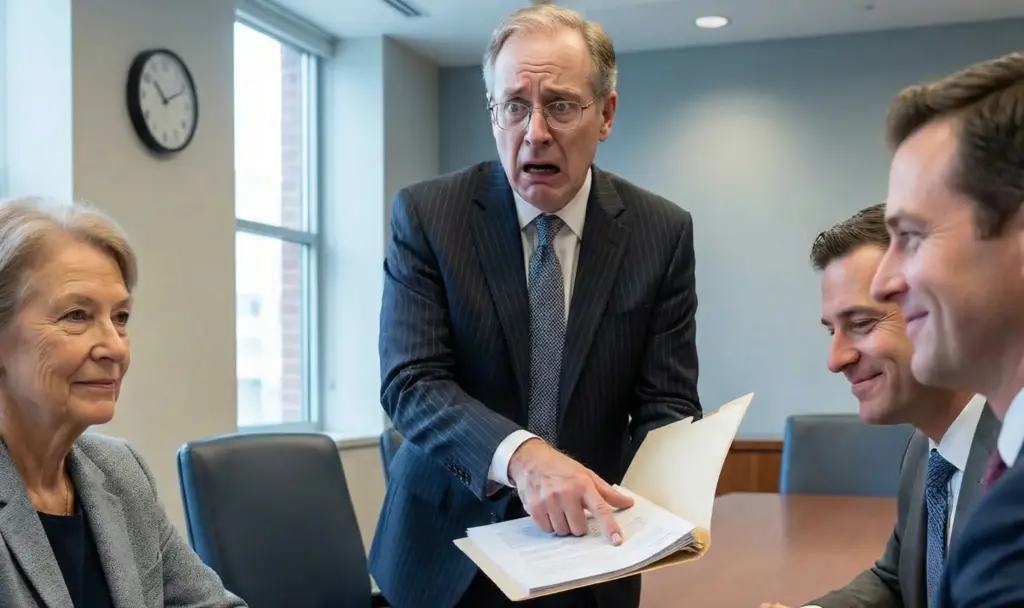
After my husband died, his kids said, «We want the estate, the business, everything.»
My lawyer begged me to fight. I said, «Give it all to them.»
Everyone thought I’d lost my mind. At the final hearing, I signed the papers. The kids smiled, until their lawyer turned pale when he read, «I’m glad to have you here.»
The funeral flowers were still fresh when they decided to destroy me. I sat in Floyd’s leather chair in his home office, the same chair where he’d spent countless evenings reviewing business documents and planning our future together.
22 years of marriage, and now I was supposed to pretend that the two men standing before me had any right to decide my fate. Sidney, Floyd’s eldest son, wore his father’s death like an expensive suit, perfectly tailored to his advantage. At 45, he possessed the same commanding presence Floyd once had, but none of the warmth.
His steel-gray eyes swept over me with the cold calculation of a businessman evaluating a bad investment.
«Colleen,» he said, his voice carrying that patronizing tone I’d grown to hate over the years. «We need to discuss some practical matters.»
Edwin, three years younger, but somehow looking older with his prematurely thinning hair and soft jaw, stood beside his brother like a loyal lieutenant. Where Sidney was sharp edges and calculated moves, Edwin was passive aggression wrapped in false concern.
«We know this is difficult,» Edwin added, his voice dripping with synthetic sympathy. «Losing Dad so suddenly… it’s been hard on all of us.»
Hard on all of us. As if they’d been the ones holding Floyd’s hand during those long nights in the hospital. As if they’d been the ones making impossible decisions about treatments and pain management.
They’d shown up for the funeral, of course. Sidney flying in from his law practice in San Francisco, Edwin driving up from Los Angeles where he ran some vague consulting business. But during the three months of Floyd’s illness, when it really mattered, I’d been alone.
«What kind of practical matters?» I asked, though something cold was already settling in my stomach.
Sidney exchanged a look with Edwin, a silent communication perfected over decades of shared secrets and mutual understanding. It was the kind of look that excluded everyone else in the room. Everyone like me.
«The estate,» Sidney said simply. «Dad’s assets, the properties, the business interests. We need to sort out how everything will be distributed.»
I felt my fingers tighten around the arms of Floyd’s chair. The leather was worn smooth from years of his hands in the same position, and I found comfort in that familiar texture.
«Floyd and I discussed this extensively,» I said. «He assured me that everything was taken care of.»
«Well, yes,» Edwin said, his tone suggesting that I was missing something obvious. «Dad did make provisions, but perhaps he didn’t explain the full complexity of the situation.»
Sidney pulled out a manila folder from his briefcase and set it on Floyd’s desk, the same desk where Floyd had kissed me goodbye every morning for 22 years. The folder was thick, official-looking, intimidating in the way that legal documents always were.
«The will is quite clear,» Sidney continued, opening the folder with theatrical precision. «The house here in Sacramento, valued at approximately $850,000, goes to Edwin and myself jointly. The villa at Lake Tahoe, $750,000, also goes to us. The business assets, roughly $400,000, will be distributed between us as well.»
Each number hit me like a physical blow. Our home, the place where Floyd and I had built our life together, where we’d hosted Christmas dinners and anniversary parties, where we’d talked about growing old together—gone. The villa where we’d spent our honeymoon, where we’d celebrated our 10th anniversary, where Floyd had told me he loved me for the first time—gone.
«And what about me?» I asked quietly.
Edwin shifted uncomfortably, but Sidney’s expression remained unchanged.
«Well, naturally, there’s the life insurance policy. $200,000. That should be more than sufficient for your needs going forward.»
$200,000 for a 63-year-old woman who’d given up her career to support her husband’s family. For someone who’d spent the last two decades managing Floyd’s household, entertaining his business associates, caring for him through his illness. $200,000 to start over.
«I see,» I said, though I didn’t see at all.
This couldn’t be right. Floyd had promised me that I’d be taken care of, that I’d never have to worry about security or stability.
«It’s not personal, Colleen,» Edwin said, and the false gentleness in his voice made my skin crawl. «It’s just that Dad always intended for the family assets to stay within the bloodline, you understand.»
Bloodline. As if the 22 years I’d spent as Floyd’s wife, as Sidney and Edwin’s stepmother, meant nothing. As if love and commitment were somehow less valid than genetics.
«Of course,» Sidney added, «we’re not heartless. You can stay in the house for 30 days while you make arrangements. We think that’s more than fair.»
Fair. They thought 30 days to uproot a life was fair.
I looked around the office, taking in the familiar details that would soon belong to someone else. The bookshelf where Floyd kept his first edition novels, the window that looked out onto the garden we’d planned together. The small photograph on his desk, not of Sidney or Edwin, but of Floyd and me on our wedding day, both of us laughing at something I could no longer remember.
«There is one more thing,» Sidney said, and something in his tone made me look up sharply.
He pulled another document from the folder, this one smaller but somehow more ominous.
«Dad accumulated some significant medical bills during his final illness. The insurance covered most of it, but there’s still about $180,000 outstanding. Since you were his wife and presumably made medical decisions jointly, the hospital and doctors are looking to you for payment.»
The room seemed to spin slightly. $180,000 in debt, with only $200,000 from the life insurance to cover it. That would leave me with $20,000 to rebuild my entire life.
«But surely the estate…» I began.
«The estate assets are tied up in probate,» Edwin interrupted smoothly. «And given the specific terms of the will, those debts are considered separate from the inherited properties. It’s unfortunate, but that’s how these things work legally.»
I stared at them both, these two men who’d called me «Mom» at their father’s funeral just three days ago. Sidney with his perfectly pressed suit and cold eyes. Edwin with his soft features and voice that suggested concern while delivering cruelty.
«I need some time to process this,» I said finally.
«Of course,» Sidney said, standing and buttoning his jacket. «Take all the time you need. But remember, the 30-day clock starts tomorrow. And those medical bills… well, the longer they sit, the more complicated things become.»
They left me alone in Floyd’s office, surrounded by the ghosts of our life together, and the crushing weight of my new reality. The silence was deafening. No comfort, no reassurance, no suggestion that perhaps we could work together to find a solution that honored both Floyd’s wishes and my basic human need for security.
I sat there as the afternoon light shifted across the room, creating shadows that seemed to mock the brightness Floyd and I had once shared here. My hands found the small drawer in Floyd’s desk where he’d always kept his personal items. Inside, beneath old receipts and business cards, my fingers touched something unexpected.
A small key I’d never seen before.
The key was old brass, worn smooth with handling. It didn’t fit any lock I could think of in the house, but Floyd had kept it in his most private space. Why?
As I held the key up to the light, I noticed Edwin’s car was still in the driveway. Through the window, I could see him and Sidney standing beside it, their heads close together in animated conversation. They were celebrating, I realized. Dividing up their inheritance, planning what they’d do with their newfound wealth.
Neither of them looked back at the house where their stepmother, their father’s wife, sat alone with the ruins of her life spread out before her. But as I watched them drive away, something strange happened. Instead of the despair I expected to feel, a different emotion began to take root.
It started small, just a whisper in the back of my mind, but it grew stronger with each passing moment.
They thought they’d won. They thought they’d successfully erased me from Floyd’s legacy, reduced me to nothing more than an inconvenience to be managed with the minimum legal requirements.
What they didn’t know, what they couldn’t possibly know, was that Floyd had always been more cunning than either of his sons realized. And after 22 years of marriage, some of that cunning had rubbed off on me. The key in my hand seemed to grow warmer as I held it, as if it were trying to tell me something.
Tomorrow I would find out what lock it opened. Tonight, I would let Sidney and Edwin enjoy their victory.
Martin Morrison had been Floyd’s attorney for 15 years, and in all that time, I’d never seen him look as uncomfortable as he did sitting across from me in his downtown office. His usually perfect composure was cracked, revealing the concerned man beneath the professional facade.
«Colleen,» he said, removing his glasses and cleaning them for the third time in 10 minutes. «I have to advise you in the strongest possible terms: this is not the right decision.»
The morning sun streamed through the floor-to-ceiling windows of his 15th-floor office, casting everything in sharp relief. The Sacramento River glittered below us, and somewhere in those gleaming office buildings across the water, people were making rational decisions about their lives. I envied them.
«I understand your concerns, Martin,» I said, my voice steadier than I felt. «But my mind is made up.»
He set his glasses down and leaned forward, his expression earnest. «You could fight this. The will… there are irregularities, questions about Floyd’s mental state during the final revision. We could contest it, delay probate, force Sidney and Edwin to negotiate.»
I’d spent the sleepless night reading and rereading the documents Sidney had left with me, trying to understand how Floyd, my Floyd, could have written me out of our shared life so completely. The language was cold, clinical, reducing 22 years of marriage to a few paragraphs about «adequate provision» and «appropriate arrangements.»
«How long would a contest take?» I asked.
«Months, possibly years. But Colleen, you’d have a real chance. I know Floyd, and this will… it doesn’t match the man I knew. The man who spoke about you with such love and respect.»
Love and respect. Had I imagined all those conversations where Floyd assured me I’d be taken care of? Had I misunderstood his promises that I’d never have to worry about my future?
«And during those months or years, what would I live on? Sidney made it clear that the medical debts are my responsibility. One hundred and eighty thousand dollars, Martin. Even if I won a contest eventually, I’d be bankrupt long before then.»
Martin’s jaw tightened. «Sidney and Edwin are playing hardball, but that’s exactly why you shouldn’t give them what they want. They’re counting on you being too intimidated or too exhausted to fight.»
He was right, of course. Every instinct I had screamed that this was wrong, that Floyd had not intended to leave me with almost nothing while his sons inherited millions. But instincts didn’t pay medical bills or put a roof over my head.
«What if I just gave them everything they want?» I asked quietly.
Martin blinked. «I’m sorry?»
«What if I signed whatever papers they need, transferred all claims to the properties, walked away cleanly? How quickly could that be done?»
«Colleen, you can’t be serious. You’d be giving up your legal rights to challenge.»
«How quickly, Martin?»
He stared at me for a long moment, his professional mask slipping to reveal genuine concern. «If you waived all claims and signed the proper releases… a week, maybe two. But why would you even consider that?»
I looked out at the river again, watching a small boat navigate the current. The boat’s captain seemed to know exactly where he was going, following some invisible map that guided him safely to his destination.
«Because fighting would destroy me,» I said finally. «Even if I won, I’d be a different person by the end of it. Bitter, exhausted, broke. Maybe it’s better to accept what’s offered and build something new.»
Martin leaned back in his chair, studying me with the intense focus that had made him one of Sacramento’s most successful attorneys. «Colleen, in 30 years of practice, I’ve never had a client voluntarily walk away from a seven-figure inheritance. There has to be something I’m missing here.»
There was something he was missing, but I couldn’t explain it to him. I couldn’t explain the certainty that had grown in me since finding Floyd’s mysterious key.
All night, I’d searched the house for what it might unlock, checking every drawer, every cabinet, every storage space I could think of. Nothing. But the key felt important, felt like Floyd trying to communicate something from beyond the grave.
«Maybe I’m just tired,» I said. «Tired of fighting? Tired of being seen as the greedy stepmother who wants to steal the son’s inheritance? Maybe it’s easier to let them have what they think they deserve.»
«What they think they deserve?» Martin’s voice sharpened. «Colleen, this isn’t about what they deserve. This is about what Floyd intended, and I’m telling you as his attorney and friend, this will doesn’t reflect his true wishes.»