


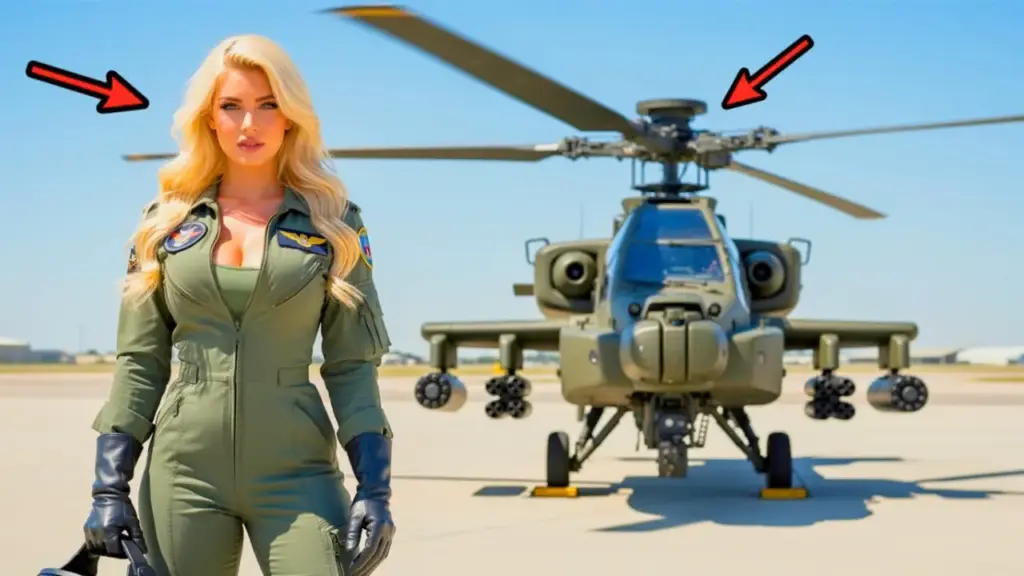
She stood on the tarmac, watching someone else climb into her cockpit. Seven months of training. Hundreds of hours in that Apache.
And then, minutes before the most important flight of her career, they pulled her. No explanation. No appeal.
Just a quiet order in front of 40 pilots and a room full of visiting brass. The whispers started immediately. Psych Eval. Insubordination. Command doesn’t trust her.
But when a four-star admiral arrived unannounced and asked one simple question, everything they thought they knew was about to shatter. What happened next would expose a truth no one was prepared to hear.
The desert sun had barely cleared the horizon when Captain Lyric Castellane pushed through the double doors of the pre-flight briefing room at Falcon Ridge Air Station. The air inside was thick with tension and the smell of burnt coffee.
Pilots stood in clusters around the flight roster board, checking assignments for Exercise Sentinel Forge. This was the kind of event that could define a career. NATO observers. Pentagon brass. Live fire demonstrations broadcast to Allied command centers across three continents.
Everyone knew what was at stake. Lyric moved through the room with the kind of economy that came from years of discipline. She was 31, lean and compact, with dark eyes that seemed to take in everything without lingering on anything.
The other pilots noticed her but didn’t engage. A few nodded. Most looked away. There was a distance around her that wasn’t quite hostility, but wasn’t warmth either. It was the kind of space people left around someone they weren’t sure how to read.
She stopped at the roster board and scanned the names. Apache 6-1, lead gunship for the close air support demonstration. Her name was printed next to it in crisp black letters.
Seven months of preparation had led to this moment. Seven months of simulator runs, live fire drills, coordination briefings with ground controllers, and endless equipment checks.
She had flown that bird more than anyone else on the base. She knew its quirks, its strengths, the way it pulled slightly left during hard banks. It was hers in every way that mattered except on paper.
She turned to head toward the equipment lockers when a voice cut through the low murmur of conversation.
“Castellane.”
Major Bridger Tallmadge stood in the doorway to the operations office. He was a broad-shouldered man in his late 40s, with a face that looked like it had been carved out of stone and left in the sun too long. He didn’t meet her eyes.
Lyric stopped. “Sir?”
“Need a word. Outside.”
The room didn’t go silent, but the quality of the noise changed. Conversations continued, but everyone was listening now. Lyric could feel it. She followed Tallmadge into the hallway.
He walked a few paces away from the door, then stopped and crossed his arms. Still, he wouldn’t look at her.
“You’re scratched,” he said.
Lyric stared at him. “What?”
“Not cleared for flight, effective immediately.”
“On whose authority?”
“Command decision.” His jaw was tight. “Don’t push it.”
“Major, I’ve been prepping for this sortie for seven months. My pre-flight checks are done. The bird is ready. I’m ready.”
“Not my call, Castellane.”
“Then whose call is it?”
Tallmadge finally looked at her. There was something in his expression that might have been sympathy, but it was buried under layers of rigid professionalism.
“Colonel Kellerman. And before you ask, no, I don’t know why. Orders came down an hour ago. You’re off the roster.”
Lyric felt something cold settle in her chest. “Who’s taking my slot?”
“Lieutenant Oaks.”
Sable Oaks. A decent pilot. Competent. But she had less than half of Lyric’s flight hours and had never flown a live fire demonstration of this scale.
Lyric didn’t say any of that. She just nodded once, slowly.
“Understood, sir.”
Tallmadge looked like he wanted to say something else. Instead, he turned and walked back into the briefing room. Lyric stood alone in the hallway for a moment, staring at the scuffed linoleum floor. Then she followed him back inside.
The briefing started five minutes later. Colonel Rhett Kellerman stood at the front of the room, a wiry man with silver hair and a voice like gravel. He went through the mission parameters with mechanical precision: weather conditions, flight paths, target zones, rules of engagement.
When he got to the aircraft assignments, he paused.
“Change to the roster,” he said. “Apache 6-1 will be flown by Lieutenant Oaks. Captain Castellane is reassigned to ground observation.”
Forty pairs of eyes turned toward Lyric. She sat in the third row, back straight, face expressionless. Ground observation. It was the kind of assignment you gave to students or pilots under disciplinary review.
It meant standing in the tower with binoculars while everyone else did the actual work. Kellerman didn’t offer an explanation. He just moved on to the next item on the agenda.
But the room had changed. Whispers started, low and insistent. Lyric could feel them like static electricity on her skin. When the briefing ended, she stood and walked out without looking at anyone.
She didn’t rush, didn’t hesitate, just moved through the room like water finding the path of least resistance. Behind her, the whispers grew louder.
In the hallway, two junior pilots stood near the water fountain. Lieutenant Gareth, a tall kid from Montana with a sunburned neck, and Lieutenant Inez, a sharp-eyed woman from New Jersey who flew transport choppers. They didn’t notice Lyric approaching until she was almost past them.
“Heard she got flagged during Psych Eval,” Gareth said.
“I heard she refused a direct order in Qatar,” Inez replied. “Whatever it was, command doesn’t trust her.”
Lyric kept walking. Her jaw tightened, but she didn’t break stride, didn’t turn around, just kept moving until she reached the old exit and stepped out into the brutal desert heat.
The tarmac shimmered under the morning sun. Rows of Apache helicopters sat in perfect formation, their rotors casting long shadows across the concrete. Ground crews moved between them, running final checks, loading ordnance, verifying systems.
In the distance, the VIP area was being set up. Chairs and awnings for the NATO observers and Pentagon officials who would be watching the demonstration. Cameras were being positioned, sound equipment tested. This wasn’t just a training exercise; it was a performance.
Lyric made her way to the command tower, a squat concrete structure with a 360-degree view of the airfield. Inside, the observation deck was crowded with officers and technicians. She found a spot near the windows, away from the main clusters of personnel.
Someone handed her a pair of binoculars. She took them without comment. Below, on the tarmac, Sable Oaks was doing her pre-flight walkaround on Apache 6-1.
Lyric watched through the binoculars. Sable was thorough, she’d give her that. She checked the rotor blades, inspected the landing gear, examined the weapons pylons. But there was a hesitation in her movements, a lack of fluidity.
She had to refer to her checklist three times for things Lyric could do from memory.
The crew chief, a grizzled Warrant Officer named Decker, stood nearby with his arms crossed. Lyric had worked with Decker for two years. He was old-school air cavalry, a Vietnam-era mechanic who’d seen more combat from the ground than most pilots saw from the air.
He didn’t suffer incompetence, and he didn’t hide his opinions. Right now, he looked profoundly unhappy. Sable climbed into the cockpit and started running through the systems checks.
Lyric lowered the binoculars and looked away. She didn’t need to watch this. On the far side of the observation deck, two senior officers stood near the radio console.
Lieutenant Colonel Wren Ferris, a slim woman with steel-gray hair and a reputation for ruthless efficiency, and Major Quinn DeSoto, a former Apache pilot who’d moved into command roles after a crash left him with a permanent limp. They were speaking in low voices, but the observation deck wasn’t large. Sound carried.
“This is a mistake,” DeSoto said.
“It’s done,” Ferris replied. “We can’t second-guess it now.”
“Oaks isn’t ready for this. You know that. I know that. Kellerman knows that.”
“It doesn’t matter.”
“It matters to the mission.”
Ferris turned to look at him. “The mission will proceed as planned. Oaks is capable. She’ll be fine.”
“And if she’s not?”
Ferris didn’t answer. She just looked out at the tarmac, her expression unreadable. Lyric stood near the window, staring at nothing. She could feel eyes on her. People were watching, wondering, judging.
She’d been through this before. The scrutiny. The doubt. The quiet assumption that if someone in command didn’t trust her, there must be a reason. It didn’t matter that no one would say what that reason was. The absence of an explanation was its own kind of evidence.
She thought about the last seven months. The hours in the simulator, the coordination drills, the briefings where she’d walked the entire squadron through the mission profile, step by step, until everyone knew their role by heart. She’d done everything right. She’d been perfect.
And it hadn’t mattered.
The radio crackled to life. “Tower, this is Apache 6-1, pre-flight complete, requesting clearance for engine start.”
The tower controller glanced at the mission clock. “6-1, you’re cleared. Standby for coordination check.”
Lyric watched through the window as the Apache’s rotors began to turn, slowly at first, then faster, until they were a blur against the pale sky. The sound was a low thrum that vibrated through the observation deck’s reinforced glass.
Then, the radio crackled again. Sable’s voice, tighter this time.
“Tower, 6-1, I’m showing a hydraulic pressure anomaly on the primary system. Need guidance.”
The observation deck went still. Every head turned toward the windows. On the tarmac, Decker was already moving toward the Apache, a diagnostics tablet in his hand.
Ferris stepped up to the radio console. “6-1, describe the anomaly.”
“Pressure reading is fluctuating. It’s within tolerance, but it’s not stable.”
DeSoto swore under his breath. Ferris shot him a look.
“6-1, standby, do not proceed with engine run-up. Ground crew is en route.”
Lyric raised the binoculars again. She could see Decker climbing up to the cockpit, leaning in to talk to Sable. He was pointing at something on the instrument panel. Sable was shaking her head.
Decker pointed again, more emphatically this time. The mission clock showed 18 minutes until scheduled takeoff. In the VIP area, NATO observers were starting to arrive.
Pentagon officials in dress uniforms, foreign military attachés, people who’d flown halfway around the world to watch this demonstration. Lyric scanned the hydraulic system through the binoculars. She could see the reservoir access panel from here.
The angle was wrong, but she knew that bird. She’d spent 200 hours in that cockpit. She could picture the system layout in her mind, and she could see what the problem was.
The hydraulic reservoir hadn’t been fully pressurized during ground prep. It wasn’t a mechanical fault. It was human error, a simple mistake that a rookie crew chief might make.
Except Decker wasn’t a rookie, which meant someone else had touched that system after his final checks, or the pressurization had been deliberately skipped. Lyric lowered the binoculars. Her hand moved toward the radio console, then stopped.
If she called this in, if she corrected the problem from here, it would look like interference. Like she was trying to sabotage Oaks. Like she was proving everything the whispers said about her—that she was unstable, unreliable, a liability.
She set the binoculars down on the console and stepped back. On the tarmac, Decker was still arguing with Sable. The mission clock ticked down. 17 minutes.
Ferris keyed the radio. “6-1, status update.”
“Still diagnosing, ma’am. Crew chief is running a full systems check.”
“How long?”
“Unknown at this time.”
Ferris turned to DeSoto. “Get me Kellerman, now.”
DeSoto pulled out his phone and walked toward the far corner of the observation deck. Lyric watched him go. Then she looked back out at the tarmac.
That’s when she saw it. A black Suburban rolling through the main gate. No escort, no advance notice.
It moved across the airfield with the kind of authority that didn’t need permission. The base security didn’t even slow it down. They just waved it through. Lyric felt something shift in her chest. She knew that vehicle, or rather, she knew what it meant.
The Suburban stopped near the command tower. The rear door opened and a man stepped out into the harsh sunlight. He was tall, probably in his early 60s, with silver hair and a chest full of ribbons that caught the light like a constellation.