


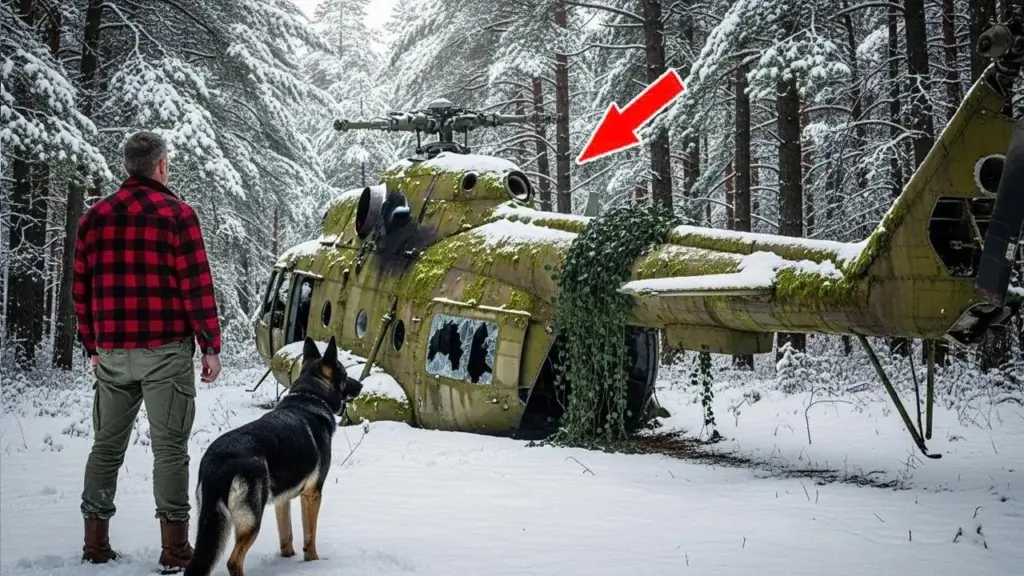
Have you ever seen a man stare into the woods like they might stare back? A frost-covered cabin, a steaming mug left untouched, and a German shepherd with eyes fixed not on the sunrise, but on something deeper, something coming. This is the story of a soldier who thought he’d left war behind, until his dog led him to a buried machine and a secret that would burn the forest down around them.
The first frost of October had laid its thin white veil across the mountain valley, shimmering faintly in the fragile dawn. Montana’s Bitterroot Range stretched endlessly, its ridgelines dark and sharp against a paling sky, as if carved by a patient hand centuries ago. Cold air drifted from the peaks, sliding down into the hollows like liquid glass, carrying with it the smell of pine, damp stone, and distant snow.
In that lonely vastness stood a solitary log cabin, its chimney coughing pale smoke into the waking sky. To anyone passing on the old timber road, the place might have seemed idyllic, a retreat carved out of wilderness. But to Gabriel Harlow, the man who lived there, it was less a sanctuary and more a fortress of silence, built plank by plank to keep the world away.
Gabriel was forty-two, though life had carved him older. His frame was lean but tough, muscle-bound tight from years of service and months of chopping wood, hauling water, and walking miles of unforgiving terrain. His face bore the look of a soldier who had seen too much and spoken too little.
A square jaw dusted with rough stubble, crow’s feet at the edges of storm-gray eyes that once scanned deserts for ambushes, and now scanned tree lines for deer. Short brown hair, already touched with silver, clung close to his scalp, as though even his hair understood discipline. He wore a plaid flannel shirt, softened by time, denim jeans faded from years of wear, and boots scarred by both sand and snow.
A man of habit, a man of ghosts. On the porch, Gabriel lifted a chipped enamel mug of coffee, its steam curling into the chill morning. He stared at the tree line, not really seeing it. In his mind’s eye, the horizon was always two places at once: the pine ridges of Montana and the arid ridges of Afghanistan.
Memories intruded without mercy. The crack of distant gunfire hidden in the snap of burning logs, the tremor of helicopter blades echoing in the gust of mountain wind. He clenched his jaw, tightened his grip on the mug, and exhaled slowly.
At his feet lay Rook. The German shepherd was four years old, coat black and silver like smoke and steel, eyes a molten amber that reflected not only the forest but the inner turmoil of the man above him. Muscular yet lithe, Rook carried himself with the precision of a trained guardian, though no drill sergeant had ever commanded him.
The dog had been plucked from a local shelter years ago, a gangly pup who had grown into a creature of quiet strength. Now, he thumped his tail softly against the wooden planks, sensing the weight in Gabriel’s silence, offering presence rather than intrusion.
«You feel it too, don’t you?» Gabriel murmured.
His voice was low, a gravelly timbre, as though each word had been dragged through sand before being spoken. Rook tilted his head, ears twitching. Gabriel reached down, pressing his calloused hand into the dog’s thick ruff.
The warmth of living fur steadied him, as it always did. For all his self-imposed exile, Gabriel was not immune to the pull of routine. Each week he and Rook vanished into the forest for hunting trips that served less for meat and more for therapy.
Out there, Gabriel could lose himself in the purity of survival, tracking signs, reading wind, testing instincts. Out there, the ghosts sometimes grew quieter. That morning, as the sun spilled orange across the peaks, Gabriel set down his mug and stretched, joints cracking in protest.
«Come on, boy,» he said. «Time to see what the woods have for us.»
Rook leapt to his feet, tail wagging with anticipation. Inside, the cabin was modest, one room dominated by a stone hearth, shelves of neatly stacked provisions, and a bedroll that never looked slept in, only endured. Gabriel moved with soldierly precision, checking his bolt-action rifle with the reverence of a man for whom a weapon was both lifeline and burden.
He packed rations, a compass, a water filter, and an old topographic map creased at the edges. Rook watched every move, occasionally nudging Gabriel’s hand, as if urging him to hurry. By mid-morning, they left the clearing, stepping into a cathedral of trees.
The forest swallowed them quickly, towering pines rising like pillars, maples bleeding gold and crimson across the canopy. The air grew cool and damp, muffling the world into stillness. Their footsteps crunched on the litter of old leaves, mingled with the distant cry of a raven.
To Gabriel, it was music. To Rook, it was territory. They moved for hours, weaving through gullies and ridges, Gabriel reading deer tracks and soft earth, while Rook’s nose quivered at scents far older than men.
The rhythm settled them both. When the sun angled low, casting long shadows like prison bars across the forest floor, Gabriel spotted fresh hoofprints. He knelt, brushing the soil.
«Big one,» he whispered. «We’ll track him slow.»
But Rook was not listening. His ears pricked forward, his body stiffened, and a low growl rumbled from deep in his chest. Gabriel froze, scanning for bear or wolf.
The trail led straight ahead, but Rook turned sharply, nose locked toward a darker tangle of brush where vines and thorns grew thick. Then, breaking discipline, Rook barked—sharp, insistent, unlike the restrained silence of a hunt. He pulled against an invisible leash, urging Gabriel off the deer trail.
Gabriel’s instincts told him to resist. Years of discipline had trained him to follow the known sign, not wander into shadows. Yet trust in Rook was deeper than instinct. It was survival.
He rose, slung the rifle across his back, and whispered, «All right, show me.»
The descent into the ravine was steep. Moss was slick beneath his boots, branches clawed at his flannel, and thorns scratched his forearms. But Rook moved with sure-footed urgency, pausing only to glance back and confirm his master followed.
The air grew heavier, tinged with the smell of damp iron. Then, Gabriel saw it: a break in the vegetation, a long, unnatural scar where trees had once snapped like matchsticks. At the bottom, hidden beneath curtains of vine and ivy, loomed a hulking shape.
Gabriel stopped, breath catching. What at first seemed stone revealed itself as metal—dark, rusted, bent into grotesque angles. His pulse quickened.
He stepped forward, pulling away vines until the truth was undeniable. A rotor hub jutted like a broken crown. The long tail boom lay twisted, half-buried in soil. Shattered glass glinted faintly where the cockpit lay, crushed against the earth.
A Black Hawk helicopter.
Time seemed to collapse. Gabriel’s mind reeled with memories of whirring blades, of dust storms and desert fire. He swallowed hard, fighting the old panic. Beside him, Rook went silent, ears lowered, eyes locked on the relic of war as though he too understood its weight.
Gabriel exhaled, his voice rough. «What in God’s name are you doing here?»
He stepped closer, hand brushing against cold steel. It was the ghost of a machine that once carried men like him across hostile skies. Now it lay entombed, swallowed by forest, forgotten by history. And in that moment, Gabriel knew the solitude he had built was about to shatter.
The light within the ravine was a strange kind of twilight, as though the forest canopy above refused to surrender more than fragments of daylight. The air was colder here, damp and heavy, carrying the odor of rust and moss mixed with something fainter, older. The unmistakable tang of oil, long dried and forgotten.
Gabriel Harlow stood motionless for several heartbeats, his breath slow but uneven, watching the tangled wreck before him. Rook shifted restlessly at his side, the dog’s hackles still raised, his body poised not in fear but in alert recognition. He knew the metal carcass was no mere relic.
Gabriel forced himself to move closer. He pushed aside the veils of ivy that had crept greedily across the machine, revealing more of its broken shape. The fuselage was canted at a brutal angle, the tail boom twisted upward like a grotesque finger pointing to the heavens.
The cockpit lay partly embedded in the earth, its windows shattered into a mosaic of jagged shards. Though muted by years of decay, the shape was unmistakable to a Marine who had seen such silhouettes slicing the skies in war zones. Black Hawk. A bird of war, now a ghost sleeping in the soil of Montana.
He swallowed against the sudden rush of memory: dust storms in Helmand province, the rotor wash stinging his eyes, comrades shouting over the thundering blades. But this was not Afghanistan. This was his forest, his refuge. And yet, war had found him here all the same.
Rook whined, drawing Gabriel’s gaze downward. The German shepherd was circling the nose of the wreck, nose pressed to the earth, sniffing with frantic concentration. His body trembled with urgency, ears twitching as though hearing something that lived only in memory.
Gabriel crouched beside him, laying a steadying hand on his flank. «Easy boy, we’ll see what’s here.»
He rose and approached the cockpit. Through the broken glass, dim light revealed the contours within. A tangle of twisted controls, seats torn and blackened, vines curling through like green veins, reclaiming the skeleton of a beast.
Then, his stomach clenched. There, slumped against the pilot’s harness, was a shape no foliage could disguise. Bone. A skull tilted forward, the jaw frozen in silent surrender.
The tattered remnants of a flight suit clung to the skeletal frame, its insignia bleached beyond recognition. Gabriel removed his cap and lowered his head. Even after years of death on battlefields, the sight of a fellow soldier abandoned in silence struck him harder than any ambush.
He whispered under his breath, a prayer unpolished but sincere. «Rest easy, brother. You deserved better.»
Rook pressed closer to the cockpit, pawing at the metal floor just beneath the pedals. His claws scraped against something hollow, producing a faint metallic echo. Gabriel frowned.
«What is it, boy?»
The dog’s growl deepened, not in aggression but insistence. He scratched harder, sending flakes of rust tumbling into the shadows. Gabriel slung his rifle across his back and climbed carefully into the cockpit.
The metal groaned under his weight, but years of weather had fused wreck to earth. It held firm. He knelt beside the dog’s chosen spot and rapped his knuckles against the floor.
A dull reverberation answered—hollow. He drew his hunting knife, wedging its tip into the seam Rook had exposed. With a sharp twist, the panel popped loose.
Dust billowed, and within the cavity lay something wrapped in waterproof plastic. His hands closed around it and pulled free a rectangular object, heavier than expected. Stripping away the covering, he revealed a ruggedized military hard drive, its casing olive drab, scratched but intact.
A surge of adrenaline coursed through him. This was no part of standard equipment. Someone had hidden it deliberately, ensuring it remained long after the pilot’s death.
«Good work, Rook,» Gabriel murmured.
The shepherd thumped his tail once against the metal, amber eyes locked on his master with a kind of triumph. Beside the hidden drive lay another object, wedged tightly under the seat frame. Gabriel tugged until it came loose.
A black gear case, standard issue but locked with a heavy combination clasp. Its surface was dented, edges scorched, yet it bore the unmistakable aura of secrecy. He placed it gently on the moss outside the wreck, studying both finds with a soldier’s suspicion.
The drive pulsed with the weight of information. The case hummed with questions. He looked back at the skeletal remains, guilt pressing in. Whoever this pilot had been, he had guarded these things with his final breath.
Gabriel touched the brittle fabric of the man’s sleeve, promising silently that the sacrifice would not rot here unseen. For several minutes, Gabriel lingered in the cockpit, scanning the twisted instruments, searching for any hint of identity.