


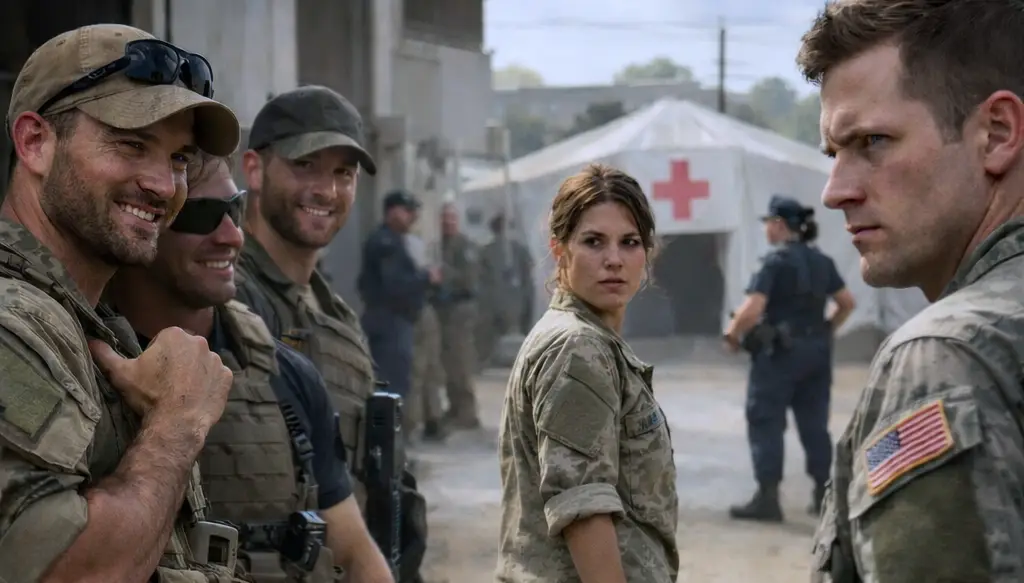
The sun hit the courtyard like a hammer. Dust hung in the air, turning every breath into grit. Generators throbbed in the background, a low, relentless heartbeat beneath the clatter of tools and distant rotors.
People moved fast on this base, carrying crates, checking manifests, and swapping out radios, because speed meant survival. She moved differently. Sergeant Emily Carter limped through the heat with a bandage seeping through her left trouser leg.
Three days earlier, an IED had blown an armored truck onto its side and tried to take her with it. It failed. She pulled two soldiers out of a burning vehicle and stayed until the ammo started to cook off.
She hadn’t slept right since.
A knot of new Navy SEALs leaned in the shade near the comms building. Boots crossed, arms folded, possessing that easy elite confidence. One watched her pass and let a smirk crawl across his face.
«Look at that,» he said. «Can’t even walk straight. Guess she’s done playing soldier.»
Someone laughed, too loud, then another. A third voice tossed in a rumor: maybe she’d been running the wrong way when it blew. Heads turned, and a few snickered.
Emily didn’t. She kept her eyes forward, pace steady, jaw set. She didn’t owe them a story, but others heard.
Corporal Ryan Brooks, a comms tech with calm eyes, stopped dead with a coil of cable in hand. Sergeant Dana Reeves of the Military Police watched from patrol. Both knew what those bandages meant.
Both had seen her crawl into fire. The SEALs didn’t know it yet, but this courtyard remembered things.
Emily Carter was not the kind of soldier who announced herself. Eight years in uniform had filed the edges off her voice and left behind something quieter, steadier. She learned early that there’s a difference between loud courage and lasting courage.
The first burns fast; the second holds the line when it’s three in the morning and the world is dirt and fear. She was a medic who refused to let the word «just» precede her title. «Just a medic» doesn’t drag a man with shattered femurs through diesel smoke.
«Just a medic» doesn’t find a pulse with fingers shaking from shock and continue anyway. She had two Bronze Stars, a Purple Heart, and a habit of slipping out of ceremonies early because applause made her uncomfortable. People noticed the scar that sliced from the bridge of her nose to her cheekbone, thin as a paper cut.
They didn’t always ask. She didn’t always answer. Ryan knew the story.
He’d been a private when she talked him through his first firefight on a radio channel that crackled like rain. «Breathe once. Now talk.» That’s what she’d said.
He obeyed, and a platoon lived because the coordinates he read out were right the first time. Sergeant Dana Reeves knew a different story: Emily stepping between a raging Staff Sergeant and a junior Specialist who’d messed up a motor pool form.
She diverted a storm with two words—»Walk away»—and then stayed late to help the kid refile the paperwork correctly. Respect isn’t loud. It accumulates.
When people got quiet around Emily, it wasn’t fear. It was gravity.
Three days before the courtyard insult, the convoy hit loose sand with the kind of bad luck you only understand if you’ve driven there. One moment, the road was a ribbon. The next, it wasn’t.
The MRAP’s front tire found the pressure plate like a magnet finds steel. The blast lifted the world. She remembered the air after, sharp with cordite and burning rubber.
She remembered legs refusing to obey. She remembered hands moving anyway. Seat belt release, door latch, a jam that would not unjam until a pry bar solved it.
Then there were fingers on a vest-drag handle and the stub of her left boot scraping asphalt. She didn’t remember falling. She only remembered hearing someone scream and realizing it was her own voice telling a half-conscious driver to keep breathing.
They credited the crew’s survival to armored design and fast response. Ryan credited it to something else: Emily’s refusal to leave until the driver blinked twice and squeezed her wrist. That squeeze is why he still sees daylight.
So when laughter floated across the courtyard like flies, something inside Ryan went cold. He looked at the SEALs new to the base, reputations trailing behind them like banners. Their leader, Petty Officer Mark Davies, wore his swagger like kit—fitted, balanced, checked.
His guys adored him. They had reason. Their AARs were clean, their missions classified.
He couldn’t square the man who led successful raids with the man who’d chosen to sneer at a soldier walking alone. Maybe it wasn’t cruelty, Ryan told himself. Maybe it was boredom, the kind that gnaws on discipline when there’s nothing immediate to do.
But the words had been knives, and they had found flesh.
Dana’s patrol path changed by a yard, close enough to catch the faces, the shoulder patches, and the time of day. Her hand drifted toward the bodycam toggle and then stayed there. She wasn’t hunting anyone.
She was collecting the truth.
Emily reached the medical tent and sat without speaking as the PA peeled back gauze and frowned. «You walk too far,» the PA said.
«She had to,» Emily replied, a trace of humor in it. «The tent was this far away.»
«You’re not funny.»
«Only on days when I’m vertical.»
The PA muttered something about stubbornness and heroism existing in the same skull without killing each other. Emily watched the flap sway as the heat reached in and touched everything. She didn’t tell anyone what she’d heard outside.
She didn’t need pity and didn’t have time for rage. There were wounds to irrigate and forms to sign and an ache in her bones that sang a low note through every hour.
On bases like this one, information doesn’t travel; it arrives already assembled. The insult passed from mouth to mouth, losing none of its edge. Someone swore they saw a phone angled just right in a reflection.
Someone else repeated the words exactly. A mechanic with grease on his knuckles said he’d marked the time down because he was halfway through changing a filter. By evening, the Deputy Base Commander had a folder she hadn’t asked for and couldn’t ignore.
Lieutenant Colonel Janet Morales had a voice like a blade—sharp only when it needed to be. She was five-foot-six, felt taller, and carried a long memory for kindness and disrespect alike. Before she read the first line of the report, she remembered an email: SFC Carter Commendation Recommendation pending. Exhibited extraordinary courage under fire.
Morales had approved it. Now she held a different narrative. Audio. Eyewitness accounts.
A still photo with faces ringed in red, because sometimes you need the obvious made obvious. Regulations aren’t suggestions here. Culture isn’t a suggestion either.
She glanced at the clock, weighed her options, and stood. «Get me Commander Porter,» she told her aide, «and MP Sergeant Reeves.»
Outside, the temperature fell a few degrees, but the courtyard stayed hot. They didn’t start with the hammer. They started with the facts.
Dana Reeves gathered statements like a medic gathers supplies: methodically, with an eye for order under pressure. «Tell me exactly what you saw and when.» She separated opinion from observation.
She did not prompt. She did not push. The story came anyway, threaded and tight, as if the courtyard itself wanted to speak.
Ryan Brooks submitted his own account last because he needed an hour to cool the kind of anger that shortens careers. He kept it simple.
«I heard: ‘Look at that, can’t even walk straight. Guess she’s done playing soldier.’ Another voice suggested she was running away from the fight when she got injured. Those are the exact words.»
He included coordinates he’d logged habitually, a timestamp, and the angle of the sun because he paid attention like that. The photo wasn’t perfect—faces grainy, one SEAL half-turned—but Dana had captured enough.
The body language told the rest: crossed arms, tilted chins, the slight forward lean that separates a joke from a jab.
Commander James Porter arrived with his jaw set. SEAL commanders carry the paradox like a birthright: willingness to do violence for the nation and refusal to tolerate violence against its people. He’d led men through blacked-out houses where every shadow could argue with your heartbeat.