


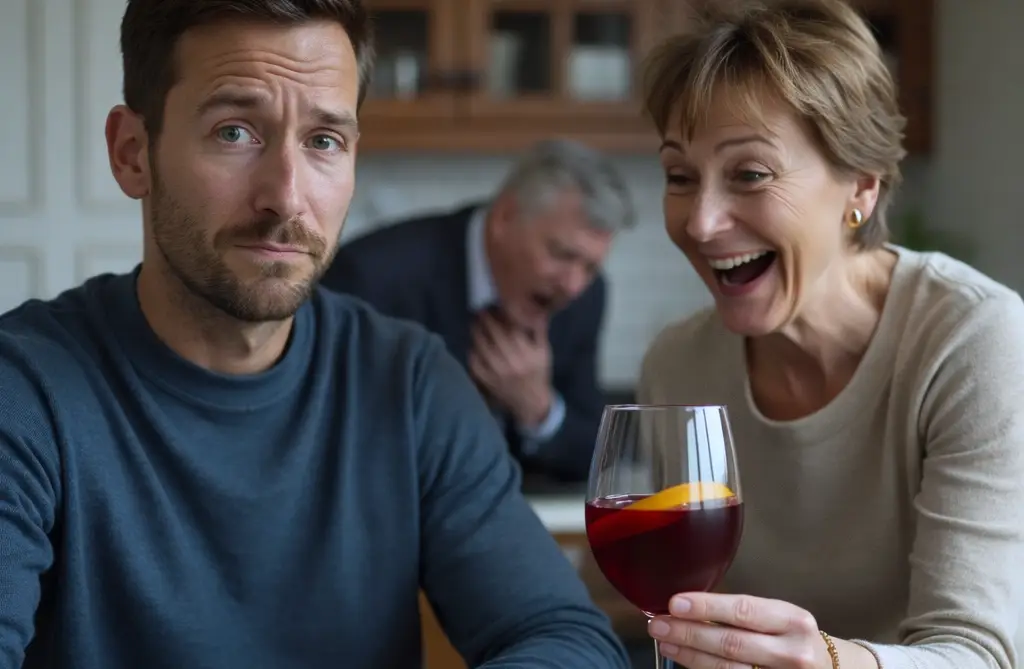
My mother-in-law poured something strange into my drink when she thought I wasn’t looking. «Special cocktail for my favorite son-in-law,» she said, offering me a smile that didn’t quite reach her cold, calculating eyes. I thanked her, keeping my expression neutral, and waited for the split second she turned to wipe the counter. With a sleight of hand born of desperation, I discreetly switched glasses with her husband—the man who had spent the last six years belittling my existence. Forty-five minutes later, the unbelievable happened.
My name is Julian Mercer. I am thirty-two years old, an independent photographer based in the rolling mountains of Asheville, North Carolina. I have built my business from absolutely nothing, starting with a second-hand camera and a lot of ambition. Today, I shoot high-end weddings, wildlife documentaries, and glossy magazine spreads. It is the kind of work that pays the bills comfortably—and then some—if you have the eye for it.
And I do have the eye. But to my in-laws, specifically Diane and Gerald, what I do has never been enough to warrant respect. «How’s the little photography hobby going?» Gerald would ask at family dinners, swirling his expensive red wine and not even attempting to mask his disdain.
Gerald was an investment banker, a man who measured a person’s worth strictly in square footage, stock options, and yield percentages. Every Sunday dinner at their sprawling estate followed the same suffocating script. Diane would fuss over her daughter’s appearance, picking at invisible lint, while Gerald would interrogate me about my finances as if he were conducting a hostile audit rather than a family conversation.
My wife, Haley, would squeeze my hand under the table—a silent, desperate apology for her parents’ behavior. I had been shooting a wildlife assignment in Montana all that week, trudging through knee-deep snow and biting winds to photograph bison for a National Geographic submission. I was absolutely exhausted, bone-tired in a way that sleep couldn’t immediately fix, but Haley had insisted we couldn’t miss her mother’s birthday dinner.
«Just a couple of hours, please,» she had promised, her eyes pleading. I should have listened to the tight knot forming in my stomach when Diane cornered me in the kitchen that evening. I should have paid attention to the way her eyes darted around the room, checking the exits before she handed me that drink. I should have noticed the slight, nervous tremor in her manicured fingers as she said, «I made it special, just for you.» Something wasn’t right. The air felt too heavy, the silence too loud.
I just didn’t know how wrong it was about to get. Haley and I met six years ago at an art exhibition where my work was being featured. She was finishing her master’s in environmental science, and I was just starting to make a real name for myself in the industry.
We connected instantly. She understood my intrinsic need to capture the world through a lens, to freeze moments in time, and I admired her fierce passion for protecting the natural world. Her parents, however, were an entirely different story.
From our very first meeting, Gerald made it abundantly clear he had expected someone different for his daughter. He wanted someone with a corner office, a robust retirement plan, a company car, and a predictable schedule—someone exactly like him. Diane was subtler in her disapproval, cloaking her insults in sweetness. She would praise my photos with one breath while asking when I planned to «settle into something stable» with the next.
She would invite me to family functions, then introduce me to their wealthy friends as «the photographer» rather than her son-in-law, as if I were the hired help. For years, I tried to win them over. I would bring expensive bottles of vintage wine to dinner, show them my published work in major periodicals, and casually mention the high-profile clients I was working with.
Nothing changed their perception that I was just a transient phase in their daughter’s life. A bohemian mistake she would eventually outgrow. Last Christmas, I overheard Diane speaking on the phone in the hallway, unaware I was nearby.
«Haley could have married Thomas, you know,» she was saying, her voice dripping with regret. «Orthopedic surgeon, family money. But she chose the creative one.» The way she paused before the word «creative» made it sound like a terminal disease.
Gerald was more direct. When Haley and I announced we were trying for a baby, he pulled me aside on the patio, the smoke from his cigar drifting between us. «Children are expensive, son,» he said, looking out over his manicured lawn.
«Maybe think about real employment before bringing one into the world.» I never told Haley these things. She loved her parents despite their obvious flaws, and I didn’t want to force her into the painful position of choosing sides.
So I smiled, shook Gerald’s hand firmly at every visit, complimented Diane’s cooking, and kept my thoughts strictly to myself. But looking back, there were signs I should have taken more seriously. The way Diane would ask Haley to help in the kitchen whenever I started talking about a successful project, effectively cutting me off.
I recalled how she would «accidentally» exclude me from family photos, framing the shot so I was cropped out of the memories. Or the time Gerald suggested therapy for Haley’s «impulsive decisions» while looking directly at me across the roast beef. I ignored it all, thinking time would eventually bring acceptance.
I was wrong. The Friday of Diane’s birthday dinner, I returned from Montana with raw, wind-burned cheeks and a memory card full of images that would pay our mortgage for three months. I was exhausted, but I showered, put on a crisp button-down shirt, and drove us to her parents’ colonial-style home in the expensive part of town.
Dinner started normally enough. Gerald bragged about a recent merger deal he had closed, citing figures meant to impress. Diane fussed over the table settings, ensuring every silver fork was perfectly aligned.
Haley’s brother, Owen, and his wife, Vanessa, made polite conversation about the weather and local politics. I nursed a beer and silently counted the minutes until we could politely leave. After the main course, Diane announced she had made her famous sangria for dessert.
She disappeared into the kitchen, and I offered to help carry the glasses out, trying to be helpful. That was when I saw it. She had two glasses set separate from the others on the granite counter.
As I entered the kitchen, she quickly added something from a small vial into one of them. It wasn’t a garnish or a flavor enhancer. It was a clear liquid—colorless, odorless.
She tucked the vial away into her apron pocket the moment she heard my footsteps on the tile. «Oh, Julian! I’ve got this,» she said, her voice pitched too brightly, her smile too wide. «This one is for you.»
«Special recipe for my favorite son-in-law,» she added. My throat tightened. The glass she pointed to had a barely perceptible film floating on the surface, catching the overhead pendant light.
«Let me help you carry these,» I said, stepping forward and taking both glasses she had prepared before she could protest. I walked into the dining room where Gerald was checking his phone, barely looking up when I approached. «Sangria, sir.»
I placed the tampered glass directly in front of him instead of taking it myself. I watched him drink it, making a vague excuse about preferring water with my dessert. Forty-five minutes later, the reaction began. Gerald turned a shade of pale I had never seen before; beads of sweat formed on his forehead, and he suddenly rushed to the bathroom.
The violent sounds of his illness echoed through the quiet house. Diane’s face drained of all color when she realized what had happened. Her eyes met mine across the floral centerpiece, and in that moment, the air between us crackled with a silent acknowledgment.
My mother-in-law had tried to poison me, and she knew that I knew. I didn’t react, didn’t confront her. I just ate my chocolate cake calmly, savoring every bite, while Haley rushed to check on her father.
In the chaos that followed—Gerald insisting it must have been food poisoning, Diane stammering breathless excuses about bad shellfish—I quietly pocketed the untouched glass that had been meant for me. Something had shifted inside me.
The anger I felt wasn’t hot or explosive. It was cold, deliberate, and calculating. I wasn’t just going to let this go, but I wasn’t going to fight them their way, either.
I was going to make them face exactly who they were. The Monday after the dinner, I took the glass to Jason, a former client of mine who ran a private toxicology lab. «Personal or professional?» he asked when I explained I needed the contents analyzed immediately.
«Family matter,» I replied grimly. Three days later, he called me. «Julian, there were benzodiazepines in that drink.»
«Nothing lethal,» he continued, reviewing the data, «but enough to knock someone out for hours, maybe cause some temporary memory loss or confusion. Where did you get this?» I thanked him and asked for a full written report. I didn’t answer his question.
That night, I told Haley I wanted to skip Sunday dinner for a while, claiming I needed to focus on preparing for an upcoming gallery exhibition. She was disappointed, naturally, but she understood. I didn’t tell her about the test results.