


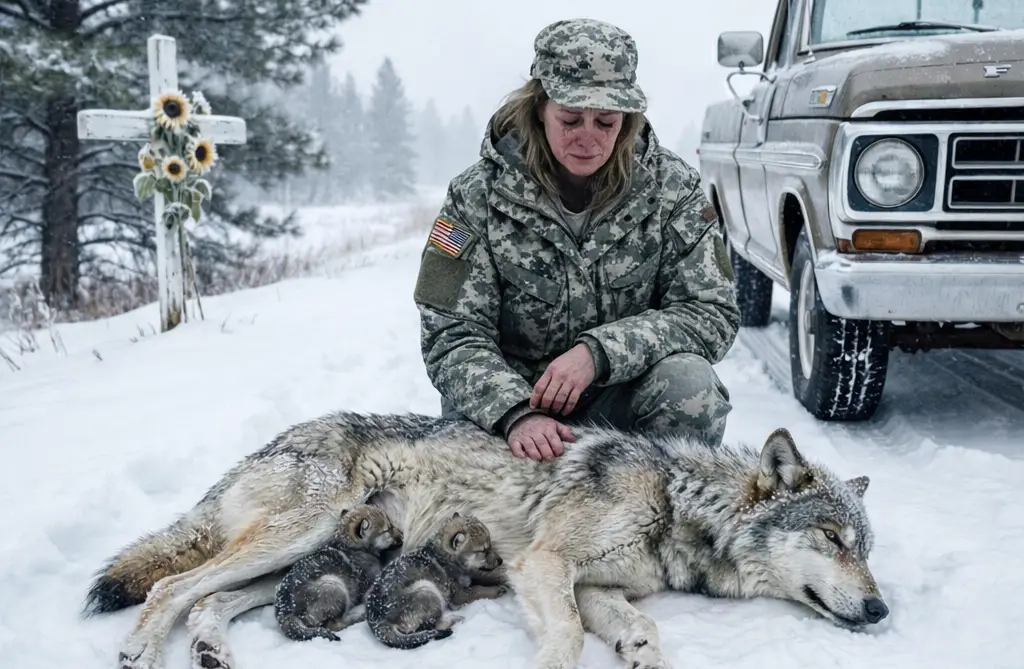
Sarah Mitchell’s knuckles were white against the cracked leather of the steering wheel as her Ford pickup sliced through the Montana blizzard. Highway 287 had ceased to be a road; it had been reduced to a claustrophobic tunnel of swirling white chaos, visibility dropping with every passing second. The world outside was nothing but wind and ice.
It was February 5th. Three years to the day.
As she neared Mile Marker 47, a familiar, sickening tremor took hold of her hands. Her heart began to hammer against her ribs—a physical reaction her body had memorized even when her mind tried to forget. This was the curve where the world had ended. This was the precise geographic coordinate where her seven-year-old son, Ethan, had drawn his final breath after black ice sent their vehicle spinning violently into a pine tree on the passenger side. His side. The side she had failed to shield.
Every year, Sarah undertook this grim pilgrimage, driving two hours from Helena to nail fresh sunflowers to the white cross she had erected on that accursed tree. The ritual was always the same: she would stand in the biting cold, the wind cutting through her layers, weeping for exactly twenty minutes. Then she would return to her empty house, loathing herself just a fraction more than she had the day before.
But this year, the script would be rewritten. This year, at the exact epicenter of her tragedy, Sarah would not just mourn a death; she would encounter a desperate fight for life. She would find another mother dying in the snow, another family shattered by that merciless curve, and she would be forced to make the most impossible choice of her existence.
Sarah had walked away from the crash three years ago with mere scratches—a physical survival that felt like a spiritual punishment. Ethan had died three hours later in the hospital, his small hand engulfed in hers while she begged a deaf universe for a trade, a rewind, anything to undo the reality crushing her chest. Three years of therapy had followed, sessions where Dr. Helen asked gentle, probing questions that Sarah could not bring herself to answer.
There had been three years of her ex-husband insisting it wasn’t her fault, right up until the day he packed his bags because he could no longer bear witness to her slow-motion self-destruction. And there had been three years of Sarah knowing, with the heavy certainty of a stone in her gut, that it was her fault. She had been the one driving. She was the one who hadn’t seen the ice.
The snow was falling with heavier intent, burying the windshield, as Sarah pulled onto the shoulder at 4:14 in the afternoon—the precise minute the accident had occurred. She reached for the sunflowers on the passenger seat. They were the same variety Ethan had adored. He used to pluck them from their garden, presenting them to her with a gap-toothed grin that made her heart detonate with a joy she was now convinced belonged to a dead past.
Stepping out of the truck, the cold hit her like a physical blow. Her boots crunched through the fresh powder, her breath pluming in the freezing air as she walked toward the white cross nailed to the pine. She stood there for a moment, letting the grief wash over her.
Then, through the veil of falling snow, she saw them.
Twenty meters from the cross, on the very shoulder where the ambulance had once idled while paramedics worked frantically on her dying child, something moved. It was a shape that didn’t belong.
It was a wolf.
She was massive, her fur a matted mix of grey and silver, lying on her side. Pressed desperately against her belly were two tiny cubs, trembling violently. The mother wolf’s flanks heaved in irregular, spasmodic rhythms. It was advanced hypothermia. Sarah froze, her mind suddenly cataloging the scene with the hyper-clarity that often accompanies shock.
Large paw prints—deep, heavy, and unmistakably masculine—led from the tree line to the highway, terminating abruptly at the asphalt. There were skid marks on the road, partially covered by new snow. Dark, crimson blood stained the pristine white in scattered, violent patches.
A drag trail led from the road back to the shoulder, accompanied by smaller, uneven prints that spoke of an immense struggle. Sarah understood the narrative written in the snow immediately. The male wolf had been struck right here, in this curve. He had been thrown eight meters, judging by the blood spatter. The female had dragged his body off the road, her instinct refusing to leave him exposed on the highway. But he was gone. And now she was here, at the exact location where Sarah had lost everything, using her fading warmth to keep her cubs alive.
The wolf’s body was failing, surrendering to the creeping cold that would claim them all within hours. One mother who had lost everything at Mile Marker 47 was bearing witness to another mother losing everything at Mile Marker 47, on the same date, February 5th.
Sarah dropped to her knees in the snow, the sunflowers slipping from her numb fingers. The cubs—twin males, perhaps eight weeks old—were attempting to nurse, but their mother had nothing left to give. They were so weak that their whimpers were swallowed by the howling wind.
With immense effort, the mother wolf lifted her head. Her yellow eyes locked onto Sarah’s. There was no predation in that gaze, no aggression, no territorial warning. There was something far more terrifying: resignation. Acceptance. She was dying, and she knew it.
But the cubs still had a chance. Sarah’s mind raced through the logistics. She could retreat to her truck and call Montana Fish, Wildlife and Parks. They would arrive in two, perhaps three hours given the severity of the storm. But in these temperatures, with hypothermia this advanced, the wolves would be corpses by then.
She could drive away. She could leave this tragedy behind just as she had tried to leave her own pain behind, pretending she had seen nothing. It wasn’t her problem; it wasn’t her responsibility. But then Sarah noticed a detail that shattered her resolve completely. The mother wolf hadn’t just been shielding the cubs from the wind.
The drag marks in the snow told a different story. She had used her last reserves of strength to pull them three meters closer to the road. Closer to the passing cars. Closer to humans. She was waiting for someone to stop. Just as Sarah had waited, praying for someone to save Ethan in the back of that ambulance.
Sarah acted without a second thought. She sprinted to the pickup, ignited the engine, and cranked the heater to its maximum setting. She snatched the emergency blankets from the cargo bed—items she had carried obsessively since the accident, always prepared, always too late.
As she approached the animals, the mother wolf did not growl. She didn’t flinch. She simply watched. When Sarah reached out and scooped up the first cub—frozen solid, lips tinged blue—the wolf closed her eyes, a gesture that screamed, Yes, please, take them.
Sarah wrapped both cubs in the thermal blankets and settled them in the back seat, sandwiched between portable heaters. Then she returned for the mother. The wolf weighed approximately a hundred pounds. Sarah weighed 137. She attempted to lift the animal and failed. The wolf let out a soft groan but offered no resistance.
Sarah realized the truth: the wolf wanted to be moved. She was soliciting help in the only language she had left. Sarah began to drag her, centimeter by agonizing centimeter. The wolf contributed weakly, pushing with her front paws whenever she could muster the strength.
It took fifteen grueling minutes. Sarah wept the entire time, sweat pouring down her back despite the freezing temperatures, screaming «Come on!» to herself, to the wolf, to God, to Ethan, and to the empty air. The physical exertion burned her muscles, but she refused to stop. When she finally maneuvered the wolf into the back seat beside the cubs, Sarah collapsed into the driver’s seat.
Her hands shook so violently she could barely turn the ignition key. She glanced in the rearview mirror. The wolf had managed to rotate her head toward the cubs. Her tongue, dry and weak, rasped gently over their fur. Her eyes drifted shut and snapped open, fighting a losing battle for consciousness.
Sarah slammed her foot on the accelerator. She didn’t head back toward Helena. She drove forward, toward Missoula. Toward the emergency veterinary clinic forty minutes away.
Through the blinding blizzard, she drove with tears streaming down her face, whispering a mantra into the dashboard: «Hold on, please hold on, do not leave them, do not leave.» She didn’t know if she was pleading with the wolf, with Ethan’s ghost, or with her own fractured soul. The windshield wipers waged a war against snow that fell as if the universe were trying to bury the entire world.
Sarah’s truck fishtailed twice on the black ice, but she kept the throttle down, one hand white-knuckling the wheel, her eyes darting to the mirror every ten seconds to verify the rise and fall of the wolf’s chest. The cubs had ceased shivering, which could mean they were warming up, or it could mean they were dying. Sarah pressed the gas pedal closer to the floor.
Her mind was assaulted by the memory of the moment Ethan died. She felt the phantom sensation of his small hand going limp in hers, heard the steady beep of the heart monitor stretching into that flat, endless tone. She remembered her husband standing in the corner of the hospital room, unable to look at her because looking at her meant confronting the unbearable truth.
Sarah had spent three years believing she did not deserve happiness. She believed she did not deserve peace or redemption. But somewhere in the last hour, dragging a dying predator through the snow at the site of her worst nightmare, something tectonic had shifted. She didn’t understand it yet, but she knew with absolute clarity that if these wolves died, the last flickering light inside her would go out with them.
Dr. James Reardon was in the process of closing the Missoula Emergency Veterinary Clinic when the screech of tires cut through the silence of the parking lot. It was 7:45 on a dead Tuesday evening. He watched as a woman leaped from a snow-covered pickup, screaming, «I need help now!»
When he yanked open the back door of her vehicle, he froze. A timber wolf and two cubs, all in the throes of severe hypothermia.
«You know I have to report this to Fish and Wildlife, right?» he said, even as he was already sprinting inside to grab a stretcher.
«I know!» Sarah screamed, helping him hoist the heavy animal. «But first you save them.»
For the next four hours, Dr. Reardon worked with the focus of a surgeon. The mother wolf’s core body temperature was 89.6 degrees Fahrenheit; it should have been 100.4. She was suffering from severe dehydration and acute malnutrition. She hadn’t eaten in days.
Every ounce of nutrition in her body had been cannibalized to produce milk for the cubs. Reardon initiated intravenous fluids, applied heated blankets, and hooked up cardiac monitors. The cubs registered at 91 degrees and were hypoglycemic. The smaller one, grey and delicate, was showing early signs of pneumonia.
Sarah refused to leave the room. She sat on the floor, her legs pulled to her chest, eyes glued to every rise and fall of their chests. When the mother wolf convulsed once—a violent spasm as her body fought the hypothermic shock—Sarah screamed and grabbed Dr. Reardon’s hand.
«Do something!»
«I am!» He was already administering a dextrose injection and ramping up the warming protocols. He had treated hundreds of animals in his fifteen-year career, but he had never witnessed a human fight this ferociously for wild animals she had found only an hour ago.
At 11:30 PM, the cardiac monitor on the mother wolf finally found a steady rhythm. At 12:15 AM, the cubs stopped shivering. At one in the morning, the wolf opened her eyes. She saw Sarah. She saw her cubs sleeping in a heated incubator beside her. She closed her eyes again, but this time, the tension was gone. It was sleep, not death.
Dr. Reardon slid down the wall to sit on the floor next to Sarah. Both were running on fumes, exhausted.
«Fish and Wildlife comes tomorrow morning,» he said softly. «They will take them to rehabilitation. You saved them, Sarah, but you know you cannot keep them, right?»
Sarah stared at the wolf’s sleeping form. «I just needed them to live.»
«Why did you do this?» Dr. Reardon asked gently. «Wolves on a highway shoulder… Most people would have just kept driving.»
Sarah didn’t answer for a long time. Then, without turning her gaze from the animals, she said, «My son died on that curve three years ago today. I was driving.»
Dr. Reardon said nothing. There were no words for that.
«I could not save him,» Sarah continued, her voice fracturing. «But these… these I could save.»
The next morning, February 6th, Rachel Torres from Montana Fish, Wildlife and Parks arrived at nine o’clock. She was professional, kind, and immovable.
«Mrs. Mitchell, protocol is clear. Rescued wild animals go to certified rehabilitation centers. The wolf and cubs will be transferred to the Northern Rockies Wildlife Sanctuary where they will receive proper care and eventual release back into their natural habitat.»
«No,» Sarah said.
Rachel blinked, taken aback. «Excuse me?»
«Not yet. The mother is weak. The smaller cub has pneumonia. Moving them now could kill them.»
Dr. Reardon stepped in. «She is right. Medically speaking, transport right now would be high risk. I recommend seventy-two hours of stabilization before any movement.»