


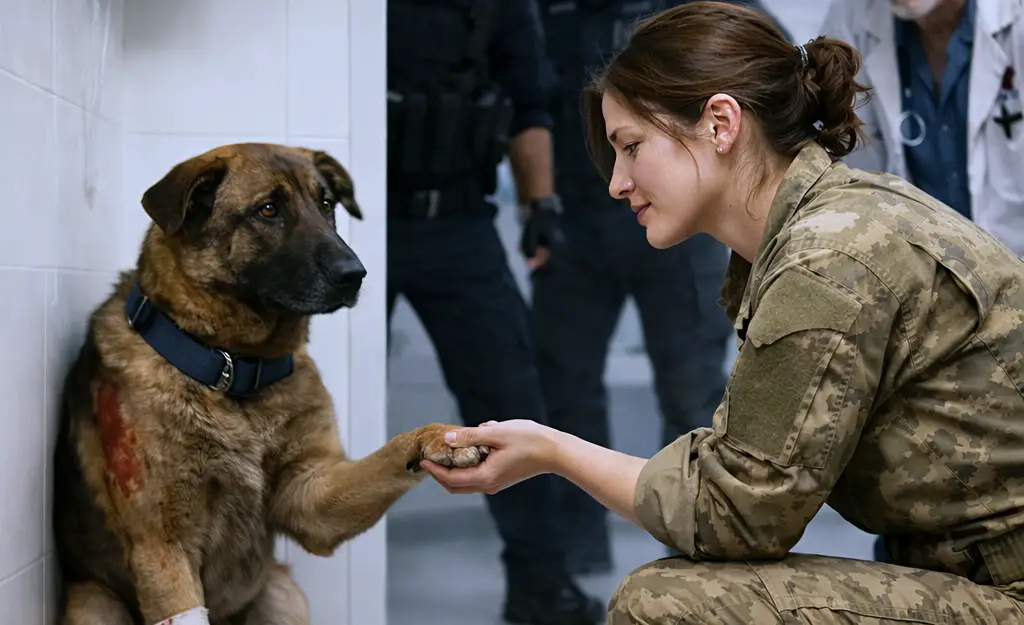
The animal had erected an invisible barrier around his broken body, a perimeter of teeth and rage that no one dared cross. He refused to let a single soul within striking distance. It didn’t matter if they were seasoned field medics carrying morphine, the base veterinarian with his soothing tones, or even the elite SEAL operators who had physically dragged him off the burning battlefield. The canine was battered, losing vital fluids rapidly, and every time a hand extended in his direction—no matter how kind the intent—he responded with a snap so violent it threatened to crush bone.
They labeled him a liability. The whispers in the corridor said he was too damaged to be salvaged, that the psychological break was permanent. They claimed he would never operate alongside a human handler again because the trust was shattered. That grim narrative held firm right up until a rookie SEAL stepped out of the shadows. She was young, lacking any impressive rank on her collar, and virtually invisible to the frantic room. She simply leaned in and whispered six specific words into the pandemonium. Six words that belonged to a lexicon used by only one unit on the face of the Earth.
The dog froze instantly, his wild eyes locking onto hers, and then, with heartbreaking deliberation, he placed his mangled leg into her open palms. What the rest of the room failed to understand was that she didn’t just see a wounded animal; she knew exactly who he was, and she understood exactly what had been taken from him. When a war dog turns his back on the world, believing he has been abandoned, sometimes the only thing that can bring him back from the edge is the right voice calling him home.
The clock on the sterile white wall clicked just past 2100 hours when the double doors to the Bayside Emergency Veterinary Clinic burst open, swinging violently on their hinges. Two Military Police officers backed in first, their boots screeching against the linoleum as they fought for traction. Their uniforms were marred by streaks of dry earth and dark, ominous stains that spoke of a rough extraction. Between them, strapped precariously to a sagging gurney, lay a wounded Belgian Malinois.
The animal was a terrifying sight. Every muscle in his body was coiled tight as a bowstring, trembling with adrenaline. His eyes were wide, frantic, and rolling, showing the whites in a way that signaled pure panic. He wasn’t barking, nor was he growling in the traditional sense. He was simply tracking every motion, watching every shifting shadow like an explosive device waiting for a clumsy technician to trip the wire.
— Call sign is Ghost, — one of the MPs gasped, struggling to catch his breath as they locked the gurney wheels. — He took shrapnel. He is refusing all approaches. We attempted field tourniquets, but he wouldn’t allow it. We could barely get him on the transport.
Ghost suddenly snarled, a visceral, wet sound that vibrated through the room, and jerked his head with enough force to snap the leather muzzle halfway off his snout. The heavy strap flailed uselessly. A nurse let out a startled yelp and stumbled backward, clutching her chest, her face draining of color.
— Good Lord, — muttered the attending veterinarian, hurriedly snapping on latex gloves while eyeing the beast warily. — What kind of animal is this? I have seen aggression, but this is different.
— A SEAL team asset, — the MP replied, his voice tight with lingering adrenaline. — Or he was. His handler is KIA. We found the dog dragging himself toward the extraction zone alone. He wouldn’t leave the body until we forced him.
A junior technician stepped forward cautiously, holding a harness sling, hoping to secure the animal. Ghost lunged—not with blind fury, and not without direction, but with a deliberate, calculated speed that was terrifying to witness. The harness clattered uselessly to the floor. One technician dived for cover behind the heavy X-ray machine, while another scrambled toward the cabinet housing the sedatives, hands shaking as he fumbled for the keys.
— He is going to lose that leg, — a lieutenant muttered from the safety of the doorway, shaking his head. — We cannot get anywhere near him. We can’t treat him. That is all muscle tissue hemorrhaging, and we are losing time.
The vet let out a sharp curse, wiping sweat from his brow.
— Prepare a full sedative load, three cc’s intramuscular. I am not getting bitten tonight, and I am not losing a patient because he is stubborn.
However, Ghost seemingly understood the word sedative, or perhaps he simply felt the shift in the room’s energy, the predatory intent of the hands reaching for him, and the arrogance of those who underestimated his intelligence. He let out a howl, a long, haunting sound that froze everyone in their tracks. It was the sound of mourning. Then he reared up, claws scrabbling on the metal, and tore through the remains of the muzzle completely, freeing his jaws.
Foam flecked his dark jowls, and crimson fluid dripped in slow, heavy lines from his rear flank, painting the gurney in alarming shades of red. Yet, strangely, he never attempted to flee. Instead, he backed himself into the corner of the table, tail tucked low, chest heaving, ears pinned flat against his skull. His eyes never broke contact with the circle of humans who were trying to fix him without ever asking permission to enter his space.
— He is unhandleable, — someone whispered, the fear palpable in the sterile air.
— He’s too far gone, — another voice added, lower, edged with hesitation. — It is like he isn’t just injured; he is terrified. He doesn’t know where he is.
No one moved to stop the veterinarian from prepping the heavy syringe. That was the precise moment a new silhouette filled the open doorway, blocking the harsh hallway light. Quiet, steady, arms folded across her chest. It was a woman dressed in dusty SEAL fatigues, her hair pulled back into a strict regulation bun, her boots scuffed gray from a recent operation. She held no clipboard, carried no rank on her tongue—she simply brought a profound stillness to the chaos.
At first, nobody noticed her, except for Ghost. His ears twitched just once, swiveling toward her, and then, for the first time in an hour, the low rumble in his throat ceased. She didn’t announce her presence, didn’t flash identification, and didn’t bark orders like the senior corpsman who was currently stomping through the clinic with too much volume and too little situational awareness.
Petty Officer Riley Hart simply stepped quietly across the threshold, her uniform wrinkled from field transport, sleeves rolled to the elbow revealing a smudge of dried earth still clinging to her wrist.
— Back out, Hart, — the senior corpsman snapped the second he spotted her in his periphery. — This isn’t a sandbox for trainees. We have a Code Red situation here.
She didn’t flinch. She didn’t argue. Her eyes were locked exclusively on Ghost. The Belgian Malinois hadn’t looked away from her since she entered the room. He was still panting, his flank pulsing with the rhythm of his frantic heartbeat, but his pupils had narrowed and focused. His body remained rigid, but less braced, as if he were trying to recall something buried deep beneath layers of instinct and trauma.
Riley took one measured pace forward, her boots silent on the tile.
— Did you not hear the direct order? — the corpsman growled, stepping toward her.
— I heard, — she said, her voice barely rising above the hum of the equipment, calm and detached.
But she kept her gaze fixed on Ghost. She watched the way his ears kept swiveling—not in a panic response, but in triangulation. She noticed the faint, almost imperceptible shift in his shoulders whenever someone walked behind him. She noted the fact that he hadn’t snapped at the MPs, only at the clinic staff who approached him incorrectly. She could almost hear the gears turning in his mind: not barking, not warning, but scanning, sorting, searching for a recognizable pattern.