


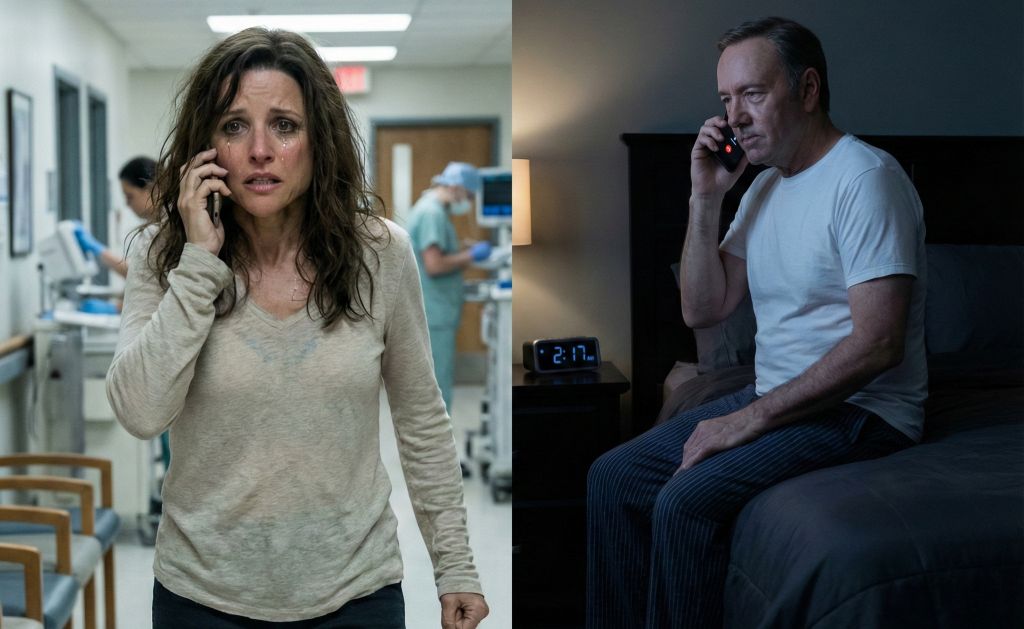
My wife shrieked at 2:00 a.m., demanding $22,000 for her son’s hospital bill. I told her to call his real father, hung up, and by sunrise, the police were reading my name off felony paperwork. That night started in my bed in Toledo, Ohio, with the furnace clicking like it couldn’t decide if it wanted to live.
February cold pressed against the windows and made the floorboards bite through your socks. The house was a plain little ranch on a quiet street near Alexis Road. It was paid off and modest, the kind of place old men brag about because it means nobody owns you but the county tax office.
Elaine wasn’t in bed again. She had fallen asleep on the couch she’d sat on after dinner, eyes glued to her phone. The other side of the mattress was empty and cool, and I told myself not to read into it. 17 years of marriage teaches you how to swallow questions.
My phone buzzed on the nightstand. Once, twice, then the screen lit up: Elaine. I checked the clock. 2:17 a.m.
I answered. «Frank?»
She hit me with panic. «Frank, oh my God, Kyle’s in the hospital. He’s hurt bad. They’re saying he might have to just suffer through the night if we don’t pay the deposit.»
In the background, I heard a fluorescent hum, a PA system, and a wheel squeaking on tile. They were hospital sounds, or at least sounds that wanted you to think «hospital.»
«Where are you?» I asked.
«I’m with him,» she said, her voice breathy and sharp at the same time. «They need cash. They need $22,000 right now.»
I sat up, the room smelling like old wood and the menthol rub I’d used on my shoulders. «$22,000?»
«Yes, they said if we can’t pay the deposit, they can’t give him the stronger pain meds. He’ll be stuck with the whole bill.»
Kyle Benson was 29, Elaine’s only child. When I met him, he was 12 and skinny as a fence post, all elbows and attitude. I taught him to throw a baseball in the backyard and later how to drive in the church parking lot after Sunday service.
I never adopted him. Elaine always said we’d do it later. Later never came, but the bills sure did. A dead battery at Meijer. A rent mix-up. A new job that needed tools.
Every time, Elaine would look at me with those watery eyes and say, «He’s trying, Frank,» like trying was the same thing as doing.
I swung my legs out of bed and stepped onto the cold floor. «What happened to him?»
«A fight,» she said quickly. «At a casino. He got jumped. He’s in agony.»
Casino. My stomach tightened. Kyle liked casinos the way some men like fishing; he said it was relaxing. He said he had a system. I’d heard that word before from guys at the plant who’d lost their whole checks by Wednesday.
«Which hospital?» I asked.
«Barton,» she said, then added too fast, «South Lake Tahoe.»
Tahoe. I stared at the dark window, the street light turning the snow piles gray. My pickup sat in the driveway, salt crusted along the wheel wells. Real life was here. This emergency was 800 miles away.
Elaine kept talking. «My Zelle limit is maxed. The cards are declining, Frank. It’s complicated. I need you to send it. Wire it, Venmo, anything. I’ll pay you back Monday. I swear.»
«Why can’t you pay?» I asked after a beat.
Then she went softer, the way she got when she wanted me to fold. «Because we’re tapped out, honey. And he’s crying. He’s asking for you.»
That old reflex flared: reach for your wallet. Fix it. Prove you’re a good man. I felt it in my hands like they were already opening the banking app.
Then another thought slid in behind it. Clear as ice. She kept saying my son. Not our son. My son.
I remembered the last emergency call at 3:05 a.m. two summers ago. Elaine swearing Kyle needed money for a medical deductible. I sent it. A week later, I saw a photo on Facebook: Kyle in a nightclub, a bottle in his hand. He was grinning like a kid who’d found a cheat code.
I’d confronted Elaine. She’d cried. I’d apologized for overreacting. That was the rhythm of our life: I paid, then I apologized.
I swallowed. «Elaine. Call his father.»
Silence. Then her voice turned flat. «Excuse me?»
«Call Kyle’s real father,» I said. My voice wasn’t loud. It was steady, like when you find a cracked part and you don’t argue with it. You replace it. «I’m not doing this anymore.»
«Frank, that man is not in our lives. And I am,» she snapped. «How can you say that when he’s in a hospital bed?»
«Because right now you’re talking to me like I’m a debit card. How can you demand $22,000 at two in the morning?» I said, refusing to explain anything besides the refusal.
«He needs help! You’re his family!» Her voice climbed into a scream. In the background, someone said, «Ma’am, please.»
Elaine plowed right over it. «If you don’t send it, he’ll suffer all night!»
My hand tightened around the phone. I pictured my pension file in the drawer. The paid-off house. The quiet life I’d earned one shift at a time. I pictured every time I’d said «yes» because guilt was easier than fighting.
I exhaled slow. «I’m going back to sleep, Frank. Call his real father,» I repeated. «Good night, Elaine.»
I ended the call. My heart was thumping, but underneath it was an empty space where guilt usually lived. I powered the phone off—black screen, no more buzzing—and lay back down.
The furnace clicked. The house settled. Outside, somewhere down the block, a plow scraped the street like sandpaper. And I slept. Like a man who finally put down a box he’d been carrying for years.
I woke up to sunlight slicing through the blinds and the smell of stale coffee from the timer I’d forgotten to reset. For about five seconds, my mind was empty. Then the memory of the call slid back in, cold and sharp.
I sat on the edge of the bed, feet on the same cold floor, and felt something unfamiliar: lightness. No buzzing phone. No knot in my chest. Just quiet.
I showered, shaved, and put on my work hoodie, even though it was my day off. Old habit. When you’ve worked a plant floor for 35 years, you dress like you might get called in.
I was pouring coffee when my phone lit up again. Unknown number. I let it ring. It stopped. Then rang again. Same number.
I answered. «Frank Whitmore.»
«Mr. Whitmore,» a man said, calm and practiced. «This is Officer Daniel Rizzo with the Dearborn Police Department in Michigan. Are you the stepfather of Kyle Benson?»
The mug paused halfway to my mouth. «I’m married to his mother,» I said. «Why is Dearborn calling me?»
There was a soft rustle of paper. «Your name came up during an incident report from last night. Mr. Benson was detained following an altercation at a casino parking structure. During booking, we discovered irregularities related to a line of credit opened using your identifying information.»