


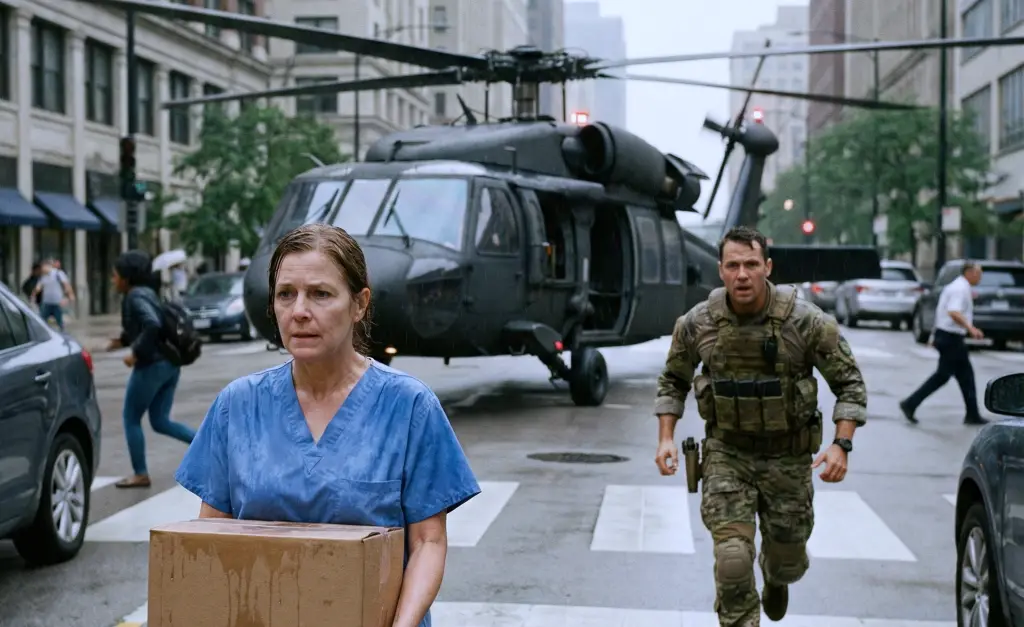
They took her badge, handed her a cardboard box, and told her she was finished. After twenty years of saving lives, Nurse Madeleine Jenkins was frustrated for doing the one thing a doctor refused to do: saving a dying child against protocol. Broken, humiliated, and walking home in the pouring rain, Madeleine thought her life was over.
She was wrong. Two military-grade Black Hawk helicopters weren’t just landing in the city centre. They were landing for her.
The wind from the rotors nearly knocked her down, but the words screamed by the special ops soldier changed everything: «We don’t want the doctor. We want the nurse.»
This is the story of how one woman went from unemployed to a national hero in less than an hour.
The fluorescent lights of the Human Resources Office at St. Jude’s Memorial Hospital in downtown Chicago hummed with a headache-inducing buzz that seemed specifically designed to break the human spirit. Madeleine Jenkins sat on the edge of a grey, fabric-covered chair that smelled faintly of stale coffee and fear.
She kept her hands folded in her lap to hide the fact that they were shaking. These were hands that could insert an IV into a collapsing vein in a moving ambulance. They were hands that had held the hearts of trauma victims and steadied nervous fathers in the delivery room. But right now, facing the smirking face of Dr. Marcus Sterling and the cold, bureaucratic stare of HR Director Linda Halloway, those hands felt useless.
«Insubordination,» Linda said, tapping a manicured fingernail on the manila folder in front of her. She didn’t look at Madeleine. She looked at the paper as if the paper were the person she was firing. «Gross misconduct. Violation of hospital hierarchy protocols. The list is extensive, Ms. Jenkins.»
Madeleine took a breath, the air tasting of recycled antiseptic. «I saved the patient, Linda. The boy, Leo… he’s alive.»
She continued, her voice trembling slightly. «If I hadn’t administered the epinephrine when I did, while Dr. Sterling was still debating the insurance authorization, that child would be in the morgue.»
Dr. Sterling shifted in his chair. He was a man who wore his stethoscope like a piece of jewelry rather than a tool. He was the chief of surgery, a man whose family name was plastered on the new oncology wing and whose ego took up more space in the room than the furniture.
«You undermined my authority in a critical trauma situation,» Sterling said, his voice smooth, practically oily. «You are a nurse, Madeleine. A highly paid, perhaps overqualified nurse, but a nurse nonetheless. You do not make decisions; you execute orders. When you pushed past me to access the crash cart, you created a hostile work environment.»
«I created a heartbeat!» Madeleine snapped, her composure cracking. «His throat was closing up. He was in anaphylaxis. You were on the phone with the legal department!»
«That is enough,» Linda cut in, finally looking up. Her eyes were devoid of empathy. «The decision has been made. Madeleine, Dr. Sterling has formally requested your termination, effective immediately. We are revoking your access to the EMR system as we speak. Security is waiting outside to escort you to your locker.»
The silence that followed was heavy and suffocating. Madeleine looked at Sterling. He offered a small, triumphant smile, the smile of a man who had never been told «no» in his life and wasn’t about to start tolerating it from a 45-year-old trauma nurse with a mortgage and a bad back.
«You’re making a mistake,» Madeleine whispered. It wasn’t a threat; it was a diagnosis.
«The only mistake,» Sterling said, standing up and buttoning his pristine white coat, «was thinking you were indispensable.»
The walk to her locker was a blur. It felt like a funeral procession for her own life. Twenty years. She had started at St. Jude’s when she was 25, fresh out of nursing school, full of idealism. She had survived the pandemic, the budget cuts, the strikes, and the endless nights of understaffing.
She knew the name of every janitor, every cafeteria worker, and the favorite color of the security guard, old Mr. Henderson. He was currently looking at her with sad, confused eyes as he waited to escort her out.
«I’m sorry, Madeleine,» Mr. Henderson mumbled as she dumped the contents of her locker into a small cardboard box.
A stethoscope, a framed photo of her late husband Mark, a half-empty bottle of ibuprofen, and a ceramic mug that said «Nurses Call The Shots.» It looked pathetic. Two decades of service reduced to a box that wouldn’t even fill the passenger seat of her car.
«It’s not your fault, Fast Eddie,» she said, using his nickname, trying to be brave. But her voice trembled.
As she walked through the trauma ward one last time, the silence was deafening. The other nurses—Jessica, Maria, David—wouldn’t meet her eyes. They knew what was happening. They knew that if they spoke up, if they defended her, Sterling would come for them next.
The hospital wasn’t a place of healing anymore. It was a kingdom, and the tyrant was on the throne.
She reached the automatic glass doors of the emergency department entrance. The blast of cold October air hit her face, stinging her eyes. It was raining, of course, it was raining. A gray, miserable drizzle that soaked the city in gloom.
Mr. Henderson stopped at the threshold. «Take care of yourself, Madeleine.»
«You too, Eddie. Watch that blood pressure.»
The doors slid shut behind her with a final whoosh. Madeleine Jenkins stood on the sidewalk, the rain instantly plastering her hair to her forehead. She clutched the cardboard box to her chest to keep the photo of Mark dry.
She didn’t have her car. It was in the shop for a transmission issue she couldn’t afford to fix now. She had to walk six blocks to the train station. She took the first step, her sneakers squelching on the wet pavement.
She was unemployed. She was alone. And for the first time in her life, she had absolutely nowhere to be.
The city of Chicago moved around her, indifferent to her tragedy. Taxis splashed dirty water onto the curb. Businessmen with umbrellas rushed past, checking their watches. Madeleine walked slowly, the weight of the box in her arms growing heavier with every step.
Her mind was a chaotic loop of the meeting. Insubordination. Hostile work environment. She replayed the moment with the boy, Leo.
He was eight years old. He had come in gasping, clutching his throat, his face turning a terrifying shade of blue. A severe reaction to a bee sting. His mother was screaming.
Dr. Sterling had hesitated, worried about a pre-existing heart condition noted in the file, wasting precious seconds debating the dosage and liability. Madeleine saw the light fading from the boy’s eyes. She didn’t think. She moved. She pushed the epinephrine.
The boy gasped, the air rushing back into his lungs like a miracle. She had saved him. And it cost her everything.
«Maybe I should have just let him handle it,» she muttered to the wet pavement. «Maybe I’m just an old, stubborn nurse who doesn’t know her place.»
She was three blocks away from the hospital, crossing a bridge over the Chicago River, when the atmosphere shifted. It wasn’t a visual change at first. It was a vibration.
The puddles on the sidewalk began to ripple. The glass in the storefront windows to her left started to rattle. A low thrumming sound, deep and guttural, began to rise above the noise of the city traffic. It sounded like thunder, but it was rhythmic.
Thwop, thwop, thwop, thwop.
Madeleine stopped. She looked up. The low gray clouds seemed to be tearing apart. Passersby stopped too. People pulled out their phones. Cars slowed down.
The noise grew deafening, a physical pressure pressing against her chest. Then she saw them.
Two UH-60 Black Hawk helicopters painted in matte black tore through the cloud layer, banking hard over the river. These weren’t traffic choppers or news birds. These were military. They were flying aggressively low, barely clearing the tops of the skyscrapers.
The downdraft hit the street instantly, sending trash cans rolling and snapping umbrellas inside out. Madeleine shielded her eyes against the wind and rain.
«What in the world?»
The helicopters didn’t head for the hospital helipad, which was blocks behind her. They didn’t head for the airport. They slowed into a hover directly over the intersection of Wacker Drive and State Street, right where Madeleine was standing.
Panic erupted on the street. People screamed and scattered, assuming it was a terror attack or a crash landing. Cars slammed on their brakes, causing a pile-up of screeching tires. But Madeleine didn’t run. Years of trauma nursing had trained her to freeze and assess, not flee.
She watched as the lead helicopter descended with terrifying precision. It wasn’t landing on a pad. It was landing right in the middle of the intersection.
The pilot was skilled, insanely skilled. The skids of the Black Hawk touched down on the asphalt with barely a bump, the rotors slicing the air feet above the traffic lights. The second helicopter hovered above, providing cover, a sniper clearly visible in the side door.
The side door of the landed helicopter slid open before it even settled. Three men jumped out. They were dressed in tactical gear, but not police SWAT. This was high-level military. No insignias, just dark green and black with earpieces and assault rifles strapped to their chests.
But the man in the lead wasn’t holding a gun. He was holding a tablet. He scanned the terrified crowd, ignoring the honking cars and the screaming pedestrians. He looked frantic.
He spun around, his eyes locking onto people, dismissing them, and moving on. Then he saw her. He saw the woman in the soaked blue scrubs, clutching a soggy cardboard box.
The soldier pointed directly at her. He didn’t just point. He started sprinting toward her, dodging a stopped taxi. Madeleine took a step back, her heart hammering against her ribs.
What did I do? Is this about the hospital? Did Sterling call the police? No, the police don’t have Black Hawks.
The soldier reached her in seconds. He was tall, imposing, with rain dripping off his tactical helmet. He looked at her scrubs, then at her face, then at the ID badge that was still clipped to her pocket—the one Linda hadn’t physically taken, only deactivated.
«Madeleine Jenkins!» the soldier roared over the scream of the rotors.
Madeleine nodded, unable to speak. She gripped her box tighter, as if it could protect her.
The soldier tapped his earpiece. «Asset located. I repeat, asset located. We are at the extraction point.» He looked back at Madeleine. «Ma’am, you need to come with us. Now.»
«I… I was just fired,» Madeleine stammered, the absurdity of the sentence tasting like ash in her mouth. «I don’t work for the hospital anymore. If you need a doctor, Dr. Sterling is…»
«We don’t want a doctor!» the soldier shouted, grabbing her arm with a grip that was firm but desperate. «And we sure as hell don’t want Sterling. Intel says you’re the trauma lead on shift. You’re the specialist for pediatric thoracic trauma, correct?»
«I… Yes, but…»
«Ma’am, the President’s goddaughter is dying in a secure location twenty miles from here. Her airway is crushed. The Secret Service medical team can’t stabilize her. They asked for the best thoracic nurse in the Midwest. Three different surgeons named you.»