


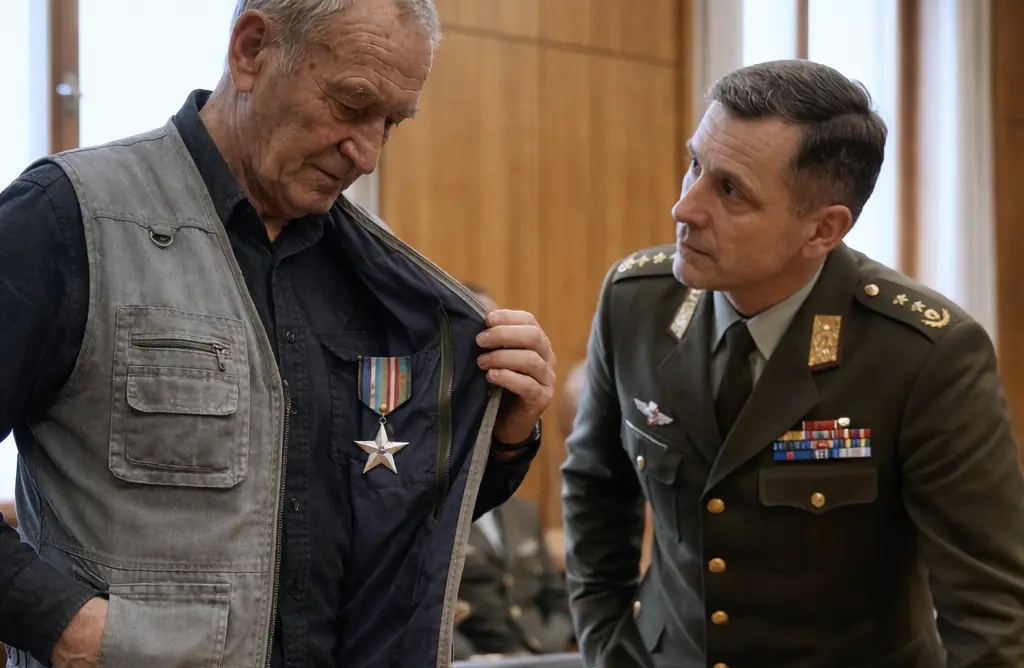
For 15 years, Frank Morrison walked the halls of the Pentagon as a ghost. To the powerful generals planning wars in the E-ring, he was just an old man pushing a squeaky coffee cart, dismissed by arrogant officers who didn’t even know his name. But the atmosphere in the room shattered the moment General Marcus Hale, the Chairman of the Joint Chiefs, spotted a faded Silver Star hidden beneath Frank’s work vest.
The room fell silent as the four-star general realized the man pouring his coffee was the Iron Lion, the fearless hero who had saved his life on Hamburger Hill 54 years ago. This is the story of a legend who served in silence.
Frank Morrison moved through the hallway with the practiced invisibility of someone who’d spent 15 years as civilian support staff. His cart wheels squeaked softly against the polished floor. He wore the standard uniform of Pentagon service workers: dark slacks and a gray work vest over a faded olive drab shirt. That shirt had once been his Army uniform, worn so many times the fabric had thinned to softness.
On the left breast of that shirt, barely visible beneath the vest, was a small Silver Star. Its once-bright finish was dulled by decades and countless washings, the ribbon faded from deep blue to pale gray. He’d been called in on short notice for an emergency briefing.
Four generals. Coffee and water service required. The usual staff person had called in sick, and Frank had volunteered to cover the shift. He didn’t mind.
At 77, sleep came hard anyway. The early morning walk through the empty Pentagon corridors gave him time to think, to remember, and to carry the weight of memory in a place that had mostly forgotten. He knocked twice on the conference room door, a courtesy more than a requirement, then pushed the cart inside.
The room was designed to intimidate, reminding everyone who entered that decisions made here shaped the world. A long mahogany table dominated the space, its surface polished to a mirror shine, surrounded by leather chairs that probably cost more than Frank’s monthly pension. One wall was entirely glass, offering a view of the flight line where F-35 Lightning IIs sat gleaming in the morning sun, their swept wings and angular surfaces representing the cutting edge of American military power.
The other walls held framed maps. Afghanistan with its mountain ranges traced in red, Iraq with its sectarian divisions marked in different colors. The Korean Peninsula with the DMZ highlighted, and the South China Sea with its disputed islands circled. They were reminders of conflicts past, present, and potentially future.
Four men sat at the table, their uniforms heavy with ribbons and stars that caught the fluorescent light. General Marcus Hale, four stars on his collar, Chairman of the Joint Chiefs, his face lined with the weight of command. General Thompson, Army, three stars, his expression stern and calculating.
General Johnson, Air Force, three stars, younger than the others, his eyes sharp with intelligence. General Rodriguez, Marine Corps, three stars, his posture parade-ground perfect even seated. Standing near the head of the table was a colonel named Derek Foster, his uniform so crisp it looked like it had been pressed moments ago, his expression impatient and irritated at the interruption.
Frank moved quietly around the table, setting down cups with practiced precision. He poured coffee from the insulated carafe: black for General Thompson, who waved away the offer of cream; cream and sugar for Rodriguez, who nodded his thanks without looking up. Johnson took his coffee with just cream, and General Hale drank his black and scalding hot.
Frank had learned these preferences over the years. He had memorized the habits of dozens of senior officers, another small way of serving that went unnoticed and unappreciated.
«The situation in the strait is deteriorating faster than our models predicted,» General Johnson was saying, his finger tracing a line on a satellite image spread across the table. «We have 72 hours, maybe less, before this becomes a shooting war.»
«Their naval forces are mobilizing, and our carriers are still three days out,» Johnson continued. «If they move before we’re in position, we’re looking at a potential catastrophe.»
Frank poured General Hale’s coffee, his movements economical and practiced, the result of fifteen years of invisible service. The general’s eyes were fixed on the maps, his jaw tight, his hands clasped so hard the knuckles were white. Frank had seen that expression before, a lifetime ago.
He had seen it on the faces of officers making decisions that would send men to die, decisions that would change lives and end them. It carried a weight no amount of training could fully prepare you for.
«The diplomatic channels are exhausted,» General Thompson added, his voice grim. «State Department says we’re out of options except military response. The president wants a plan on his desk by 1800 hours today, full spectrum options, from show of force to direct engagement.»
«Sir, your coffee.»
Colonel Foster’s voice was sharp, annoyed, cutting through the tension like a knife. He gestured impatiently at Frank, not quite looking at him.
«You’re blocking the display. Move along. We don’t have time for interruptions.»
Frank nodded. «No offense taken.»
He’d been dismissed by better men and worse. He had learned decades ago that taking offense at small slights was a waste of energy better spent elsewhere. He finished pouring and started to push his cart toward the door, the wheels squeaking slightly, a sound that had become so familiar he barely heard it anymore.
«Wait.»
General Hale’s voice was quiet, but it carried the weight of command that came from four decades of service and the authority of the nation’s highest military position. The room fell silent instantly, every officer’s attention snapping to the general.
«Hold on a moment.»
Frank stopped, his hand on the cart handle, his posture neutral and patient. «Sir?»
General Hale stood slowly, his chair scraping against the floor, the sound loud in the sudden silence. He walked around the table with deliberate steps, his eyes never leaving Frank’s chest. His expression shifted from confusion to recognition, to something that looked like disbelief and awe mixed together.
Specifically, the general’s gaze was locked on the small Silver Star visible where Frank’s vest had shifted slightly as he reached to pour the last cup of coffee.
«That metal,» General Hale said, his voice strange, tight, the words coming out carefully as if he was afraid of what the answer might be. «Where did you get that?»
Frank glanced down at the star, then back at the general, his expression calm and neutral. «I earned it, sir. Vietnam. Long time ago. May of 1969.»
«Vietnam.» General Hale’s face had gone pale, the color draining from his cheeks as if he’d been physically struck. His hand came up slowly, not quite touching the metal, hovering inches away as if it might burn him or disappear if he made contact. «When? What unit? What battle?»
Frank kept his voice neutral, professional, the way he’d learned to speak to officers who outranked him by galaxies of authority and power.
«5th Battalion, 7th Cavalry, 1st Brigade, 101st Airborne Division. Hamburger Hill. Hill 937, in the A Shau Valley. The assault lasted ten days. I was there for all of them.»
The conference room had gone completely silent. The satellite images on the table, the crisis in the strait, the urgent timeline—all of it was forgotten. The other generals were watching now, confused, sensing something significant happening but not understanding what. Their briefing materials lay forgotten in their hands.
General Hale took a step back, his hand coming up to cover his mouth, his eyes searching Frank’s face with an intensity that was almost painful to witness. The general’s breath was coming faster now, his military composure cracking like ice under pressure.
«What’s your name? Your full name and rank?»
«Frank Morrison, Sir. Sergeant Major, United States Army, retired. I served 30 years, mustered out in 1996 as an E-9. Been working here at the Pentagon as civilian support staff for the last 15 years.»
The general took another step back, and now his hand was trembling—actually trembling—something Frank had never seen in a four-star officer.
«Oh my God. Oh my God. You’re Frank Morrison. You’re the Iron Lion. You’re the man who held the line. You’re the reason I’m alive.»
Colonel Foster stepped forward, his confusion evident, his irritation at the interruption warring with concern for his superior officer. «Sir, what’s going on? Who is this man?»
General Hale held up a hand, cutting him off, never taking his eyes from Frank’s face. When he spoke, his voice was shaking, decades of military bearing and control giving way to raw emotion.
«Gentlemen, do you know who’s been serving our coffee? Do you have any idea who this man is? This is Sergeant Major Frank Morrison, the Iron Lion of Hamburger Hill.»
Hale continued, his voice rising. «In May of 1969, during the battle for Hill 937, he saved 23 lives under fire. He held a position that every tactical manual said was indefensible. He was wounded three times and refused medical evacuation until every single man under his command was safe. Including me.»
The moment General Hale said those words, spoke that date and that place, the conference room began to dissolve in Frank’s mind like smoke and wind. The polished mahogany table became red mud churned by artillery and monsoon rain. The air conditioning became the suffocating heat and humidity of the jungle in May.
It was the kind of wet heat that soaked through your uniform and never let go, that made every breath feel like drowning. The smell of coffee gave way to gunpowder, blood, and the acrid stench of napalm that clung to everything. It got into your pores and your lungs and never quite left.
Frank was no longer 77. He was 25, his uniform soaked with sweat and other men’s blood, his M16 rifle hot enough to burn his hands. His voice was hoarse from shouting orders over the thunder of artillery and small arms fire that never seemed to stop.
The noise went on for days until the sound became a physical thing you carried inside your skull. The hill had no official name except the number on the military maps: Hill 937. But the soldiers who fought there, who bled and died on its slopes, called it Hamburger Hill.
They called it that because it ground men up like meat in a grinder, because it consumed whole companies and spat out survivors who would never be whole again. The North Vietnamese Army (NVA) had fortified the summit with bunkers, tunnels, and machine gun nests, turning it into a fortress that commanded the entire valley. American command had decided it needed to be taken, that the strategic value justified the cost.
It was the 10th day of the assault when Frank’s platoon was sent up. It was the 10th day of hell that would stretch into eleven. Frank’s platoon—what was left of it after nine days of brutal fighting—was pinned down 50 meters from the summit, caught in a kill zone that the NVA had prepared with deadly precision.
They’d lost their platoon leader, 1st Lieutenant Richards, in the first 10 minutes of the assault. He had stepped on a Bouncing Betty mine that had torn him apart so completely there wasn’t enough left to send home. The radioman, Specialist Torres, was dead with a bullet through his throat, the handset still clutched in his hand.
Half the platoon was wounded, bleeding into the mud. Their cries for medics mixed with the crack of AK-47 fire and the deeper boom of RPG launches. The NVA was pouring fire down on them from reinforced positions that American artillery couldn’t touch without risking friendly fire casualties that would have been catastrophic.
Frank lay behind a fallen teak tree, its trunk torn and splintered by bullets. His M16 was aimed uphill at an enemy he could barely see through the rain and smoke. His mind raced through tactical options that all seemed to end in death.
Beside him, a young 2nd Lieutenant named Marcus Hale was bleeding from a shrapnel wound in his left leg. The fabric of his uniform was soaked dark red, his face pale with shock, pain, and the kind of fear that came from knowing you were about to die.
«We have to fall back,» Hale gasped, his voice high and tight with panic. His hands shook as he tried to wrap a bandage around his own leg. «We have to retreat. We can’t take that position. It’s suicide. We’ll all die if we stay here.»