


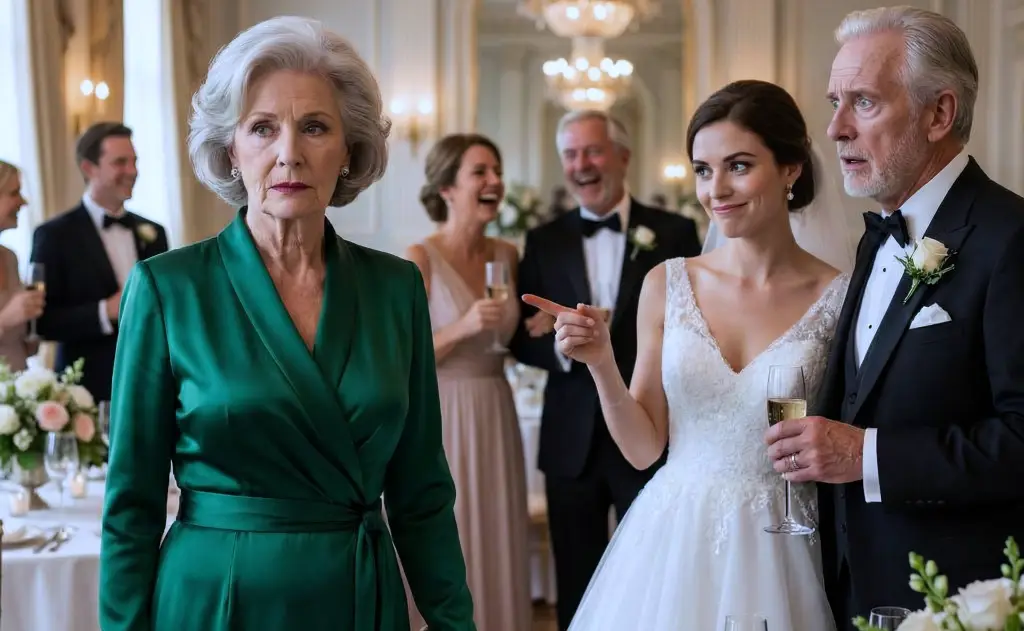
“Ladies and gentlemen, I’d like you to meet the old fat pig we have to put up with.”
The words hit me like ice water, standing there in my emerald green dress that had cost more than most people’s monthly rent. I watched Bradley’s new bride, Sophia, gesture toward me with a champagne flute while her wealthy family erupted in laughter.
Then her father’s face went white as fresh snow.
“Wait, aren’t you Margaret Harrison? My new boss at Harrison Industries?”
Let me tell you how I ended up being called a pig at my own son’s wedding—the wedding I’d paid for entirely, down to the last rose petal.
Two hours earlier, I’d been adjusting Bradley’s bow tie in the church vestry, proud as any mother could be.
“Thanks for everything, Mom,” he’d said, not quite meeting my eyes. “I know the wedding cost a fortune. $300,000 to be exact, not that I was counting.”
I’d watched him fidget with his cufflinks, the ones his father wore at our wedding 32 years ago before cancer took him when Bradley was twelve.
“Your father would be so proud,” I whispered, straightening his shoulders.
But as I stood in that reception hall, listening to my son’s new in-laws mock me openly, I realized pride was a luxury I could no longer afford.
The Harrison family owned half the commercial real estate in Chicago. James Harrison, Sophia’s father, controlled a business empire worth billions. What he didn’t know was that his company’s board had voted me in as CEO exactly one week ago.
My first official day was Monday morning.
“Mrs. Harrison,” James stammered, his champagne glass trembling slightly. “I had no idea. Sophia never mentioned…”
“Mentioned what, Daddy?” Sophia’s voice was sharp with confusion. She looked between us, her perfect smile faltering.
“That Bradley’s mother is Margaret Harrison.”
The silence spread like spilled wine across white linen. Sophia’s mother, Patricia, stepped forward with the kind of smile wealthy women perfect in finishing school.
“Oh my goodness, what a delightful coincidence. You share the same last name as my husband’s company.”
“Not a coincidence,” I said calmly, watching James’s face cycle through several shades of pale. “I kept my married name after my husband died. Harrison Industries was his family’s business. I inherited his shares when he passed.”
The math was simple enough, even for people distracted by champagne. Controlling interest, voting power, the ability to hire and fire anyone I pleased. Sophia’s laughter died completely.
“You’re saying you own Daddy’s company?”
“Not own, dear. Control,” I smiled the same smile I’d used in a hundred board meetings. “There’s a difference.”
Bradley appeared at my elbow, finally sensing the tension.
“Mom, is everything okay?”
I looked at my son, this man I’d raised alone after losing his father. A man who’d worked two jobs to put through business school, who’d sacrificed everything to give him every opportunity. I realized he’d positioned himself slightly closer to his new wife than to me.
“Everything’s perfect, sweetheart,” I said, patting his arm. “I was just getting acquainted with your new family.”
James cleared his throat, his business instincts finally kicking in.
“Mrs. Harrison, perhaps we could schedule a meeting next week? I’d love to discuss…”
“Monday morning,” I interrupted smoothly. “Nine o’clock sharp. My assistant will send you the address.”
I turned to Sophia with my warmest smile.
“Congratulations on your marriage, dear. I’m sure we’ll be seeing much more of each other.”
As I walked away, I heard Sophia hiss to her mother.
“Why didn’t you tell me she was somebody important?”
“We didn’t know,” Patricia whispered back frantically. “Your father said Bradley’s mother was just some middle-class widow.”
Just some middle-class widow.
The words followed me to the ladies’ room, where I locked the door and stared at my reflection. My dress was elegant, my jewelry modest but real. My makeup was perfect, despite the emotional earthquake I’d just experienced.
In the mirror, I saw a woman who’d spent thirty years building a business empire in her husband’s memory. A woman who’d raised a son alone, paid for his education, his apartment, his car, and now his wedding.
A woman who’d been called a pig by people who didn’t realize she could destroy their entire world with a single phone call.
But most importantly, I saw a woman who was just beginning to understand her own power. My phone buzzed with a text from my assistant: Board meeting moved to Tuesday. Emergency HR situation requires immediate attention Monday.
I smiled at my reflection and began reapplying my lipstick. Monday was going to be very interesting indeed.
The path to that humiliating moment had started eighteen months earlier when I’d made the mistake of being too generous with my son’s happiness. Bradley had called on a Tuesday evening, his voice carrying that particular tone that meant he needed something expensive.
“Mom, I’ve got incredible news. Sophia said yes!”
I’d been reviewing quarterly reports in my home office, but I set everything aside. My son was engaged. Despite everything else, the mother in me was genuinely thrilled.
“Oh, honey, that’s wonderful! When did you propose?”
“Last night at Aurelio’s. You know, that fancy place downtown where you took me for my graduation dinner?”
I remembered. The bill had been four hundred dollars for two people. But seeing Bradley’s face that night, so proud of his MBA, had made every penny worth it.
“Tell me everything,” I said, settling back in my chair.
For the next hour, Bradley described the proposal and the ring—which cost more than most people’s cars—and Sophia’s reaction. What he didn’t mention was how they planned to pay for a wedding. That conversation came a month later.
“The thing is, Mom,” Bradley said, his fingers drumming against my kitchen table. “Sophia’s family has certain expectations.”
I poured him more coffee, noting how he avoided eye contact. After raising him alone, I knew all his tells.
“What kind of expectations?”
“Well, her sister’s wedding was at the Four Seasons. Three hundred guests. A very elegant affair.”
“I’m sure it was beautiful.”
“And her cousin got married at the Drake Hotel. Sophia’s been dreaming of something similar since she was a little girl.”
I waited. In business, silence was often the most powerful negotiation tool.
“The venues she’s looking at are around two hundred thousand dollars,” he said quickly. “Just for the basics. Not including flowers, music, photography, all the other things.”
“Two hundred thousand,” I repeated calmly.
“I know it sounds like a lot, but Mom, she’s the one. I want to give her everything she deserves.”
What about what you deserve? I thought. What about what I deserve after sacrificing everything for your happiness?
But I looked at my son’s face, so hopeful, so young, despite being thirty-one years old. And I felt the familiar tug of maternal love overriding common sense.
“Have you talked to Sophia about a smaller wedding?”
“You don’t understand. Her family? They’re wealthy, Mom. Really wealthy. Her father owns Harrison Industries.”
The irony wasn’t lost on me. My son had no idea that I’d been quietly acquiring shares in James Harrison’s company for years, building toward the controlling interest my husband had always dreamed of securing.
“And you feel pressure to match their lifestyle?”
“I want to be worthy of her,” he said simply.
Those six words broke my heart. I’d raised this boy to believe he was worthy of anything, anyone. How had I failed so completely that he thought love required a price tag?
“Bradley, if she loves you, a courthouse ceremony would be enough.”
“Mom, please. I’m not asking you to pay for everything. Just help us get started. I’ll pay you back once my career takes off.”
His career. Bradley had graduated with his MBA a year earlier and was working at a mid-level consulting firm, making decent money but nowhere near enough to support the lifestyle he’d grown accustomed to through Sophia’s family.
“How much help are we talking about?”
“Maybe two hundred and fifty thousand? Three hundred at most?”
Three hundred thousand dollars. The number sat between us like an unwelcome dinner guest.
“Bradley, that’s more money than most people make in five years.”
“I know. But you can afford it, right? The business is doing well. And after Dad’s life insurance…” he trailed off, realizing how callous that sounded.
My husband’s death had indeed left me financially comfortable, but hearing my son calculate the value of his father’s life so casually made me feel sick.
“Let me think about it,” I said.
That night I sat in my husband’s study, looking at his photograph on the desk. We’d built Harrison Industries together, starting with a single small office building and growing it into one of Chicago’s premier commercial real estate companies. After he died, I’d continued expanding, making strategic acquisitions, building the empire he’d envisioned.
What would you do? I asked his picture. But I already knew the answer. Robert had always been too generous with Bradley, unable to deny him anything. It was one of the few areas where we disagreed.
The next morning, I called Bradley and told him yes.
Looking back now, standing in that bathroom mirror after being called a pig by my son’s new in-laws, I realized that single word—yes—had been the beginning of my transformation from doting mother into something far more dangerous.
Because by Monday morning, I would be their new boss. And unlike my son, they were about to learn that my generosity had limits.
Monday morning arrived with Chicago’s typical autumn chill. I dressed accordingly: power suit, minimal jewelry, hair pulled back in the style that had intimidated corporate America for the past twenty years.
At exactly nine o’clock, I walked into the Harrison Industries boardroom, where James Harrison sat fidgeting with his phone like a nervous teenager.
“Mrs. Harrison,” he stood quickly, extending his hand. “Thank you for agreeing to meet so early.”
“Mr. Harrison,” I replied, taking the seat at the head of the conference table that was rightfully mine. “Though I think we need to clarify something before we begin.”
I opened my briefcase and removed a folder containing the stock certificates, board resolutions, and legal documentation that proved my controlling interest in his family’s company.
“As of last Monday, I own 51% of Harrison Industries. Which means this is my boardroom, and you work for me.”
James’s face cycled through several emotions before settling on barely controlled panic.
“Mrs. Harrison, I think there’s been some misunderstanding. This company has been in my family for three generations!”
“Built on land and initial capital provided by my husband’s grandfather in 1952,” I corrected calmly. “Your grandfather was the junior partner, Mr. Harrison. The contracts are quite clear.”
I slid a manila envelope across the polished table. Inside were photocopies of the original partnership agreements—documents I’d spent years tracking down through legal archives and private collections.
“Your family managed the business beautifully while maintaining minority ownership, but when my husband died, his shares passed to me. I’ve spent the last fifteen years quietly purchasing additional stock whenever it became available.”
“This is impossible,” James whispered. But his hands shook as he flipped through the paperwork.
“The impossible part,” I said, allowing a small smile, “is that you didn’t notice. Your own board approved my appointments to key positions. Your CFO reports directly to me. Your legal team answers my calls.”