


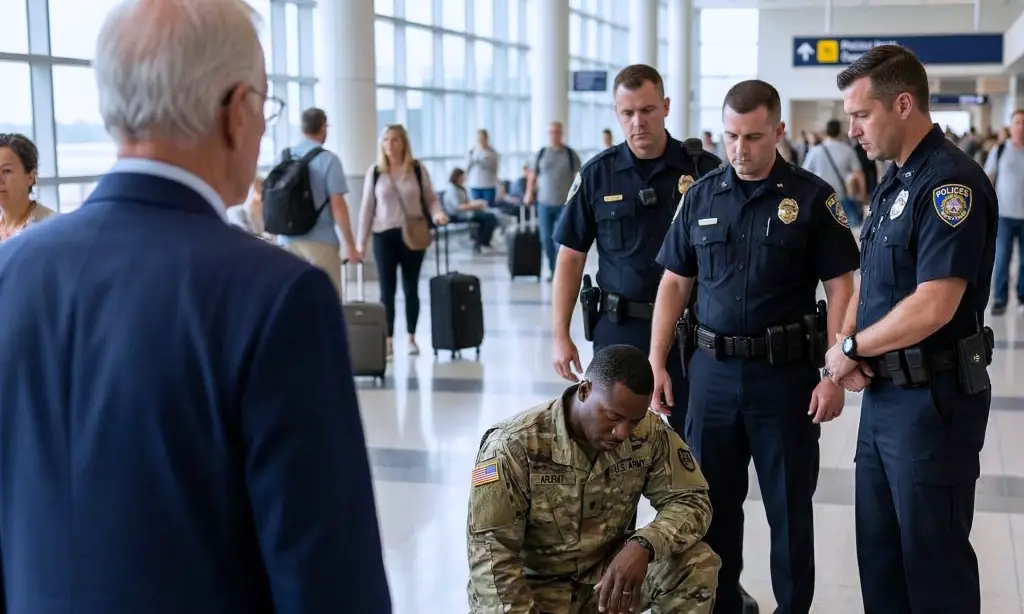
«Officer, please. I’m just trying to get home to my family.»
The words drifted through the stagnant air of Atlanta Airport, Terminal T South, hanging heavy with desperation. The man standing there was a soldier, fresh off a commercial flight that marked the absolute end of a fourteen-month deployment. He was finally standing on American soil, minutes away from the life he had left behind.
Officer Lawson ignored the bone-deep weariness in the man’s tone. With a sneer, he snatched the military ID card from the soldier’s grip, gave a sharp, derisive laugh, and flicked the plastic card onto the scuffed floor tiles.
«Fake,» he spat out. «Just because a black man puts on a stolen uniform, it doesn’t make him a soldier, pal. It makes him a criminal.»
To his right, Officer Walsh grabbed the soldier’s duffel bag and dumped it upside down. Socks, t-shirts, and shaving kits cascaded onto the polished linoleum. Officer Tanner moved in, bringing the heel of his heavy tactical boot down hard on a soft, purple object that had tumbled free—a plush rabbit, a gift specifically chosen for a six-year-old girl.
«That belongs to my daughter,» the soldier said, his voice straining to remain level.
Lawson shoved him, hard, forcing the man face-down onto the cold, unforgiving tiles.
«Hands behind your head!» he barked. «Get down like the thug you are.»
And just like that, a returning serviceman—a recipient of the Bronze Star and a combat medic who had saved lives while bullets flew overhead—found himself pinned to the floor of a domestic airport terminal. Three police officers surrounded one black soldier. A crowd began to form, smartphones raised like vigilant eyes, yet nobody stepped forward to intervene.
However, exactly five feet behind the cluster of officers, a man in a navy blue blazer had been standing motionless for two minutes. It was General Raymond T. Caldwell, this soldier’s commanding officer. He was the man whose own son lived because of this soldier. He was standing right there, completely unnoticed, and in three minutes, these officers would desperately wish they had checked their six.
Six hours prior, Aaron Griffin had let his eyes drift shut as the aircraft began its initial descent into Atlanta. It had been fourteen months—four hundred and twenty-six days defined by sand, searing temperatures, and the desperate, bloody work of saving men who might never remember his name.
He was a Staff Sergeant, a combat medic with the 3rd Brigade Combat Team, 101st Airborne Division. He was the breed of soldier trained to sprint toward the detonation while the rest of the world ran the other way.
His phone buzzed against his palm. A text from Emma, his wife of eight years.
«Lily won’t stop asking if your plane got lost. She made you a sign. Purple glitter everywhere. Hurry home, baby.»
A smile touched his lips, the exhaustion lifting briefly. He typed a reply: «Landed. 15 mins. Can’t wait to hold you both.»
Lily had been five years old when he shipped out. She was six now. He had missed a birthday party complete with a unicorn cake. He had missed her first day of kindergarten, absent for that crucial moment she shouldered the new backpack she had picked out all by herself.
He had missed them over the course of twenty-seven video calls, many of which froze mid-sentence because a satellite connection simply couldn’t bridge the gap between a father and his child. In his duffel bag, nestled safely between rolled socks and his shaving kit, was a stuffed rabbit he had purchased at a base exchange in Kuwait. It was purple, her absolute favorite color.
He had carried that rabbit through three forward operating bases, two helicopter transfers, and one terrified night where a mortar round landed fifty meters from his tent. Next to the toy was a simple manila folder. Inside lay his Bronze Star citation.
Four months ago, that medal had altered the trajectory of his life. A convoy had struck an IED outside a forward operating base in Syria. Even now, Aaron could vividly see the black smoke choking the stark blue sky.
The screaming had cut through the ringing in his ears. The lead vehicle was flipped on its side, fuel leaking into sand that was already hot enough to burn skin. A lieutenant was pinned beneath the twisted wreckage.
He was young, only twenty-six. His femoral artery had been severed. Blood was pooling faster than the human mind could process. Aaron hadn’t thought; he had simply moved.
He dragged the lieutenant free. He clamped the artery shut with his bare hands. He held that pressure for eleven agonizing minutes while the man screamed and the medevac chopper circled above, hunting for a landing zone through the blinding smoke.
Eleven minutes. His muscles cramped. Blood soaked through his fatigues, hot and sticky. The lieutenant’s eyes went glassy, snapped into focus, then drifted again.
«Stay with me, man. Stay with me. I’ve got you. James. My name’s James. Please don’t let go.»
«I won’t, James. I promise.»
The lieutenant lived. Aaron moved on. That is the medic’s burden. You save who you can, you don’t dwell on it, and you don’t ask for gratitude. You simply move to the next patient. He never learned the lieutenant’s surname. Just James. Just a promise kept in the burning sand.
Two weeks later, a general flew into the base to pin medals on a dozen soldiers. Aaron stood in formation. His mind was on Emma. On Lily. On going home.
When the general reached him, something unusual occurred. The handshake was firm, regulation, but the general’s eyes were swimming with tears. His voice cracked on the words.
«Outstanding work, Staff Sergeant. Truly outstanding. I owe you more than you know.»
Aaron hadn’t understood at the time. Generals do not weep over routine commendations. But this one, General Raymond T. Caldwell, Commanding General of the 3rd Brigade, looked at Aaron as if he owed him a debt that could never be settled.
Aaron had nodded, replied, «Thank you, sir,» and filed it away. He didn’t make the connection then. He would soon.
In the first-class cabin, thirty rows ahead of Aaron, a man in a navy blazer adjusted himself in seat 2A. He had gray hair cropped to military regulation and maintained perfect posture even in the cramped airline seat. He possessed the stillness of a man accustomed to commanding thousands in the theater of war.
General Raymond T. Caldwell was returning from a five-day tour of his deployed troops. He was traveling in civilian attire today: blazer, khakis, Oxford shirt. This was standard procedure for senior officers on commercial flights. As the passengers boarded, Caldwell watched the aisle, scanning faces out of ingrained habit. Then he saw him.
In the coach section, window seat, eyes already fluttering shut, sat Griffin. Caldwell’s jaw set.
There he is, he thought. The man who saved my son.
He briefly considered walking back to coach to tell Aaron the truth. But Griffin looked shattered. Let him rest,Caldwell decided. He’s earned it.
They didn’t speak. Caldwell returned to his book, though he kept glancing back.
The wheels touched the tarmac at 6:31 PM. Aaron texted Emma. He had no idea those next fifteen minutes would destroy him, only to save him.
Terminal T, South. Baggage carousel 4.
The mechanical hum of the conveyor belts starting up blended with the shuffle of exhausted travelers and the squeak of luggage wheels on the terrazzo. The scent of fast food and industrial floor wax hung in the recycled air.
Aaron stepped off the escalator, scanning the display monitors. Flight 1248, carousel 4. He shifted his duffel to his opposite shoulder and began the walk. He was a black man in Army fatigues, traveling solo. He had tired eyes and clothes wrinkled from twenty-two hours of transit. He didn’t notice the three officers tracking him from the far wall.
Sergeant Derek Lawson, an eighteen-year veteran of the Atlanta airport police force, was forty-one. His personnel file held fourteen complaints, yet zero sustained findings. He was the type of cop who selected his targets with precision, knowing exactly how much leverage he had.
He saw Aaron and smiled. It was the smile of a predator locating a straggler.
«Him.»
Walsh looked over. He was twenty-nine, eager, buzzing with fresh-from-the-academy energy. «The soldier?»
«The uniform’s probably fake. Look at him. Wrinkled. Tired. Probably stole it off a clothesline.»
Tanner frowned. He was thirty-one. He knew better, but he remained silent. «You sure, Sarge?»
«Trust me. I know his kind.»
Twenty feet behind Aaron, General Caldwell retrieved his bag from carousel three. It was a nondescript black roller with no military insignia. Nothing to draw the eye. His gaze remained fixed on Griffin. Something felt off.
The hairs on the back of his neck stood up—an instinct sharpened by thirty years in combat zones. It was the internal alarm that had kept him breathing through three deployments. Then he saw the cops moving. Three of them, vectoring toward Griffin. There was intent in their stride, their formation tight. Caldwell stopped and watched.
Lawson intercepted Aaron first. «Sir, I need to see some identification.»
Aaron turned. «Of course, officer.»
No hesitation. No attitude. Just compliance, exactly as he was trained. He reached into his pocket, produced his military ID, and handed it over. Calm. Respectful. Professional.
Lawson studied the card. He took his time. His eyes darted from the photo to Aaron’s face, then back again. His lip curled. Then came the laugh.
«This is fake.»
Aaron blinked, confused. «Excuse me?»
«Fake. Forged. You people are getting better at this, I’ll give you that. But I’ve seen enough phonies to spot one.»
«Sir, that is a valid military ID. I just returned from a 14-month deployment to Syria. If you scan the hologram…»
«I don’t need to check anything.» Lawson held the ID up for Walsh and Tanner to see. «See this? Wrong font. Wrong placement. Probably bought it online for fifty bucks from some scammer in China.»
The ID was authentic. It was pristine, issued six weeks prior at Fort Campbell and verified by the Department of Defense. None of that mattered.
Walsh and Tanner flanked Aaron. Three badges. Three bodies. A wall closing in.
«Where’d you get the uniform?» Lawson demanded.
«I am an active duty Army Staff Sergeant. Third Brigade, 101st.»
«Stolen. That’s what I thought. Probably lifted it from a thrift store. Or maybe you mugged a real soldier and took his clothes. Wouldn’t be the first time I’ve seen that.»
«Sir, I served fourteen months in a combat zone.»
«A black man in a uniform doesn’t make you a soldier.» Lawson stepped in closer, invading his space until Aaron could smell stale coffee on his breath. «It makes you suspicious. It makes you a target. And right now, it makes you mine.»
Caldwell was fifteen feet away now. Then twelve. Then ten. He could hear every syllable. His hands were trembling. Not from fear, but from a cold, simmering rage.
That’s my soldier. That’s the man who saved my son.
He wanted to move, wanted to intervene instantly. But something told him to hold. To watch. To document. He pulled out his smartphone and hit record.
Lawson grabbed Aaron’s duffel. «Search this.»
Walsh took it, unzipped it, and upended it. He shook the contents onto the floor without a shred of respect. Clothes tumbled out. Toiletries skittered across the tile. The manila folder containing Aaron’s Bronze Star citation landed face down in a puddle of spilled shampoo.
And the purple rabbit. Lily’s rabbit.
It rolled across the tile and came to a stop against Tanner’s boot.
«That’s my daughter’s,» Aaron said.
Tanner looked down at it. Looked at Aaron. Looked at Lawson. Then he stepped on it. He ground it under his heel. Slowly. Deliberately.
«Oops.»
Something fractured in Aaron’s eyes. But he didn’t move. He didn’t react.
Don’t give them an excuse. Don’t give them a reason.
Lawson’s smile widened. «Now, get on your knees.»
Aaron Griffin knelt. Not because he was guilty. Not because he was afraid. He knelt because he knew the math. Three cops. One black man. An airport full of witnesses who would record but wouldn’t testify.