


The taxi pulled up to the curb in front of the modest suburban house that my husband, Michael, and I had strained to buy three years ago. Michael quickly opened the car door, helping a gaunt, frail woman step out. It was my mother-in-law, Elizabeth.
I hadn’t seen her in six months, and her appearance had deteriorated strictly. Terminal lung cancer with metastasis had drained the life from a woman who was once as strong as an oak. Now, she was nothing but skin and bones.
Her eyes were sunken into dark sockets that reflected an infinite weariness. I hurried over to take the old suitcase from Michael’s hands. A potent smell of medication and antiseptic hit me, stinging my nose.
Michael looked at me, a certain evasion in his eyes. His voice was urgent, as if someone were chasing him. He told me to help his mother get settled in her room so she could rest, adding that he needed to talk to me about something important right away.
I escorted my mother-in-law to the small downstairs bedroom I had thoroughly cleaned the day before. Elizabeth sat on the edge of the bed. Her breathing was a heavy, wheezing gasp, sounding like the bellows of an old forge.
She took my hand, her rough, calloused skin brushing against mine. She said nothing, only looking at me with a strange expression. It was a mixture of pity and resignation.
I returned to the living room. Michael was already there, adjusting his tie. Next to him stood a large, perfectly packed suitcase. My intuition told me something was wrong.
Michael approached, placing his hands on my shoulders. In a grave, serious voice, he said, «Sophia, I just received the board’s decision this afternoon. The company is sending me to Germany for a year to oversee a key project. It is my only chance for a promotion to regional director.»
I froze, looking back and forth between the suitcase and his face. I stammered, «A year? Why so sudden? Mom just got here, sick as she is. You are planning to leave now?»
Michael sighed. His face showed a distress that seemed meticulously rehearsed. He knew it was a sacrifice for me, but he told me to look at his mother.
«Terminal lung cancer,» he said. «The treatment costs are a fortune every day. If I do not accept this assignment, where will we get the money for her medicine? For the radiation therapy?»
He insisted he was doing this for the house, for his mother, and for our future. His words fell upon me like a net of moral responsibility, preventing me from voicing any objection. He was right; his mother’s illness was a bottomless pit that swallowed our money.
My salary as an office administrator barely covered our basic expenses. Michael took a debit card from his wallet and placed it in my hand. «The PIN is our wedding anniversary,» he explained.
«Every month, the company will deposit my salary here. Use it to take care of Mom,» he continued. He promised to save everything he could over there to send more. As his wife and her daughter-in-law, this was the moment he needed me most to take charge of everything at home.
He asked if I would help him. I held the lightweight card in my hand, but my heart felt as heavy as lead. I nodded in resignation.
Michael gave me a quick hug. The cologne emanating from his shirt wasn’t his usual scent of sweat and hard work. It had a distant, expensive touch.
He said he had to go, or he would miss the red-eye flight, leaving everything in my hands. The sound of the suitcase wheels rolling across the tile floor, and then the engine of a cab driving away in the rain, were the last sounds I heard from him.
The house fell into a terrifying silence. I stood paralyzed in the middle of the living room, feeling loneliness envelop me. I went back to my mother-in-law’s room.
Elizabeth was still sitting there, her back propped against the headboard. Her clouded eyes were fixed on the dark window. She did not ask where her son had gone, nor did she cry or try to stop him.
She just let out a sigh, a sound as fragile as a dry leaf being stepped on. «He is gone, daughter,» she said in a hoarse voice. I tried to hold back tears and went to cover her with the blanket.
«Yes, he went on a business trip to earn money for your treatment,» I soothed her. «Do not worry, Mom. I am here to take care of you.»
Elizabeth turned to look at me. Her gaze no longer reflected weariness, but a compassion so deep it made me shudder. She whispered, «You poor thing, my child.»
She continued, «He is gone. Consider him gone for good.» At that moment, I thought she was referring to Michael’s long trip.
I could not have known that in that ambiguous phrase, she was referring to a definitive departure—that of the humanity of her own son. Outside, the rain continued to pour, washing away the last traces of Michael. It left the sick old woman and me alone in that empty house.
Three months passed, feeling as long as three centuries. My life had been turned upside down, trapped in a relentless cycle: the office, the hospital, and the kitchen, perpetually smelling of medicine.
My mother-in-law’s health deteriorated faster than expected. Gut-wrenching coughing fits tormented her day and night, preventing me from getting a single full night’s sleep. Every morning, I arrived at the office with dark circles under my eyes and my spirits crushed.
My boss had already reprimanded me twice for being late and for my lack of focus. But what could I do? Every morning I had to clean her, attend to her hygiene needs, and feed her pureed meals before I could leave the house.
The money on the card Michael left me barely amounted to $500 a month. He claimed part of his salary was being withheld for work insurance or some bureaucratic process. With $500, I could barely cover the medical supplies and some painkillers not covered by her insurance.
All the expenses for food, bills, and daily life came from the small savings account I had been building since I was single. Every Sunday night, Michael would video call. It was a moment I both anticipated and dreaded.
On the phone screen, Michael always appeared against a white wall or sometimes in the corner of a quiet coffee shop. He always complained. He said it was so cold there, and the work was incredibly stressful.
He claimed to have meetings late into the night and no time to rest. I looked at his face on the screen, his skin rosy and his hair perfectly styled. It was a stark contrast to my own disheveled and gaunt appearance.
I wanted to scream. I wanted to tell him about the sleepless nights patting his mother’s back, or the times her illness became violent and terrifying. But seeing his expression of a busy, important man, I swallowed my complaints.
One night, while searching for my mother-in-law’s old medical records to prepare for her next radiation session, I remembered that Michael had scanned some documents. He had saved them on his old laptop, which he had left at home.
It was a computer he rarely used, tucked away in a closet because he said it was too slow. I plugged it in and turned it on. The screen lit up, displaying the family folders.
I found the medical file and was about to email it to myself to print. However, when I opened the Chrome browser, Michael’s Google account was still logged in. Perhaps in the rush of his departure, or because he thought I was technologically illiterate, he had forgotten to sign out.
A small notification popped up in the top right corner of the screen: «Google Photos has synced 12 new photos.» Out of curiosity, and also because I missed my husband, I clicked to see them.
I thought they would be pictures of snow in Germany or of him with his foreign colleagues. They were not. What I saw was the deep blue of the sea and sky, a radiant and stunning landscape.
The most recent photo had been taken two hours ago. It showed a lavish seafood platter with a huge red lobster next to a glass of sparkling wine. The location tag read: «A five-star resort in Miami.»
My heart lurched, and my hand on the mouse began to tremble. I scrolled to the next photo. It was the back of a young woman.
She was wearing a bright orange bikini and lying on a lounge chair with a cocktail in her hand, posing in a way that oozed relaxation. Though it was only her back, I instantly recognized her light brown hair with large curls. It was Natalie.
She was a former colleague from the marketing department whom Michael had introduced to me at the company Christmas party the previous year. At the time, he had said she was a «very dynamic girl» and that he considered her a little sister.
I kept scrolling. Tears began to well up, blurring the images on the screen. The third photo was a shirtless selfie of Michael, wearing sunglasses, grinning from ear to ear.
Behind him was an infinity pool, and the silhouette of that girl swimming. There was no Germany. No key project. No snow. No late nights working.
There was only Miami, golden sun, blue sea, expensive seafood, and a mistress. While I was here, in this house that reeked of sickness, cleaning up after his dying mother, he was living a lie. I was counting every penny to buy soft food, while he used the money he claimed was «withheld» to fund a lavish affair.
I slammed the laptop shut. The sharp snap echoed in the silent night. The initial pain quickly gave way to a nausea that rose in my throat.
I looked at my hands, the same hands that moments ago were washing a towel stained with illness. Now they seemed ridiculous, pathetic. My devotion and my trust had all been turned into a cruel joke by him.
From the bedroom, my mother-in-law’s cough sounded again, a guttural sound that tore at my soul. I stood up and wiped away my tears. I wasn’t wiping them because I was no longer sad, but because I knew that from that moment on, I was no longer the docile, self-sacrificing wife of yesterday.
A storm broke over the city at midnight, bringing an icy chill that seeped through the cracks of the poorly sealed windows. In the small room, steeped in the scent of medicine, my mother-in-law’s breathing became a sharp whistle. It sounded like a dry leaf skittering across asphalt.
Elizabeth had adamantly refused to go to the hospital to be put on a ventilator. She said she wanted to die at home, in her own bed, not surrounded by the cold, tangled tubes of an intensive care unit. I sat on the edge of the bed, wiping her forehead with a warm, damp cloth.
The dim light from the nightstand lamp illuminated the ravaged face of a woman who had worked tirelessly her entire life. Suddenly, she opened her eyes. They were already clouded by illness, but they shone with a strange intensity, like an oil lamp burning brightest just before it goes out.
She waved her bony hands in the air, searching for me. I took her hand. It was ice-cold, all skin and bone, but she squeezed mine with incredible force.
Her sharp nails dug into my skin, causing a sharp pain, but I dared not pull away. She looked at me, her lips moving. Her ragged breath smelled of farewell.
She whispered, her broken voice drowned out by the drumming of the rain on the roof, «Sophia, my child. Michael is a scoundrel. I know everything.»
She paused, gasping for air. «I know where he is.» My heart tightened. So, she knew.
The old woman, bedridden and seemingly detached from the world, knew the cruel truth I had just discovered. She had not said anything, not because she did not know, but because the pain was too great to put into words. Tears welled up in the wrinkles at the corners of her eyes.
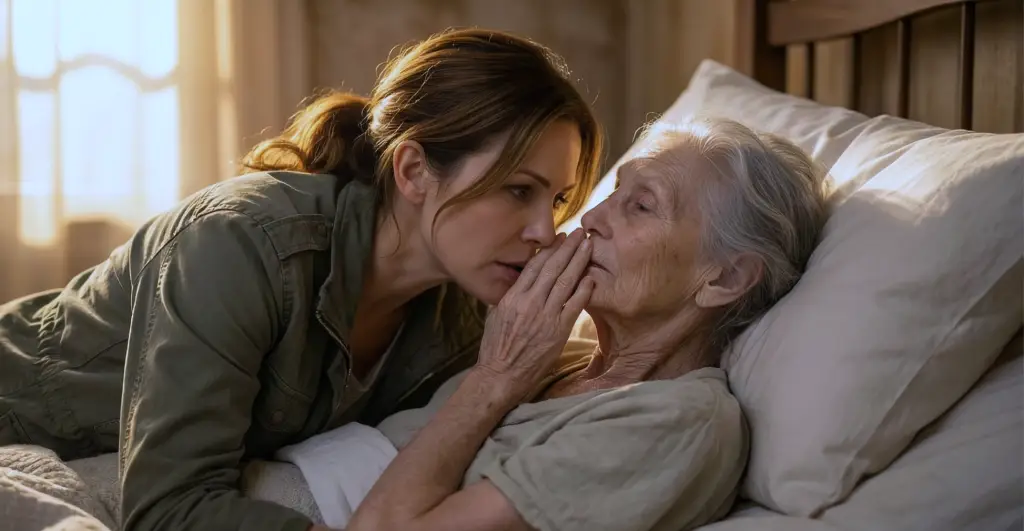
She struggled to sit up, pulling me closer. She whispered in my ear as if she feared someone might hear, though only two lonely women remained in that house. «Good daughter, listen to what your mother is telling you.»
«After you are finished with my funeral, go back to my hometown alone. Remember, go alone,» she insisted. «Go to the old kitchen and dig under that big ceramic crock where we used to keep the pickles, in the corner. I have hidden something there for you.»
Her voice faded away, lost in the roar of thunder that shook the sky. The hand gripping mine suddenly went slack and fell limply to the side of the bed. Her heavy, labored breathing stopped completely.
The room plunged into absolute silence, broken only by the sound of the torrential rain. It felt as if nature wanted to wash away all the suffering of a lifetime. Mom was gone.