


The Medicaid clerk’s face went pale as she stared at her computer screen. Her fingers froze above the keyboard, and for a moment, the hum of fluorescent lights overhead seemed unbearably loud.
«Miss Brooks,» she said quietly, lowering her voice as if afraid the words themselves might cause damage. «According to this record, you passed away in 1990.»
I blinked, certain I had misheard her. My name is Aaliyah Renee Brooks, and I was very much alive, sitting in a cramped government office with cracked linoleum floors and plastic chairs that groaned under my weight. My hands were rough, scarred from years of warehouse shifts and factory work, clutching a folder of expired insurance papers like they were the last proof that I existed.
Around me, other people waited their turn, eyes fixed on their phones or the floor, unaware that my entire life was quietly unraveling one sentence at a time.
«That’s not possible,» I said, leaning forward. «I’ve used that Social Security number since I was eighteen. Every job. Every tax form.»
The clerk, Sharon Lewis, a woman with tired eyes behind thin glasses, swallowed hard and typed again. Slower this time. Her expression shifted from confusion to something closer to fear. She glanced at me, then at the screen, then reached for her phone with hands that trembled just enough for me to notice.
I was thirty-two years old. Recently laid off. Down to my last fifty-two dollars. And apparently, according to the government, I did not exist. Or worse, I existed as someone who had been dead for more than three decades.
Behind me, memories stirred. The ghost of Patricia Dawson, my stepmother, standing in the doorway all those years ago, arms crossed, jaw tight, eyes cold.
«You are not my blood,» she had said more times than I could count. «And you never will be.»
Patricia married my mother, Denise Brooks, when I was eight years old, two years after the man I believed was my father died in a trucking accident. From the first day I moved into her house, she made one thing painfully clear: I was an inconvenience she had inherited, not a child she had chosen.
Her biological daughter, Brianna, got new clothes, birthday parties, and warm smiles. I got silence, secondhand shoes, and reminders to stay out of the way. Patricia never raised a hand to me; she didn’t have to. Every look, every dismissive sigh, told me exactly where I stood.
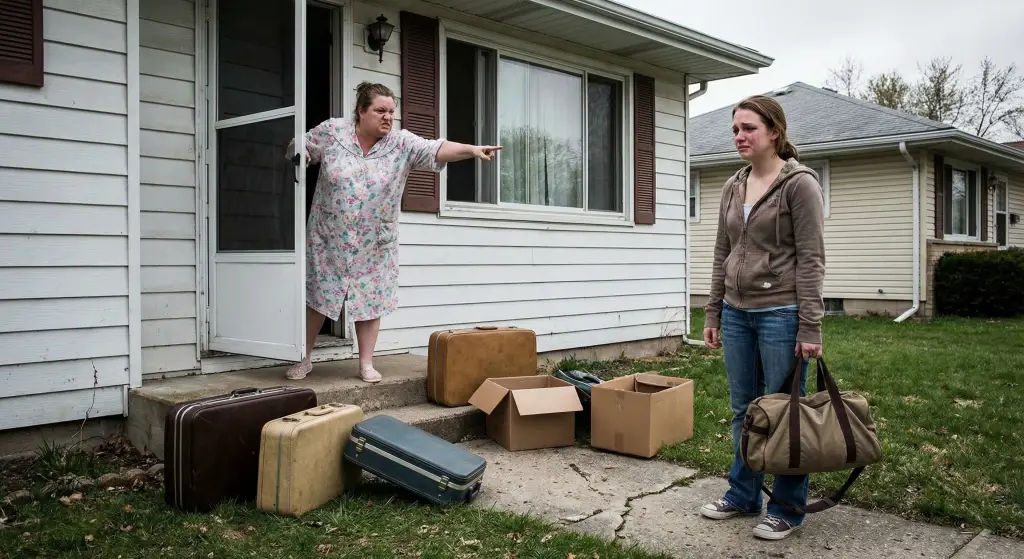
The morning I turned eighteen, my bags were waiting by the door. Now, sitting in that Medicaid office with my world tilting off its axis, I realized something chilling. Being thrown out at eighteen for «not being blood» was nothing compared to what I was about to learn. Because the life I had fought so hard to build might not have been mine at all.
The fluorescent lights buzzed overhead, casting harsh shadows across the peeling walls of the office. Somewhere down the hall, a baby cried. A printer jammed. Life went on for everyone else, while mine quietly came apart.
«Miss Brooks,» Sharon Lewis said carefully, «I need you to stay seated for a moment.»
«What is this about?» My voice came out sharper than I intended. A security guard near the exit shifted his stance, hand hovering close to his radio. «If there’s a problem with my paperwork, I can come back another day.»
She shook her head slowly. «It’s not a paperwork issue.»
She turned her monitor slightly away from me, but not before I saw it. Red warning text. Symbols I had never seen before. Not normal. Not routine.
«The Social Security number you’ve been using?» she continued, lowering her voice. «It was flagged internationally in the mid-1990s.»
«Internationally?» I let out a short, humorless laugh. «That’s impossible. I’ve had this number since I got my first job. Grocery store, night shifts, minimum wage. Nobody ever said anything.»
Sharon picked up her phone, hesitated, then set it back down. Her eyes softened, and that somehow made everything worse.
«It belongs to a child,» she said, «who was reported deceased in a trucking accident in 1990, along with her father.»
The room tilted.
«My father died in a trucking accident,» I said automatically. The words were muscle memory, rehearsed a thousand times. «But that was 1997. I was six. I remember the funeral.»
Sharon inhaled slowly. «The child in this record was three.»
Something cold slid down my spine. Before I could respond, a tall man in a dark suit appeared beside her desk. He looked like someone who had spent his life navigating rules and consequences. Late fifties. Calm posture, sharp eyes.
«Thomas Grant,» he said briefly, glancing at Sharon’s screen. His expression shifted. Confusion, then recognition. Then something that looked disturbingly close to awe.
«Dear God,» he whispered. He straightened instantly. «Lock the file. Do not call anyone else. I need to make a very specific phone call.»
«What’s happening?» I demanded, rising from the chair. «I haven’t done anything wrong.»
«No one’s accusing you of anything,» he said quickly, holding up a hand. «But you need to understand that what we’re seeing here… it changes everything.»
He studied my face like it held answers I didn’t know I had. «Miss Brooks,» he said slowly, «is that the name you’ve always gone by?»
«Yes,» I snapped. «Since birth. My mother is Denise Brooks. My father died when I was a child.»
«When exactly?»
«September,» I said. «1997, highway accident, storm. His truck jackknifed.»
Thomas wrote something down, his pen precise and steady. «How old were you?»
«Six, almost seven.»
«And your memories from before that age?» The question caught me off guard.
«I remember things,» I insisted. «Our apartment. A yellow kitchen. My mother singing. My father’s laugh.»
«Are those memories clear?» he asked gently. «Or do they feel… distant?»
I hesitated. They felt real, but fuzzy, like photographs left too long in the sun.
My phone buzzed in my pocket. Unknown number. I looked down, and my breath caught as I read the message.
Stay where you are. Your real mother has been searching for you for 32 years. Signed, Agent Keisha Monroe, FBI Missing Children Division.
The words blurred as my vision filled. I wasn’t dead. But the girl I thought I was… might never have existed at all. My hands were shaking as I showed the message to Thomas Grant.
He read it once, then again, his jaw tightening.
«I just got off the phone with the federal building,» he said quietly. «They’re already mobilizing.»
Sharon Lewis looked like she might faint. «FBI? Over a Medicaid application?»
«This stopped being about Medicaid the moment that number came up,» Thomas said. «Miss Brooks, I need you to understand something very clearly. No one here believes you committed a crime. But the identity you’ve been living under belongs to a child who died more than three decades ago.»
I sank back into the plastic chair, my legs suddenly unable to hold me. «That doesn’t make sense,» I whispered. «I have a birth certificate, school records, medical files… a whole life.»
«All built on that same identity,» Thomas replied. «An identity created before you were old enough to question it.»
Sharon finally spoke, her voice barely audible. «Is… Is that even her real name?»
I swallowed hard. «Aaliyah Renee Brooks. It’s the only name I’ve ever known.»
Thomas pulled a chair and sat across from me, lowering himself to my level. «I need you to think carefully. Tell me about your earliest memory. Not stories you were told—something you remember.»
I closed my eyes. A yellow kitchen. Sunlight on the walls. A woman humming while stirring something on the stove. The smell of coffee. Safety. But when I tried to focus on faces, on details, they slipped away like smoke.
«I don’t remember faces,» I admitted. «Not really. My mother always said we moved a lot.»
«Before or after your father died?»
«Before,» I said automatically, then froze. «No, that doesn’t make sense.»
Thomas nodded slowly. «That’s the inconsistency.»
My phone buzzed again. Federal Building, East Lincoln Avenue, 5th floor. Your biological parents are flying in from Tulsa. They have been searching since 1991.
I stared at the screen until the words felt unreal. «My… real parents?» I asked.
Thomas exhaled. «According to the FBI, yes.»
The room felt too small. The air too thin. «What about my mother?» I asked. «Denise. Where is she?»
Thomas checked his phone. «She was located earlier today, living under the name Angela Watkins. She’s in custody.»
The words landed like a physical blow. «In custody? For what?»
«For kidnapping,» he said gently. «A warrant issued in 1991.»
My chest tightened. Memories shifted, reassembling themselves with horrifying clarity. Denise holding me too tightly. Her eyes always searching my face. The way she panicked whenever I got sick or hurt. The total absence of baby photos before a certain age.
«She stole me,» I said, the words tasting wrong in my mouth.
Thomas nodded. «And raised you as a replacement for a child she lost.»
Another memory surfaced. Patricia Dawson’s cold stare. Her hatred. Her insistence that I was not her blood.
«She knew,» I said suddenly. «That’s why she hated me.»
«According to the FBI,» Thomas replied, «Patricia found out when you were seventeen. Denise confessed. Begged her not to report it until you were legally an adult.»
«So she waited,» I said bitterly. «Then threw me out.»
«Yes,» he said. «She believed she was protecting you by forcing independence.»
I laughed once, sharp and hollow. «She destroyed me instead.»
Thomas stood. «Agent Monroe will explain everything. Your real name, your real family.»
I rose on unsteady legs. «I don’t know who I am,» I said.
«You’re about to,» he replied.
And somewhere in Tulsa, people who had never stopped loving me were boarding a plane, finally coming to meet the daughter they thought they’d lost forever.
Two hours later, I sat in a federal building conference room that smelled like burnt coffee and old carpet. The walls were bare except for a flag and a clock that ticked too loudly, counting down seconds I wasn’t ready to face.