


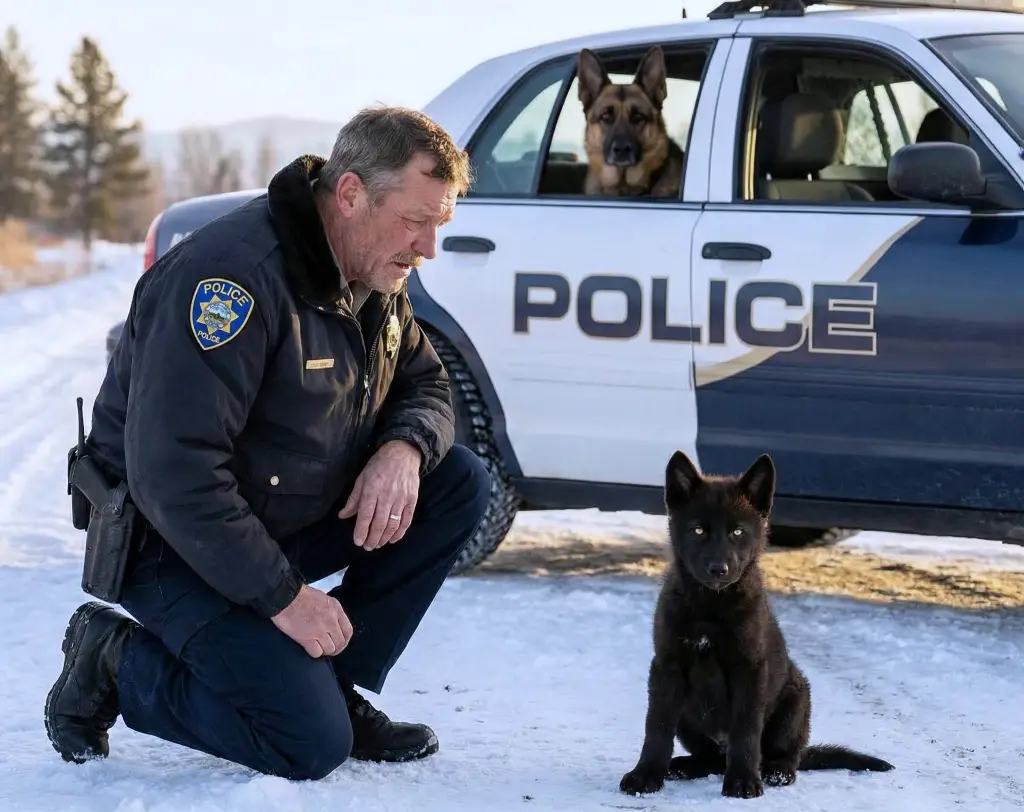
The morning sun hung low over the Montana mountains, painting the snow-covered landscape in shades of gold and amber. It was the kind of light that made everything feel sacred, the kind that turned ordinary moments into something worth remembering. Officer Thomas Reed had seen thousands of mornings like this one during his 28 years with the K-9 unit, but he had never learned to take them for granted.
Thomas guided his patrol car along the familiar dirt road that wound through the Bitterroot National Forest. The route was etched into his memory like the lines on his own hands. He knew every curve, every dip, and every place where the road narrowed between ancient pines.
He had driven this path at least a thousand times, maybe more. It was the kind of routine that could lull a man into complacency if he let it. But today, something was different.
Chief sensed it first. The eight-year-old German Shepherd sat in his usual position in the back seat, separated from Thomas by a metal grate. However, nothing could separate the bond they had built over nearly a decade of partnership.
Thomas had trained dozens of dogs in his career and had worked with some of the finest animals the department had ever seen. But Chief was different. Chief was not just a partner; he was family.
The dog began to shift restlessly, his dark brown eyes fixed on something ahead that Thomas could not yet see. A low whine escaped his throat, a sound Thomas had never heard from him before. In eight years, Chief had barked at suspects, growled at threats, and howled during the long nights of search operations, but he had never whined. Not once.
Thomas slowed the car, his instincts sharpening. After nearly three decades in law enforcement, he had learned to trust the signals that most people ignored. He felt the hair rising on the back of his neck and the subtle change in atmosphere that preceded something significant.
Most importantly, he trusted the behavior of his dog. That was when he saw it. A small black shape sat in the middle of the road, perhaps thirty yards ahead.
At first, Thomas thought it might be a rock, or perhaps a piece of debris blown in by the wind. But rocks did not move, and this shape was definitely moving. It was a pup—a wolf pup—no more than three months old, with fur as black as midnight and eyes that caught the morning light like chips of amber gold.
The pup was sitting in the exact center of the road, positioned as if it had chosen that spot with deliberate intention. It was not running, and it was not hiding. It was waiting.
Thomas brought the car to a complete stop and killed the engine. In the sudden silence, he could hear Chief’s breathing grow heavier, more urgent. The German Shepherd pressed his nose against the grate, his entire body trembling with an emotion Thomas could not quite identify.
Protocol was clear in situations like this. Wild animals, especially wolves, were to be reported to the Department of Fish, Wildlife, and Parks. Officers were not to approach, not to interact, and not to interfere with nature’s course.
Thomas had followed protocol his entire career. It was what made him good at his job. It was what had kept him alive. But protocol had never accounted for the look in that pup’s eyes.
Thomas opened his door slowly, keeping his movements deliberate and non-threatening. The cold air hit his face immediately, carrying the sharp scent of pine and snow. He stepped out onto the frozen road, his boots crunching against the thin layer of ice that covered everything.
The pup did not move. Behind him, Chief began to bark. It wasn’t the aggressive warning bark he used for suspects, nor the excited bark he used when tracking a scent. This was something else entirely.
It was almost pleading, as if the dog was trying to tell Thomas something that words could never express. Thomas approached slowly, covering the thirty yards in small, measured steps. With each step, he expected the pup to bolt.
That was what wild animals did. They sensed danger and they fled. It was the most basic survival instinct hardwired into their DNA over millions of years of evolution.
But this pup defied every expectation. When Thomas was ten feet away, he stopped. The pup watched him with those impossible golden eyes, and for a moment, neither of them moved.
The wind whispered through the pines. Somewhere in the distance, a bird called out. The world held its breath.
Then, the pup stood up. It was a small movement, just a shift from sitting to standing, but it carried the weight of intention. The pup took two steps toward Thomas, then stopped.
It looked at him, then turned its head toward the forest on the right side of the road. Then it looked back at Thomas. It was asking him to follow.
Thomas had seen dogs communicate with their handlers thousands of times. He had seen Chief indicate the presence of drugs, weapons, and missing persons with subtle shifts in body language that most people would never notice. But he had never seen a wild animal communicate so clearly, so deliberately, with a human being.
The pup began to walk toward the tree line, pausing every few steps to look back over its shoulder. Its message was unmistakable: Come with me. I need you to see something.
Thomas made a decision that violated every protocol he had ever followed. He returned to the car and opened the back door. Chief bounded out immediately, his training momentarily forgotten in the urgency of whatever he was sensing.
The German Shepherd did not chase the pup or show any sign of aggression. Instead, he fell into step beside Thomas, his body pressed against his partner’s leg in a gesture of solidarity. Together, the three of them entered the forest.
The pup led them through snow that reached Thomas’s knees in places, navigating between trees and over fallen logs with the sure-footed grace of an animal born to this environment. Thomas struggled to keep up, his 52-year-old body protesting the unexpected exertion, but he did not stop. He could not stop.
Something in the way the pup moved, the purpose in its small body, made stopping impossible. They walked for fifteen minutes, maybe more. Thomas lost track of time in the white silence of the forest.
The only sounds were his own labored breathing, Chief’s panting, and the soft crunch of snow beneath three sets of feet. Then, the pup stopped. They had reached a small clearing where a collection of large rocks formed a natural shelter.
The rocks were covered in moss and ice, creating a cave-like structure that was barely visible unless you knew exactly where to look. It was the kind of place that nature provided for its most vulnerable creatures, a refuge from the wind and the cold and the countless dangers of the wild. The pup sat down at the entrance of this shelter and looked at Thomas with those golden eyes.
Its message was clear: This is what I needed you to see.
Thomas approached the rocky shelter carefully, his heart pounding in his chest. He had a terrible feeling that he knew what he was going to find. Orphaned pups usually meant a dead mother nearby, killed by hunters, disease, or simply the cruel mathematics of survival.
But what he found inside the shelter was not what he expected. There was another pup. This one was also black, but smaller than the first—much smaller.
It lay curled in a tight ball in the deepest corner of the shelter, its fur dull and matted, its breathing shallow and rapid. Even from several feet away, Thomas could see the way its ribs protruded beneath its skin. This pup was starving. This pup was dying.
The first pup, the one who had been waiting on the road, walked past Thomas and curled up next to its sibling. It began to lick the smaller pup’s face with gentle, persistent strokes, as if trying to warm it back to life through sheer force of will. Thomas understood everything in that moment.
This pup had not been lost. It had not been abandoned. It had been waiting.
Every morning, it had walked to that road and sat in the middle of the frozen dirt, waiting for someone to pass by. Waiting for someone who could help. And every evening, when no one came, it had returned to this shelter to spend another night keeping its dying brother alive.
How many days had it done this? How many mornings had it walked to that road full of hope, only to return at sunset with that hope diminishing? Thomas did not know. But he knew that today, finally, the waiting had ended.
Chief moved before Thomas could react. The German Shepherd walked into the shelter and lay down beside the two wolf pups, positioning his body to provide warmth. The smaller pup, who should have been terrified of this much larger predator, instead pressed itself against Chief’s fur with a shuddering sigh of relief.
It was as if it understood, on some instinctive level, that this dog meant safety. Thomas watched this scene unfold and felt something crack open in his chest. It was a feeling he had been running from for three years.
It was a feeling he had buried so deep that he thought it could never surface again. But here, in this frozen forest, watching a German Shepherd protect two orphaned wolves, the feeling rose up like a wave and threatened to drown him. He thought about Kevin.
His younger brother had been the weak one in their family, though Thomas would never have used that word out loud. Kevin was sensitive where Thomas was tough, uncertain where Thomas was confident. Kevin had always needed protection, and Thomas had always provided it.
That was their dynamic. That was who they were. Until three years ago.
Kevin had called on a Thursday night, his voice carrying that particular tone that Thomas had learned to recognize over forty years of brotherhood. Something was wrong. Kevin needed to talk.
But Thomas was in the middle of a major operation, coordinating search teams across three counties. He told Kevin he would call back. He never did.
Two weeks later, Kevin was dead. It was a heart attack, alone in his apartment. The doctor said that if someone had been with him, if someone had called for help immediately, he would have survived.
But no one was there. No one was ever there. Thomas had not spoken about this to anyone.
Not to his ex-wife, not to his colleagues, not even to Chief. He had simply absorbed the guilt like a sponge absorbing water, letting it saturate every fiber of his being until it became indistinguishable from who he was. He was the man who had not returned his brother’s call.