


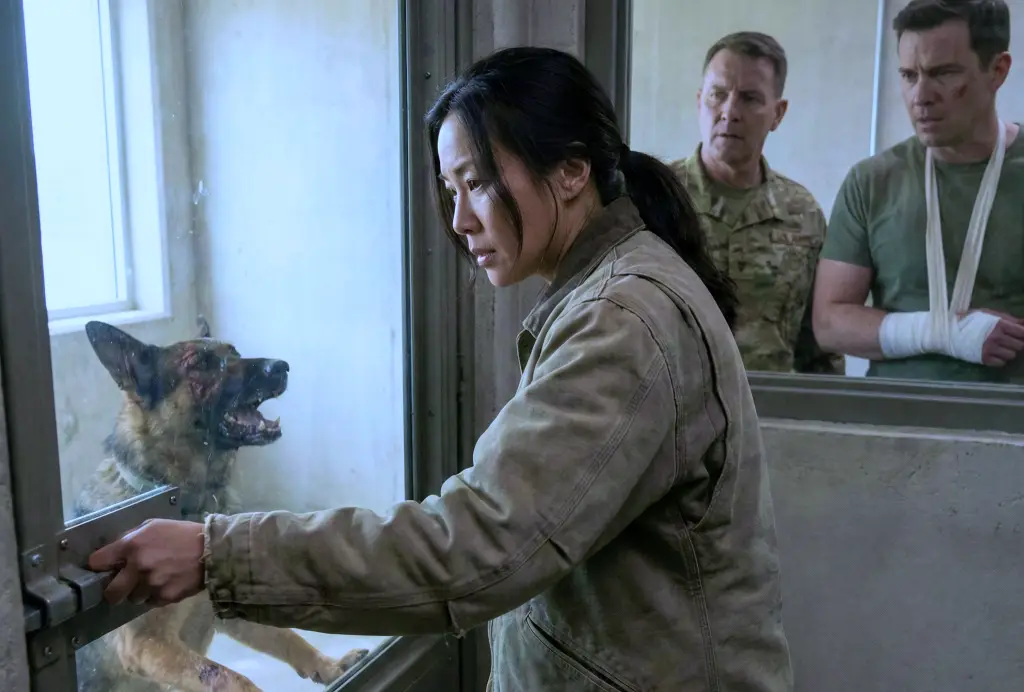
What you’re about to read happened at a military base in front of hundreds of witnesses. A decorated combat dog, trained for classified missions, had become so dangerous that professional handlers couldn’t control him. The decision was made: he would be euthanized the next morning.
But then, a woman no one recognized stepped forward and did something that should have been impossible. What happened when she entered that kennel would reveal a secret the military tried to bury.
Fort Bridger, a military working dog facility, sat under a relentless June sun. It was the kind of heat that turned asphalt soft and made the air shimmer above the parade grounds. American flags snapped in the hot breeze as families arrived through the main gates.
Children pressed their faces against chain-link fences to catch glimpses of the dogs they’d come to see. This was Demonstration Day, an event held twice yearly. It was a chance for the public to witness the precision and power of America’s military K-9 units.
Picnic blankets were spread across manicured lawns. Phone cameras rose in anticipation. Everything looked perfect. Major Cordell Haskins stood at the podium in his dress uniform, every crease sharp enough to cut paper.
His smile was practiced, his voice amplified through speakers that carried across the grounds.
«Today, you’ll witness the finest working dogs in the United States military,» he announced to polite applause. «Each one is a highly trained specialist, worth hundreds of thousands of dollars in training and experience.»
Behind him, handlers stood in perfect formation with their dogs. Malinois and German Shepherds, all groomed and disciplined, sat at attention while the crowd murmured appreciation. But in the back kennels, away from the cameras, the smiling families, and the carefully choreographed displays, something was very wrong.
The sound came first. A low, guttural growl that seemed to vibrate through concrete walls. Then came the sound of metal rattling, violent and rhythmic. Then, a man’s sharp curse, quickly stifled.
Staff Sergeant Brecken Lowell pressed his back against the kennel wall, breathing hard. A fresh scratch bled down his forearm. He’d been handling military working dogs for fifteen years. He knew aggression.
He knew the fear response. He knew the difference between a dog having a bad day and a dog that had fundamentally broken. Razor was broken.
The massive German Shepherd paced his kennel with the focused intensity of a predator, not a companion. His coat bore the scars of three combat tours. One ear had a notch taken out of it, probably from shrapnel.
His eyes were amber and wild, tracking every movement outside his cage with an intelligence that somehow made him more frightening, not less. A metal plate on the kennel door read his designation in block letters: RAZOR – R.C.V.D. 2023 – COMBAT OPS – HIGH RISK.
Lieutenant Yannis Obel approached with two other handlers. His face was set in the expression of a man who’d run out of options. He was the facility’s chief canine officer, responsible for every dog on the base, and Razor had become his greatest failure.
«The demonstration starts in ten minutes,» he said quietly. «He’s supposed to be out there.»
«He’s a decorated combat dog,» Yannis continued. «The families want to see a hero.»
«He’s not a hero anymore,» Brecken replied, pressing a gauze pad against his arm. «He’s a liability. That’s the third handler this month.»
They had tried everything. Behavioral specialists. Modified training protocols. Medication. Nothing worked.
Razor had served his country with distinction, earned a Canine Medal of Courage, and completed missions in places the public would never hear about. But something had shattered inside him. He refused commands. He lunged at handlers.
He wouldn’t eat unless his food bowl was placed inside his kennel by a long pole. The last time someone tried to leash him for a routine medical exam, he’d bitten through a leather glove and nearly broken the handler’s wrist.
«We have to try,» Yannis said. «One more time. For the optics, if nothing else.»
Brecken looked at the lieutenant like he’d suggested walking into a minefield. «You’re not serious.»
«I am. We muzzle him. We get him out there. We show the crowd that even our most challenging cases receive care and attention. Then we bring him back, and tomorrow, we do what needs to be done.»
The words hung in the air, unspoken but understood. Tomorrow, Razor would be euthanized. The paperwork was already drafted. The decision was final.
This demonstration would be his last public appearance, though the crowd wouldn’t know it. They’d just see a dog that looked dangerous, reinforcing whatever fears they already had about military animals being too aggressive for civilian life.
It took all three handlers and a catchpole to get Razor muzzled and moving. He fought every step, paws scraping against concrete, muscles coiled tight under his scarred coat. His eyes never stopped scanning, searching for something none of them could identify.
When they finally got him outside, the sunlight seemed to make him worse. His head swung left and right, nostrils flaring, his entire body tense as a loaded spring. Major Haskins’ voice boomed across the demonstration ring.
«And now, one of our most distinguished veterans. Razor, recipient of the K-9 Medal of Courage, served three tours in classified operations and represents the highest level of training our program can achieve.»
The crowd leaned forward as Razor entered the ring. Then they went very quiet. This was not what they had expected to see.
This was not a proud military dog demonstrating obedience and skill. This was something closer to a caged predator finally given room to hunt. Razor’s head stayed low, his gaze sweeping the crowd in a pattern that looked deliberate and methodical.
When Brecken tried to guide him through a basic heel command, Razor didn’t even acknowledge him. The handler might as well have been invisible.
«Razor, sit,» Brecken commanded, his voice cracking slightly.
The dog ignored him completely. A child in the front row pointed.
«Mommy, why won’t he listen?»
Yannis stepped into the ring, attempting to take control. He’d handled hundreds of dogs in his career. He knew how to project authority, how to read K-9 body language, and how to redirect unwanted behavior.
But when he approached Razor, the dog’s lips curled back behind the muzzle. A sound emerged from his throat that made several people in the crowd step backward. Then, Razor lunged at the perimeter fence.
He didn’t lunge at a person specifically, just toward the crowd in general, testing the barrier. Families stumbled over each other, trying to create distance. A woman screamed. A toddler started crying.
The carefully orchestrated demonstration dissolved into chaos in seconds.
«Clear the ring,» Major Haskins ordered, his practiced smile finally cracking. «Now.»
Handlers moved in from all sides, using catchpoles and commands that Razor continued to ignore. They managed to drag him back toward the kennels while the crowd whispered among themselves.
«That dog’s dangerous.»
«Why would they even bring him out?»
«He should be put down.»
The murmurs followed Razor all the way off the field, a chorus of judgment from people who had no idea what he’d done for them, or what he’d sacrificed in places they’d never see.
In the back row of the observation bleachers, far from the families and their picnic blankets, a woman sat alone. She wore cargo pants and weathered hiking boots despite the heat. A canvas jacket that looked like military surplus, but bore no insignia, hung on her shoulders.
Her hair was pulled back in a simple ponytail. No makeup. No jewelry. She didn’t look like she belonged at a family-friendly demonstration, but she also didn’t look like she was military.
She existed in some undefined space between worlds. She’d been watching Razor with an expression that was difficult to read. Not fear. Not pity.
Something closer to recognition, though that seemed impossible. Her hand rested on her knee, fingers tapping in a deliberate rhythm.
Tap. Tap. Pause. Tap.
Tap. Tap. Pause. Tap.
Over and over, like she was counting something or sending a message in a code only she knew. When the handlers dragged Razor past her section, something changed. His head jerked in her direction mid-struggle.
For just a second, maybe two, his thrashing stopped. His nostrils flared wide. His eyes locked onto her position in the bleachers with a focus he hadn’t shown anyone else.
Then the handlers yanked him around the corner and he was gone, back toward the kennels and his concrete cell. The woman stood slowly while everyone else headed toward the exits, processing what they had witnessed and discussing whether the demonstration should continue.
She walked in the opposite direction, toward the restricted area, toward the kennels. Security didn’t stop her. Nobody seemed to notice her at all.
Thirty minutes later, the argument was well underway in the observation room outside Kennel Seven. Razor had been locked down, muzzled, still shaking with adrenaline from the demonstration. Through the reinforced glass, they could see him pacing tight circles, never settling.
Outside, Yannis and Brecken stood with Major Haskins and Dr. Imani Sutter, a behavioral psychologist who’d been contracted to evaluate problematic cases. Dr. Sutter held a tablet, scrolling through notes and data points with the detached efficiency of someone who’d made this kind of recommendation before.
«He’s beyond rehabilitation,» she said. «Textbook case of severe PTSD, handler separation anxiety, and possible neurological damage from blast exposure. The aggression patterns are escalating.»
«The refusal to respond to any handler suggests a complete breakdown in training foundation,» she added.
«So, what are you recommending?» Major Haskins asked, though his tone suggested he already knew.
A pause, just long enough to feel heavy.
«Humane euthanasia, before someone gets seriously hurt.»
Brecken turned away, suddenly very interested in the floor. Even Yannis, usually rigid in his commitment to protocol, shifted his weight uncomfortably. They had all known this was coming.
They’d discussed it in private, run through the options, and consulted the manuals. But hearing it spoken aloud made it real in a way that paperwork never could.
«Give me two more weeks,» Yannis tried, though his voice lacked conviction.
«You’ve had three months, Lieutenant,» Haskins said quietly. «We’ve tried everything. Six different handlers, four training protocols, medication, environmental modifications.»
«No handler can control him,» Haskins concluded. «He’s a danger to personnel and a liability to this facility. Tomorrow morning, I’m signing the paperwork.»
The words settled over the room like dust. Razor would be euthanized at 0800 the next day. A decorated combat veteran, a dog who’d saved lives in operations no one was allowed to discuss, would be put down in the same facility that was supposed to care for him.
Because he’d become inconvenient. Because he wouldn’t cooperate. Because the system had no room for broken things, even when the system was what broke them.
«I can control him.»
The voice came from behind them, quiet but absolutely certain. Everyone turned. The woman from the bleachers stood in the doorway.
She had her hands in her jacket pockets. Her posture was relaxed, her expression calm. She didn’t look nervous or hesitant. She looked like someone stating a simple fact.
«Ma’am, this is a restricted area,» Yannis started, his hand moving toward his radio. «You need to leave immediately.»
«I can control him,» she repeated, softer this time. Her eyes were on Razor through the glass, not on the men trying to establish authority. «Let me try.»
Brecken almost laughed. «Lady, no offense, but we’ve had professional handlers try. Handlers with fifteen, twenty years of experience. This dog has attacked three separate people in the last month.»
«He doesn’t respond to commands,» Brecken added. «He doesn’t respond to positive reinforcement. He barely acknowledges that humans exist.»
The woman finally looked at them. «Is that what you think? That he doesn’t acknowledge humans?»
She tilted her head slightly. «He acknowledges you just fine. He’s chosen not to obey you. There’s a difference.»
«Excuse me?» Haskins stepped forward, his command presence filling the small room.
«Razor,» she said, still not moving from the doorway. «Serial designation MWD-447. Trained at Lackland Air Force Base in 2019. Deployed March 2020.»
«Specialized in explosives detection, high-value target location, and personal protection for Tier One operators,» she recited the information like reading from a file she’d memorized. «He’s been separated from his primary handler for two years, four months. That’s why he won’t respond to anyone.»
«How do you possibly know that?» Dr. Sutter’s fingers had stopped scrolling. Her professional detachment cracked just enough to show genuine surprise.
The woman didn’t answer. She was already walking toward the kennel door. Yannis moved to block her path.
But something about the way she held eye contact made his hand drop from his radio. There was no challenge in her gaze. No aggression.
But there was something that made him hesitate. A quality he’d seen before in operators who’d spent too much time downrange. A kind of quiet certainty that came from places most people never had to go.
«Five minutes,» she said. «If I can’t calm him in five minutes, you can remove me and proceed with your plan.»
«This is insane,» Dr. Sutter muttered.
Major Haskins studied the woman for a long moment. Something about her bearing gave him pause. The way she stood. The economy of her movements.
She didn’t carry herself like a civilian, but she wasn’t wearing a uniform. She had no visible rank. No identification. No authorization to be in this area at all.