


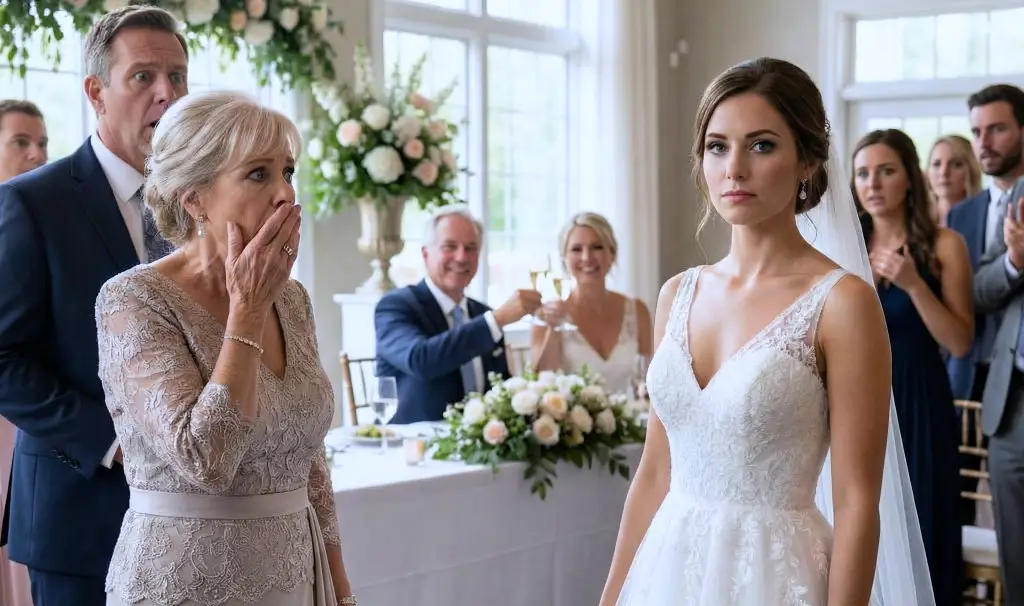
My name is Tori Thatcher, and I’m 32 years old. Five years ago, my mother called me three days before Thanksgiving and said seven words that shattered everything I thought I knew about family.
«Don’t come home this year. Victoria doesn’t want drama.»
No explanation, no apology, just a door slammed shut on 27 years of trying to belong. I spent that Thanksgiving alone at a restaurant in Boston, watching happy families laugh together while I fought back tears over a cold turkey dinner. I had no idea that the strangers at the next table would become the family I’d always dreamed of.
I had no idea that five years later, they’d be introduced at my wedding as the parents of the bride. Meanwhile, my biological parents stood watching uninvited, realizing they’d been replaced in every way that matters.
Let me take you back to the phone call that changed everything. I remember exactly where I was standing when my phone rang. It was November 21st, three days before Thanksgiving.
I was in my tiny studio apartment in Boston, surrounded by half-packed bags and the scent of the pumpkin candle I’d lit to get myself in the holiday spirit. I’d already bought my plane ticket home to Connecticut. Non-refundable, of course.
Mom’s name flashed on my screen. I smiled and picked up. «Hey, Mom. I was just about to—»
«Tori.» Her voice was flat, cold. «I need to tell you something.»
My stomach dropped. That tone never meant anything good. «What’s wrong? Is Dad okay?»
«Your father’s fine.» A pause. «Listen. I’ve been thinking, and… don’t come home this year.»
I actually laughed. I thought she was joking. «What do you mean?»
«Victoria doesn’t want drama. She’s pregnant again, and she doesn’t need the stress.»
I gripped the phone tighter. «Drama? What drama? I haven’t even talked to Victoria in months.»
«Exactly,» Mom’s voice hardened. «And let’s keep it that way.»
«You know how you get,» she continued.
«How I get?» My voice cracked. «Mom, I literally just asked her last year why she didn’t invite me to her baby shower.»
«That’s not drama. That’s a question.»
«See? That’s exactly what I mean. You always make everything about you.»
I stood there, frozen, watching the snow fall outside my window. Twenty-seven years old, and my mother was telling me I wasn’t welcome at Thanksgiving because I’d once asked why I was excluded.
«Mom, I already bought my ticket.»
«Then get a refund.» Her tone left no room for negotiation. «Victoria is pregnant. She doesn’t need stress. You understand?»
The line went dead. I understood perfectly. I’d always been the acceptable sacrifice. I wish I could say this was the first time, but as I sat on the edge of my bed staring at my useless plane ticket, the memories came flooding back like a highlight reel of disappointment.
Take my sixteenth birthday party, for example. I’d been planning it for months—a small gathering with my three closest friends. Mom promised we’d have cake and go bowling.
But the morning of, Victoria called crying because she’d failed her calculus final and needed emotional support. My party was cancelled. We spent the day consoling my sister instead.
«Don’t be dramatic, Tori. Your sister needs us more right now. You can celebrate next weekend.»
We never did. Then there was my college graduation. I’d worked so hard for that moment, enduring four years of late nights, part-time jobs, and scraping by on ramen.
I was the first person in my family to graduate with honors. When I walked across that stage, I looked for my parents in the crowd. Their seats were empty.
They showed up two hours late. Victoria had a routine prenatal checkup that couldn’t be rescheduled.
«You understand, sweetheart. Your sister’s baby is more important than a ceremony.»
More important than me. That’s what she meant. That’s what she always meant. I learned early that complaining only made things worse.
«Don’t be so sensitive. Stop making everything about yourself. Why can’t you just be happy for your sister?»
So I stopped complaining. I became smaller, quieter. I thought if I was agreeable enough, easy enough, invisible enough, maybe then I’d finally earn their love.
I was 27 years old, sitting in a cold apartment with a worthless plane ticket, and I finally realized the truth. There was no amount of «small» that would ever be small enough.
I called my father. I don’t know what I expected. Maybe some small part of me still believed he’d stand up for me just this once. The phone rang four times before he answered.
«Hey, kiddo.» His voice was cautious. He already knew.
«Dad, did Mom tell you?»
A long pause. I could hear the TV in the background, probably a football game. «She mentioned it.»
«And you’re okay with this? You don’t think maybe I should be allowed at Thanksgiving with my own family?»
Another pause. Longer this time. «You know how your mother is, Tori. She’s just trying to keep the peace.»
«By excluding me?»
«It’s not like that.»
«Then what is it like, Dad? Tell me. Because from where I’m standing, it looks like you’re all choosing Victoria over me. Again.»
Silence. I could hear him breathing. I could almost see him sitting in his recliner, rubbing his forehead the way he always did when he wanted to disappear from a conversation.
«Dad, do you want me there?»
Five seconds passed. Ten.
«I think…» He cleared his throat. «I think it’s better if you listen to your mother this year.»
Something inside me went quiet. Not sad. Not angry. Just… empty.
«Okay, Dad.»
«Tori, don’t be like…»
«I said, okay.»
I hung up. He didn’t call back. I sat in my apartment as the sun went down, watching the shadows stretch across my floor. My father had a chance to choose me, to say one word in my defense, and he chose silence instead.
He was always in the middle, I realized. He just always chose to stand on their side. But as the darkness settled in, something else settled too. A quiet decision. If I wasn’t welcome at their table, I’d make my own.
Thanksgiving Day arrived gray and cold. I woke up in my studio apartment to the sound of my neighbor’s family arriving. Footsteps overhead, children laughing, the muffled warmth of voices I couldn’t make out.
The smell of something delicious drifted through the vents. Someone was making stuffing. I made instant coffee and sat by the window, watching the snow fall on the empty street below.
My phone stayed silent all morning. No calls. No texts. Not even a «Happy Thanksgiving» from anyone in my family.
Around noon, I made the mistake of opening Instagram. Victoria had posted a photo. The whole family was around the dining table: Mom, Dad, Victoria, her husband Brad, and their two-year-old son in a tiny turkey sweater. Everyone was smiling.
The caption read: So grateful for my family. These are the people who matter most.
I zoomed in on the photo and counted the place settings. Four adults. One toddler. Five chairs.
There wasn’t even an empty seat where I should have been. They hadn’t just excluded me; they’d erased me. It was like I’d never existed at all.
I closed the app and stared at the ceiling. I thought about ordering delivery and spending the day in bed. That’s what I deserved, right? A sad meal alone in my dark apartment, feeling sorry for myself. That’s what the «dramatic daughter» gets.
But something in me refused. No. I wasn’t going to sit here and let them win. I wasn’t going to let their rejection turn me into exactly what they accused me of being: a sad, bitter, dramatic mess.
I grabbed my coat. If I was going to eat Thanksgiving dinner alone, I was going to do it somewhere with actual food. With light. With life. I just had to find a restaurant that was still open.
Harborview Grill was one of those old Boston institutions. Dark wood, brass fixtures, the kind of place that still had cloth napkins and candles on every table. More importantly, it was one of the few restaurants in the city that stayed open on Thanksgiving.
When I pushed through the door, the warmth hit me like a wave. The smell of roasted turkey and fresh bread filled the air, along with the soft clink of glasses. And everywhere, there were families.
Couples with grandparents. Parents with children. Groups of friends who laughed like they’d known each other forever. The restaurant hummed with the sound of people who belonged somewhere.
The hostess looked at me with barely concealed pity. «Just one tonight?»
«Just one.»
She led me to a tiny two-top in the corner, squeezed between the kitchen door and a large family that took up three tables pushed together. I could have touched their chairs if I reached out.
«Your server will be right with you.»
I sat down, opened the menu, and tried to look like this was a choice. The family next to me was celebrating hard. There was an older couple at the head of the table, probably in their late sixties, a middle-aged man with his wife and two kids, and a younger man around thirty who kept making everyone laugh.
Three generations. Easy. They passed dishes back and forth without asking. They interrupted each other in the way that only people who truly love each other can.
I watched them out of the corner of my eye and felt something crack open in my chest. This is what family is supposed to look like.
The server arrived with a bread basket and a tight smile. «The Thanksgiving special?»
«Please.»
I was going to get through this dinner. I was going to be fine.
I wasn’t fine. My turkey arrived—golden skin, cranberry sauce, a perfect scoop of mashed potatoes. It looked like a magazine photo, but I couldn’t taste any of it.
I sat there pushing food around my plate, trying not to look at the family beside me. Trying not to think about my own family gathered around their table in Connecticut, laughing and passing the gravy without a single thought about the daughter they’d discarded.
Suddenly, I understood something I’d been avoiding for 27 years. This wasn’t about Thanksgiving. This wasn’t about Victoria’s pregnancy or Mom’s need for peace. This was about a pattern so deep it had shaped my entire life.
I had spent 27 years trying to earn a place at their table, bending myself into smaller and smaller shapes. Swallowing my hurt, apologizing for having feelings, staying quiet when I should have spoken, speaking up only to be told I was too much.