


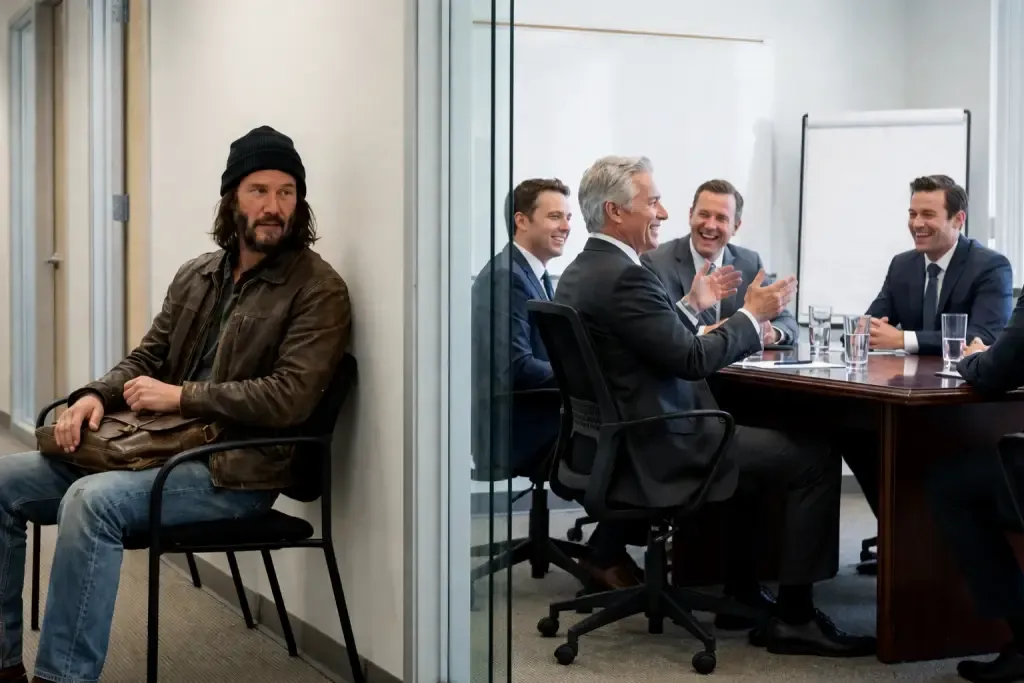
Keanu Reeves walked into his own company and was told to wait in the hallway like a delivery man. The executives inside were laughing, drinking whiskey, completely unaware that the man in the worn leather jacket owned 50.3% of everything around them. They looked at his faded jeans and old sneakers and decided he was nobody worth acknowledging.
Seven minutes later, Keanu stepped into that boardroom. He didn’t come to talk. He came to fire every single one of them.
But what he discovered next was far worse than disrespect. They weren’t just arrogant. They were planning to destroy everything he had built.
What most people did not know about Keanu Reeves was that beyond his acting career, he had quietly built something significant. Six years ago, he had co-founded Meridian Studios, an independent film company in Los Angeles dedicated to telling meaningful stories. He owned 50.3% of the company, making him the majority shareholder.
But unlike most investors who demanded constant attention, Keanu had chosen to remain in the shadows. In all official documents, he was listed simply as K. Reeves. Most employees had never met him or even seen his face in connection with the company.
For six years, Keanu had stepped back from daily operations, dedicating his time to charitable causes around the world. He had trusted his executives to maintain the values he had built into Meridian Studios. He communicated through emails and occasional video calls, always with his camera off, preferring to listen rather than be seen.
Perhaps that had been his mistake. On this particular Tuesday morning, Keanu decided to visit the company headquarters without any announcement. He wanted to see how things were truly running, to feel the real pulse of the organization rather than the polished reports that landed in his inbox every quarter.
He did not call ahead. He did not arrange for anyone to meet him. He simply showed up, the way any owner might check on something they genuinely cared about.
The Meridian Studios building rose 12 stories into the Los Angeles sky, all glass and steel and modern ambition. The lobby was a cathedral of corporate success, with polished marble floors that reflected the morning light and abstract art pieces that cost more than most people earned in a year.
Everything about the space was designed to impress, to intimidate, to remind visitors that they were entering a place of power and importance. Keanu walked through the gleaming entrance dressed exactly as he always was in his private life: a brown leather jacket softened by years of wear.
It was the kind of jacket that told stories if you looked closely enough. He wore faded jeans that fit comfortably rather than fashionably, and simple sneakers that had walked countless miles.
A dark beanie was pulled low over his hair, partly for warmth, partly out of habit. His beard was fuller than usual, adding to an appearance that was deliberately unremarkable. Over his shoulder hung an old leather satchel, worn at the edges and modest in appearance.
Most people would assume it contained nothing of importance. They would be wrong. He looked like someone who might work at a bookstore or teach guitar lessons on weekends.
He looked like a man who fixed motorcycles in his spare time or volunteered at animal shelters. He certainly did not look like a man who controlled a major film studio worth hundreds of millions of dollars. And that, of course, was exactly the point.
The young receptionist glanced up as he approached the front desk. Her name tag read Emily, and she had joined Meridian Studios only four months ago. Fresh from a communications degree and eager to climb the entertainment industry ladder, she had been trained to handle the constant flow of people who passed through these doors.
Agents with their confident smiles, actors with their desperate hope masked as casual interest, directors with their artistic intensity, writers clutching scripts like lottery tickets—she had learned quickly that in this business, everyone believed they were special. Her job was to sort the truly important from the merely hopeful. And she had developed a keen eye for the difference.
She looked at the man standing before her. There was something familiar about his face, even half-hidden beneath that beanie, and those kind eyes. That quiet way of standing, as if he had no need to take up more space than necessary.
Recognition flickered across her mind like a half-remembered song. Keanu Reeves, the actor. She had seen his movies when she was younger.
Her father had loved those action films, the ones where Keanu moved through impossible situations with calm determination. But that was years ago, was it not? A different era entirely. Her initial spark of interest faded quickly into professional assessment.
She saw celebrities regularly. This was a film studio, after all. Just last week, she had directed a famous director to the third floor without so much as a flutter in her pulse.
She was beyond being starstruck. And besides, she thought, studying him with the cool evaluation she had perfected, when was the last time Keanu Reeves had been in anything significant? She could not remember seeing his name attached to any recent project.
No buzz on social media. No premieres covered by entertainment news. He had faded from the spotlight the way so many actors did once their moment passed.
Looking at his worn jacket, his old bag, and the beanie that seemed almost out of place in this temple of polished success, Emily felt her assumption solidify into certainty. This was not a man at the height of his career. This was someone on the decline, probably here hoping to charm his way into a meeting, maybe secure a small role in one of their upcoming productions.
She had seen it before. Former stars who could not accept that their time had ended, wandering into studios with hopeful smiles and outdated headshots. It was sad, really, but it was not her job to be sentimental.
She arranged her face into that particular expression of polite dismissal, the one that conveyed helpfulness while communicating clearly that the person before her was not particularly important.
«Can I help you?» she asked, her tone efficient and cool.
«I’m here to see the executive team,» Keanu said quietly.
His voice was soft, unhurried, carrying none of the demanding energy she usually heard from industry people trying to project importance.
«Do you have an appointment?»
«No, I don’t.»
Emily almost allowed herself a small laugh. No appointment, dressed like that, expecting to walk in and see the executives. This was exactly the kind of optimistic delusion she encountered every week.
«I’m sorry,» she said, her voice taking on that practiced tone of false sympathy. «But the executive team is in a very important strategic meeting right now. They absolutely cannot be disturbed. These sessions are critical to the company’s direction.»
She paused, letting the weight of those words settle. Critical, direction—words designed to remind him of his place in the hierarchy of importance.
«You’re welcome to wait over there,» she continued, gesturing vaguely toward a row of simple chairs along the hallway wall.
They were positioned away from the main traffic flow, out of sight from the important areas. The kind of seating reserved for delivery people, maintenance workers, and visitors who did not quite belong.
«But honestly,» she added, lowering her voice as if sharing a helpful secret, «it could be a very long wait. These meetings sometimes go on for hours. You might want to come back another time, or perhaps call ahead to schedule something proper.»
Keanu looked at her for a moment, his expression unreadable. Then he simply nodded.
«I’ll wait,» he said.
He walked to the chairs she had indicated and sat down, his old satchel resting on his lap. He did not argue, he did not protest. He did not pull out a business card, drop names, or demand to speak with someone in charge. He simply accepted the seat he had been assigned, like a man who understood that some lessons could only be learned through observation.
Emily watched him go, then turned back to her computer with a small shake of her head. Just another hopeful who would eventually realize he was wasting his time and leave. She had already forgotten him.
Minutes passed. The lobby hummed with the busy energy of a successful enterprise. Well-dressed men and women walked past in purposeful strides, their expensive shoes clicking rhythmically on the marble floor.
They carried tablets and phones and the unmistakable air of people who believed their work truly mattered. None of them glanced at the man in the worn jacket sitting quietly by the wall.
A group of young executives hurried past, discussing market projections in loud, confident voices. They did not notice him.
A woman in designer heels walked by, speaking rapidly into her phone about a talent negotiation. She did not see him.
An older gentleman in a perfectly tailored suit strode toward the elevator, checking his Rolex. He did not acknowledge the quiet figure in the waiting area.
Keanu watched them all. He noted the expensive watches, the designer bags, the carefully cultivated images of success. He remembered when Meridian Studios had been different, when he had walked these halls himself in the early days, talking to everyone from the creative directors to the cleaning staff.
He had insisted on a culture where ideas mattered more than appearances, where every person was treated with dignity regardless of their title or their wardrobe. What he was seeing now was something else entirely.
About five minutes into his wait, a young man emerged from a side corridor. His name was Brantley Shaw, and he had recently been promoted to junior executive.
It was a modest title in the grand hierarchy, but Brantley wore it like a crown bestowed by royalty. His suit was expensive and slightly too tight, chosen for its Italian label rather than its fit. On his wrist gleamed a Rolex that had cost him three months of salary, a purchase he considered an essential investment in his professional image.
Brantley walked with the confident stride of someone who believed the universe was arranging itself for his inevitable success. He was heading to the water cooler when he noticed the man sitting in the waiting area.
He recognized the face immediately. Even with the beanie and the fuller beard, there was no mistaking those features. Keanu Reeves, the action star from those old movies that played on cable television late at night.
But instead of respect or even curiosity, Brantley felt only a warm surge of superiority. He had heard the whispers in industry circles. Keanu Reeves had gone quiet—no major projects in years, no presence at the important parties, no mentions in the trades.
He was yesterday’s headline, a name that belonged to a different chapter of Hollywood history. And just look at how he was dressed.
Brantley’s eyes swept over the worn leather jacket, the faded jeans, the old bag, and the beanie that looked like it had been purchased at a thrift store. This was not how successful people presented themselves. This was how people looked when they had given up, when they were desperate, when they had nothing left but hope and a familiar face.
Brantley smirked to himself. This was probably some washed-up celebrity hoping to leverage past fame into a present opportunity. Maybe he was here to audition for a supporting role, or worse, to beg for any part at all.