


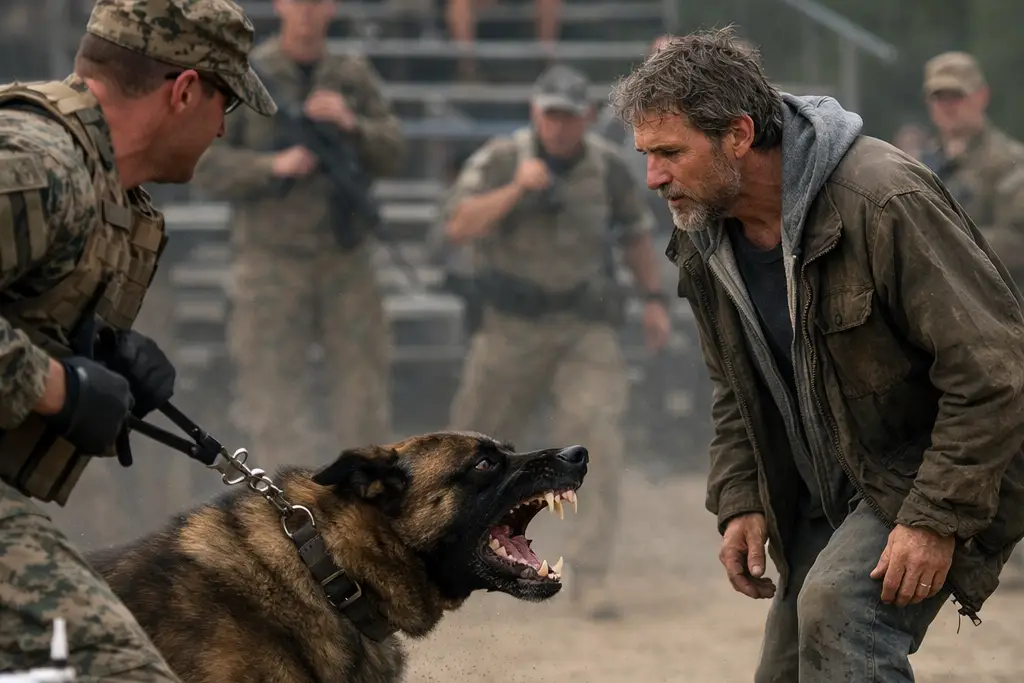
Staff Sergeant Derek Pullman gripped the reinforced leash with both hands. The Belgian Malinois on the other end lunged forward, eighty pounds of muscle and rage straining against the metal muzzle. Ajax.
Four years old. Rescued from a conflict zone eight months ago. Three handlers attacked, eighteen stitches, zero progress.
«This is Ajax’s final evaluation,» Pullman announced into the microphone, his voice carrying across the Camp Lejeune training field. Families and veterans watched from metal bleachers.
«If he can’t be controlled today, he’ll be humanely euthanized this evening,» the crowd murmured. Parents pulled children closer.
Then, a man in a torn jacket stood up in the third row, boots held together with duct tape. Amber eyes that hadn’t focused on anything in months suddenly locked onto the dog.
Cole Reeves stepped over the fence and walked onto the field. And everything changed.
Three weeks earlier, the rain had started at 2:00 AM under the Jefferson Bridge. It wasn’t the light kind. It was the kind that soaked through four layers of clothing and turned cardboard into mush.
Cole Reeves pulled his military backpack closer, protecting three items: a K-9 training manual from 2008, a photo of him with a German Shepherd named Titan, and an ultrasonic whistle no one else remembered how to use.
Miguel Torres, 62, a former army medic, sat across from him, wringing water from his wool cap. «You know what day it is tomorrow?» Miguel asked.
Cole didn’t answer. He rarely spoke anymore.
«Big demonstration at Lejeune,» Miguel continued. «K-9 program. Free meals for vets who show up.»
Cole’s eyes flicked toward Miguel, then back to the rain.
Miguel grinned, showing three missing teeth. «Knew that’d get your attention. When’s the last time you had a hot meal that wasn’t from a dumpster?»
Cole’s stomach answered for him.
«Come on, Nomad,» Miguel said. «One meal, that’s all.»
The name hit Cole like shrapnel. Nomad. His call sign. He hadn’t heard it in four years. Not since the day he’d walked out of the VA hospital and decided he didn’t deserve to be called anything at all.
But hunger made decisions easier. The next morning, they shuffled through the veteran entrance at Camp Lejeune. A young Marine barely glanced at their DD-214 discharge papers before waving them through.
The base smelled like diesel fuel and cut grass. Families carried folding chairs toward the outdoor arena. Children ran ahead, excited. Cole and Miguel found seats in the bleachers with other veterans.
A woman in a volunteer vest handed them Styrofoam containers: meatloaf, mashed potatoes, green beans. Cole ate slowly, methodically, the way you eat when you don’t know when the next meal is coming.
The mechanical process of chewing, swallowing, not tasting, just fueling. Then a voice crackled over the speakers.
«Ladies and gentlemen, thank you for joining us today. I’m Staff Sergeant Derek Pullman, head instructor of the K-9 program here at Camp Lejeune.»
Cole looked up. Pullman was young, maybe thirty-four, with a clean uniform and a confident stride—the kind of man who’d never failed at anything important.
«Today we’re going to discuss something difficult,» Pullman continued, pacing the center of the arena. «We’re going to talk about the reality that not every military working dog can transition back to normal operations.»
A handler led a Belgian Malinois into the arena. The dog was muzzled, restrained by a leash that looked like it belonged on a wild animal. The dog pulled forward with enough force to drag the handler sideways.
«This is Ajax,» Pullman said, his voice somber. «He’s a combat veteran, just like many of you here today. He served in a special operations unit overseas.»
«He saved lives. But eight months ago, he was extracted from a hostile zone and brought stateside for rehabilitation.»
The dog lunged again. The handler stumbled.
«Since his arrival, Ajax has attacked three qualified handlers,» Pullman explained. «The most recent incident required stitches and resulted in permanent nerve damage to the handler’s left hand.»
The crowd shifted uncomfortably.
«We’ve exhausted every modern rehabilitation protocol,» Pullman continued. «Behavioral conditioning with certified animal psychologists, desensitization therapy, pharmacological intervention. Nothing has produced results.»
«Today is Ajax’s final evaluation. If we cannot establish safe control, he will be humanely euthanized at 1700 hours.»
Cole’s hands tightened around the Styrofoam container. It cracked slightly.
Miguel leaned close. «That’s messed up. Dog probably just needs someone who understands.»
But Cole wasn’t listening. He was watching Ajax. The way the dog’s ears rotated independently, scanning for sounds. The way his weight shifted before each lunge.
Not aggression, but calculation. The way his eyes fixed not on Pullman, but on the horizon beyond him, as if searching for something that no longer existed.
Cole had seen that look before. In mirrors. In puddles. In the reflection of storefront windows he passed on the street.
Pullman handed the microphone to an assistant and approached Ajax. He knelt carefully, extending a gloved hand.
«Easy boy. Easy now.»
Ajax’s body coiled. Then exploded forward. The muzzle clanged against Pullman’s forearm guard with a metallic crack that echoed across the arena.
Pullman jerked back, maintaining his grip on the leash.
«See?» Pullman stood, brushing dirt from his knee, addressing the crowd. «Unprovoked aggression. This level of reactivity makes him unsuitable for any operational capacity. He’s a liability.»
Something inside Cole snapped. Not anger. Recognition.
He stood up.
Miguel grabbed his arm. «Cole, what are you doing?»
But Cole was already moving. He stepped over the low barrier fence, boots crunching on gravel as he walked onto the field. His duct-taped boots left uneven prints in the dirt.
A young corporal saw him first. «Sir, sir, this is a restricted area!»
Pullman turned, eyes narrowing. «Security! We have an unauthorized individual on the training field.»
Cole kept walking. Slow. Deliberate. His eyes never left Ajax.
The dog’s head swiveled toward him, ears up, alert. Pullman stepped into Cole’s path, blocking him.
«You need to leave now.»
Cole stopped. Looked at Pullman, then past him at Ajax.
«I can help,» Cole said. His voice was rough from disuse.
«Help?» Pullman’s expression hardened. «Listen. I don’t know what you think you’re doing, but this is a military working dog, not a pet. He’s dangerous.»
«I know. Do you?»
Pullman crossed his arms, looking Cole up and down. The torn jacket with holes at the elbows. The dirt under the fingernails. The hollow cheeks. The smell of someone who hadn’t showered in days.
«Are you qualified to handle military working dogs?»
«I was.»
«Was?» Pullman’s tone sharpened. «When?»
«Fifteen years. Marine Corps canine handler.»
Pullman’s expression softened slightly, but skepticism remained. «You’re a veteran, OK, I respect that. But this isn’t the 2000s anymore, brother. Training protocols have evolved. We use evidence-based methodologies now.»
He gestured back to the dog. «You don’t know this dog. You don’t know his triggers, his trauma profile, his—»
«I know enough,» Cole interrupted quietly.
From the bleachers, Miguel stood up, shouting over the crowd noise. «That’s Nomad! That’s Cole Reeves! Check his service file!»
Several veterans in the crowd turned to look at Miguel, then at Cole.
Pullman’s radio crackled. «Staff Sergeant, Colonel Finch is asking what’s happening down there.»
Pullman pressed the radio to his mouth. «Ma’am, we have a situation. A homeless veteran claims he can handle Ajax. Says his name is Cole Reeves, call sign Nomad.»
Static. Then a woman’s voice, sharp with surprise. «Did you say Nomad?»
«Yes, ma’am.»
A longer pause. «Stand by.»
Pullman lowered the radio, studying Cole with new eyes. «You’re telling me you’re the Nomad? The one from the Afghanistan Handler reports?»
Cole said nothing.
«Because if you are, you’ve got one hell of a file,» Pullman said. «But that was four years ago. And you’re…» Pullman gestured vaguely at Cole’s appearance. «You’re not exactly operational anymore.»
«Neither is he,» Cole said, nodding toward Ajax.
The radio crackled again. «Staff Sergeant Pullman, this is Colonel Finch. Let him try.»
Pullman’s face went pale. «Ma’am, if he gets injured…»
«That’s an order, Staff Sergeant. Clear the area and let Reeves work.»
Pullman stared at the radio. Then at Cole. He stepped aside slowly. «Your funeral,» he muttered.
What Cole didn’t know was that at that exact moment, 200 yards away in the command office overlooking the field, Colonel Andrea Finch was pulling up a file she hadn’t thought about in years.
The screen displayed a black and white photo of a younger Cole Reeves in dress uniform standing at attention. Below it, lines of text: Classified. K-9 Special Operations Handler. Call sign: Nomad.
She read the commendations. Navy and Marine Corps Achievement Medal. Three Purple Hearts. Combat Action Ribbon. Specialization: High-Risk K-9 Rehabilitation and Handler Training.
She scrolled through mission reports, incident logs, performance reviews. Every report said the same thing. When a dog couldn’t be controlled, when a handler couldn’t connect, when a K-9 unit faced impossible odds, you called Nomad.
And within 72 hours, the problem was solved.
Finch leaned forward, reading the final entry. Medical Discharge. March 2012. PTSD. Recommended for Ongoing VA Treatment.
The date sent a chill through her. March 2012. The Sangin Incident. She remembered that report. Two Marines killed. One K-9 fatality. The handler had ignored the dog’s alert under pressure from command.
Finch’s jaw tightened. She looked through the window at the figure in the torn jacket, walking slowly toward Ajax.
«You poor bastard,» she whispered. «You’ve been carrying that for four years.»
She picked up her radio. «All security personnel, stand down. Do not interfere. Repeat, do not interfere.»
Cole walked toward Ajax. The handler holding the leash looked at Pullman. Pullman nodded once.
The handler released the leash and stepped back quickly, putting fifteen feet between himself and the dog. Ajax didn’t charge. He stood there, trembling.