


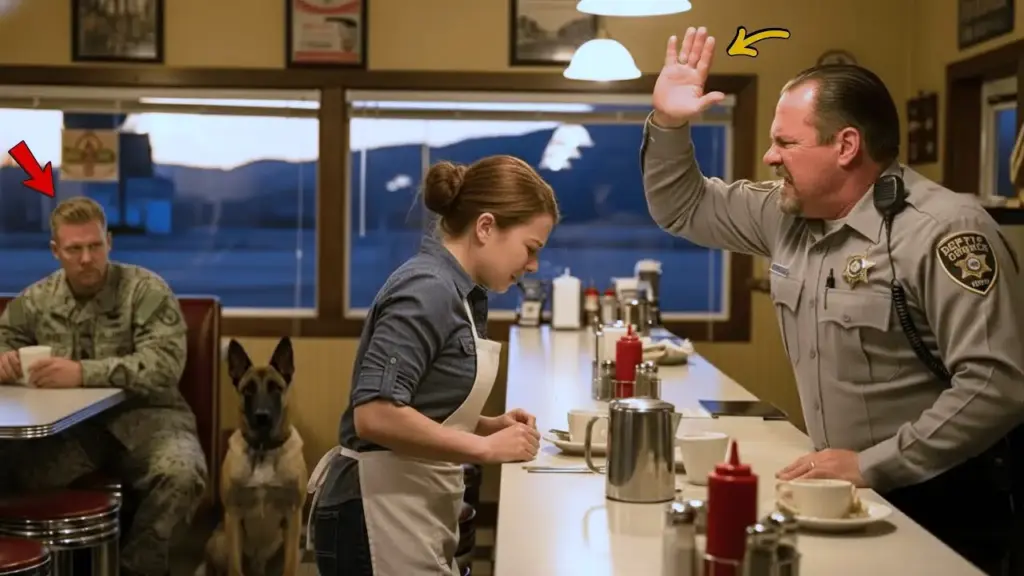
The slap echoed through the diner. The woman staggered. Coffee spilled across the floor. No one moved. At a corner table sat a Navy SEAL, a disciplined canine lying silent at his feet. There was no reaction. No movement. Not a single word.
The man wearing the badge had grown used to silence in this town. He was used to fear. He was used to people looking away. Authority had made him believe he was untouchable. That belief was wrong. The limits he challenged belonged to a Navy SEAL who knew exactly when to strike.
Late autumn in western Colorado didn’t announce itself with romance. It arrived like a quiet warning that sank into the seams of everything. It crept into the thin air, into the wood frames of old buildings, and into the breath that turned white the instant it left your mouth. A weak, pale sun hovered behind low cloud cover.
The highway cut through the foothills in long gray stretches bordered by pines and patches of early snow that looked more like ash than winter. The town was the kind travelers missed if they blinked. It had one main road, a few dim storefronts, and a roadside diner sitting at the edge of gravel and wind, its neon signs stuttering in and out like it was deciding whether to stay alive.
Inside that diner, warmth existed only because the heater fought hard. People spoke softly because they’d learned volume attracted the wrong kind of attention. Daniel Brooks rolled in without drama, an old pickup crunching across the lot, tires spitting stones, the engine ticking as it cooled.
He sat for a beat with both hands on the wheel, shoulders relaxed, chin slightly lowered, eyes taking in the windows. He noted the door and the lone cruiser parked a little too confidently near the side of the building. Daniel was thirty-four, tall and lean-muscled, possessing the kind of strength that looked understated until it moved.
His sandy blonde hair was cut short in a strict military style—tight at the sides, short on top. There was no fashionable fade, because habit was easier than reinvention. A short boxed beard framed his jaw, neat and clipped, and a thin pale scar ran along the jawline like an old punctuation mark.
His hazel eyes had the steady watchfulness of a man trained to notice what others missed. However, his face carried no invitation to conversation, and no threat either. It was just presence, controlled and quiet. He wore a Navy working uniform, Type III in AOR2 green.
The blouse and trousers matched, the velcro patches blank with no name, no rank, and no insignia. His tan combat boots were dusted with road grit. He looked like someone who had left a place in a hurry and hadn’t bothered to become anyone else yet.
At his left side, the canine moved as if the cold couldn’t touch him. The Belgian Malinois was five years old, compact and powerfully built. He had a fawn coat laid under a dark black overlay along his back and face, which made his amber eyes seem even darker when he focused.
The dog’s chest was broad, his legs spring-loaded, his posture disciplined. There was no wasted motion and no nervous scanning, only a calm, professional readiness shaped by repetition and trust. He wore a worn leather collar, plain and functional. Later he’d use a matte black tactical harness, but tonight it was only the collar.
The dog’s identity was kept quiet, the same way Daniel kept his. The Malinois stayed close without crowding, matching Daniel’s pace, head level, ears reading the world. He wasn’t drifting beside his owner. He was a working partner who understood silence as a tool.
Daniel stepped out, the wind catching the hem of his blouse. Together they crossed the gravel and pushed into the diner. The bell above the door gave a thin, tired jingle that didn’t carry much cheer. Warmth hit first, then the smell.
It smelled of burnt coffee, old grease, a faint sweetness from something overcooked hours ago, and the low murmur of people trying to keep their lives small. The diner was narrow with cracked vinyl booths and scuffed linoleum. The counter had been wiped so many times the surface looked permanently tired.
Near the windows sat four immigrant workers, late twenties to early forties, faces worn by outdoor labor and long hours. Their jackets were heavy, their hands rough. Their voices were kept low in Spanish, not because they were ashamed, but because they had learned in places like this that being noticed could become a problem faster than it became a kindness.
One of them, a man with a weathered face and salt-and-pepper stubble, kept glancing toward the door like he expected someone to come in and decide he didn’t belong. Another, younger, had bruised knuckles and a careful stillness. It was the kind of stillness that came from trying to stay employed in a town that could swallow you without leaving a trace.
Behind the counter moved Lena Parker, early thirties, tall and slender with a quiet, tired grace. Her auburn hair was pulled into a loose bun that never stayed neat for long. She had pale skin freckled lightly across her nose and green eyes that carried softness.
But those eyes also held the guarded patience of someone who’d learned to keep her reactions inside her chest. Lena was polite to everyone in the way people become polite when politeness is armor. She smiled even when she didn’t feel it and apologized even when she wasn’t at fault.
She moved through the space with shoulders slightly rounded, as if she’d spent years trying not to take up too much room. There was an old story in that posture: an ex-husband who left and a custody fight that taught her how quickly a woman’s truth could be disregarded in a small town. So now she worked hard, spoke softly, and survived by not giving powerful men a reason to turn their attention toward her.
Daniel chose a corner booth with his back to the wall, a habit that didn’t announce itself as tactical unless someone knew what they were looking at. The Malinois slipped under the table and lay flat, chin on paws. He was nearly invisible, present but not displayed, because discipline meant being ready without being theatrical.
When Lena came over, Daniel ordered the cheapest breakfast item on the menu in a steady, polite voice, using no extra words. He ate slowly when it arrived, methodically, cutting each piece with an economy of motion. Halfway through, he slid a portion down for the dog.
The Malinois accepted it without sound, tail barely moving. He chewed with controlled restraint, the kind of quiet that came from training and from knowing his handler’s expectations were absolute. The bell over the door rang again, sharper this time.
The diner’s murmur thinned the way a room changes when something unwanted enters. Mark Holloway stepped inside. He didn’t look like a man who ever asked permission to exist. Holloway was in his late forties, tall enough to loom and heavy through the chest and waist.
He wore his deputy uniform like a possession rather than a service. His cheeks were ruddy, his nose slightly swollen, and his eyes small and restless. His thinning dark hair was slicked back with too much product, an attempt at control that couldn’t hide years of drinking.
A short, uneven beard clung to his jaw, more neglect than style. The lines around his mouth pulled downward into a permanent impatience, as if the world owed him comfort and he resented it every moment it didn’t pay. His sidearm sat at his hip.
His hand drifted near the grip in an almost lazy way. It wasn’t because he feared anything in this diner, but because he enjoyed the reminder of what the badge and the weapon made possible. He didn’t greet the owner. He didn’t nod at the customers.
He looked at people the way you look at furniture you expect to obey you. A couple of locals went still. The immigrant workers dropped their eyes toward their cups. Lena’s hands tightened around a coffee pot for half a beat.
Then she forced them loose again, because in her body lived a memory of what happened when she showed fear or anger. Holloway sat at the counter and barked an order without saying «please.» He laughed once at something no one else could hear, loud and sudden.
It was a laugh that landed like a slap even before his hand ever moved. Lena moved quickly, careful, her steps measured, her voice soft. She set the mug down, and for a moment everything looked like it would pass the way it always passed—quiet, ugly, survivable.
Then, her elbow clipped the edge of the pot. Coffee splashed across the counter, a few drops hitting Holloway’s sleeve. The slap sounded like the crack of wood breaking, sharp enough to cut through the diner’s stale air.
Lena’s head snapped to the side. She stumbled half a step, her bun loosening, a strand of auburn hair falling across her cheek. Her face went still in the stunned way bodies go still when they are trying to decide whether pain is real.
A red mark bloomed instantly along her cheekbone. She didn’t scream. She didn’t cry. Her hand rose halfway, then stopped, hovering as if touching her face might turn the moment into something officially true.
Holloway stood over her, breath thick with alcohol and contempt. His eyes were bright with the satisfaction of being watched and not challenged.
«Watch what you’re doing,» he said, his voice loud enough for everyone. It was the tone of a man performing power. «You people get lazy when you think nobody’s paying attention.»
The phrase «you people» hung in the air without choosing a target, which made it worse. It could be Lena. It could be the immigrant workers. It could be anyone Holloway wanted to shrink. No one spoke. The cook stayed hidden in the kitchen.
A local man in a booth stared down at his plate like it contained instructions for survival. One of the immigrant workers clenched his jaw so hard the muscle jumped. But he kept his hands wrapped around his cup because he knew how fast a town could turn against someone without paperwork.
Lena swallowed, straightened slowly, and forced a small apology that didn’t belong to her. She had learned that apologies sometimes bought you time. Daniel saw it all and did not move. He didn’t stand. He didn’t speak.
His posture remained easy, shoulders relaxed, hands calm. His eyes were steady on Holloway without the heat of anger, without the softness of pleading. Under the table, the Malinois tightened like a drawn wire.
The dog’s muscles shifted beneath his short coat, his amber eyes locking on Holloway’s boots. A low vibration of readiness hummed in his chest. Daniel’s foot pressed lightly against the dog’s shoulder, barely a touch, a private signal.
The Malinois stayed down, disciplined, silent. He had been trained to wait for permission the way other dogs waited for food. Daniel’s silence wasn’t weakness. It was restraint, a controlled decision not to feed the scene with reaction.
But Mark Holloway didn’t understand restraint. In Holloway’s world, the loud ruled and the quiet submitted. He turned then, scanning the diner for eyes that looked away, for bodies that flinched. His gaze landed on Daniel.
He saw the blank Velcro patches, the calm face, the dog hidden under the booth. He noted the absence of apology in Daniel’s posture. Holloway misread the stillness as fear and the quiet as surrender.