


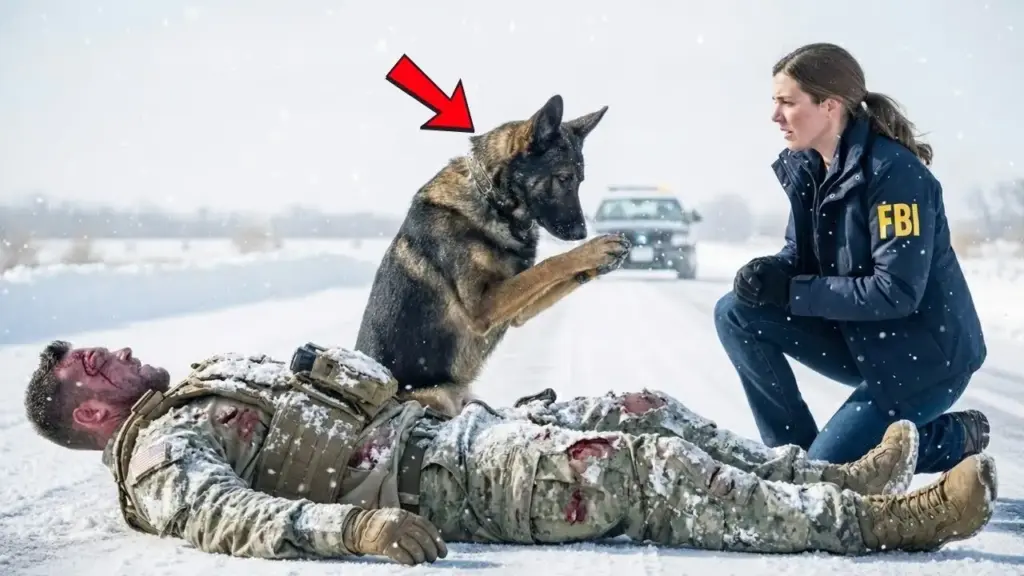
Snow fell hard along Highway 61 near Frostgate, Minnesota, turning Lake Superior’s wind into a white wall that swallowed headlights and hope. In that hush of winter, a wounded Navy SEAL in a dark uniform lay half-buried in the drift. A dark stain spread slowly across the snow as the cold tried to claim him.
Beside him, a sable German Shepherd rose on his hind legs and pressed his front paws together. He was begging an off-duty FBI agent to stop and see what God had placed in her path. She knelt, wrapped the soldier against the ice, and felt the sharp truth of it. This was no accident, and someone out there was still hunting.
The snow came down the way it does along Lake Superior when winter is in a serious mood. Thick flakes looked gentle until they hit the windshield and turned into a bright, endless blur. Highway 61 stretched ahead like a ribbon of pale glass.
The road markings were half-buried, the shoulders swallowed by drifts that rose and fell like frozen waves. Wind ran sideways across the asphalt, making the whole world feel tilted. It was the kind of night that made a person wonder if the Earth had edges.
Mara Whitlock kept both hands on the wheel, steady as a metronome, though her mind was anything but. She was thirty, lean, and athletic in that quiet, disciplined way. She had the look of someone who had trained their body to obey even when their heart was tired.
Her dark brown hair was pulled back into a low knot that always came loose by the end of a long day. Her eyes—blue-gray, sharp, and watchful—had the habit of scanning without her meaning to. It was as if danger might be written on the snow itself.
She wore a plain winter coat over her work clothes. It was nothing flashy, nothing that screamed FBI. She had learned that attention was a kind of weather, too; sometimes useful, often deadly. Tonight, she wanted no attention at all.
The case she had been chasing all week was still a mess of half-answers and slippery names. She had sat across from people who smiled too easily. They spoke about charity and community with mouths that never reached their eyes.
She had driven away from interviews with the same old feeling in her chest. It was the sense that evil didn’t always wear a mask. Sometimes it wore a parka, held a coffee cup, and shook your hand.
Her heater fought the cold, the vents breathing warm air that smelled faintly of old leather and peppermint gum. The radio murmured low, more static than music. Mara was thinking about turning it off when her headlights caught something that didn’t belong.
It was a shape near the edge of the lane. At first, it looked like a dark heap of plowed snow. Then the wind shifted, and the shape moved just a little.
Mara’s stomach dropped as if the road had vanished beneath her tires. She slowed hard, hazards blinking. The car drifted slightly before her training pulled it straight.
Her gaze snapped to the shoulders, to the tree line, and to the long empty stretch behind her. Nothing. There was just snow, wind, and that deep northern silence that never felt empty; it felt like it was listening.
She rolled closer, her heart beating with that familiar rhythm she hated recognizing. Then she saw the boots. A man lay on his side near the reflective edge line.
One arm was curled under him as if he had tried to hold himself together. His uniform was dark and stiff, the fabric heavy where snow had started to freeze. He looked too big to be there, too solid.
It was like someone had dropped a statue onto the road and the storm was slowly carving it down. Mara pulled over, tires crunching into a drift. She grabbed her flashlight and her trauma kit, then paused with her hand on the door handle, listening.
Snow ticked against the glass. Wind moaned around the frame. Somewhere far off, a truck groaned like a ship in fog.
No voices, no footsteps. Still, her instincts insisted: Do not assume you’re alone. She cracked the door and stepped into the cold.
It hit her like a slap, clean and brutal. Her breath turned white instantly, her boots sinking to the ankle. She kept the flashlight low, sweeping the road, the ditch, and the trees.
The beam caught tire tracks. They were fresh and sharp, leading off the shoulder about fifty yards back. When she followed the angle with her light, she saw it.
A vehicle was down in the snowy ditch, tilted hard. Its rear lights blinked weakly like tired red eyes. It was not a simple slide; the tracks were too straight, too forced.
Mara’s jaw tightened. Then, something moved between her and the man on the road. A dog.
He came out of the swirling snow like a shadow with a heartbeat. He was a German Shepherd with a broad chest and strong legs. His coat was sable—black along the back, brown and tan on the sides—now dusted white so he looked half-made of winter.
He was big and not young, with a faint silvering around his muzzle that gave him a dignified, weathered look. His ears were upright and alert. His eyes were a deep brown that seemed almost human in their urgency.
He didn’t bark. He didn’t lunge. He ran straight toward Mara, stopped, and, impossibly, rose on his hind legs.
His front paws came together, pressed tight in front of his chest like hands in prayer. For a second, Mara just stared. Her brain tried to file it under absurd, like a magic trick at a county fair.
But the dog’s body trembled with strain, his breath coming fast. His paws were held together with desperate precision. This wasn’t a trained performance; this was pleading.
The dog dropped back down, took two steps toward the man, then looked back at her. His eyes were wide, as if saying, Please. Now. Mara swallowed hard.
Humor flickered through her fear in a single, shaky thought. Of course. Of course, the first creature I meet in the blizzard is a dog who prays better than most people.
Then the humor vanished, replaced by a colder truth. Someone had left this man here to die. She moved in, keeping her light steady.
The dog—Rook, she would learn later—stayed close but gave her space. He shifted his weight, watching her hands. His tail didn’t wag.
He was all business, all vigilance, like an old soldier guarding his own. Mara knelt beside the man, careful not to slip. His face was pale, his lips tinged blue, and his lashes were clumped with ice.
He was handsome in a hard-edged way. It was the kind of face shaped by discipline and loss. He had a strong jaw, stubble dark against his skin, and a brow drawn even in unconsciousness.
His hair was cropped short, military neat, but damp and flattened by snow. A patch on his sleeve marked him as Navy. His posture, even collapsed, carried the stubbornness of someone who didn’t quit.
«Hey,» Mara said, loud enough to cut through the wind. «Can you hear me?»
A faint sound, a breath that rattled, answered her. His eyes fluttered but didn’t focus. Mara’s gloved fingers found the injury, warm against the cold, soaking through the uniform near his side.
It wasn’t a dramatic gush, which was worse in a way. It was a steady leak, quiet and determined. She opened her trauma kit, hands moving from memory.
Pressure first. Warmth. Keep him alive.
A sharp flash of light, brief and unnatural, blinked from the tree line. In the same heartbeat, the snow beside Mara’s knee puffed upward like it had been slapped by an invisible hand. Mara froze.
Not lightning. Too low. Too precise.
Her pulse didn’t race; it narrowed. Rook’s growl rolled out of him, low and controlled, a warning that vibrated in her bones. He stared into the darkness beyond the road, ears pinned forward, body angled like a shield.
Mara didn’t see a red dot. She didn’t see a sniper’s laser slicing the storm. But she knew what it felt like to be watched by someone who wanted you quiet.
The wind hid sound. The snow hid movement. The night gave every coward in the world a place to stand.
Mara forced herself to breathe once, slow, like she was lowering a weapon inside her own chest. She didn’t drag the man far; she couldn’t. He was solid muscle, heavy with wet clothing and winter gear.
Instead, she rolled him carefully, inch by inch, out of the lane. She ensured no passing vehicle, or worse, no aimed shot, would have a clean line. She pulled a silver emergency blanket from her kit and wrapped him fast.
The material crinkled like foil in a church offering plate. She looped a tow strap from her trunk around his shoulders and tugged. She didn’t haul him across the world, just enough to slide him into the windbreak behind her car’s rear end.
Metal and drifted snow made a small pocket of shelter. Rook stayed beside them, pressed close, his breath steaming. When Mara’s hands shook, he didn’t nudge her like a pet.
He simply held position, eyes locked outward, guarding the dark. Mara leaned in close to the man’s face.
«Stay with me,» she said, her voice fierce and quiet. «Don’t you dare leave me out here.»
His lips moved. A sound came out, half word, half prayer. «Ethan.»
So he still knew his name. Mara glanced toward the ditch again, toward the blinking red taillights and the tracks that didn’t look like an accident. She looked at the empty highway, swallowed by white.
Someone had set this up. Someone had wanted him alone. And now, by stopping, she had stepped into the same trap.
But she couldn’t drive away. Not with a man injured in the snow. Not with a praying dog staring at her like she was the last door left open in the storm.
Mara tightened her grip on the blanket around Ethan’s shoulders. She pressed her palm to his side to keep pressure on the wound and let her mind click into that cold, clear place where fear becomes focus. If someone was watching, then someone would come closer.
And if they did, Mara Whitlock was done letting winter take what didn’t belong to it. She kept her body between Ethan and the open road, the way she’d once learned to stand between a frightened witness and a courthouse crowd. She was calm on the outside, braced on the inside.
Behind her car, the windbreak was only a small mercy, but in a storm, small mercies were how people lived. The emergency blanket crackled each time Ethan’s chest rose. His breath came shallow and uneven, a rough whisper trapped in his throat.
His skin, where it showed at the edge of his collar, looked waxy with cold. The injury seeping through his uniform had the stubborn patience of a leak that refused to stop. Rook stayed close, a broad, sable German Shepherd dusted with snow, posture tight as a drawn bow.
The dog’s muzzle was lightly grayed, his eyes dark and intent. Every few seconds his gaze snapped to the tree line as if he could see footprints where no human eyes could. He wasn’t frantic; he was focused.
That was somehow worse. Frantic animals panicked. Focused animals knew.
Mara pressed gauze harder to Ethan’s side and spoke like a command. «Ethan, look at me.»
She kept her voice low because the night felt like it had ears. «You’re going to stay awake long enough to tell me what happened.»