


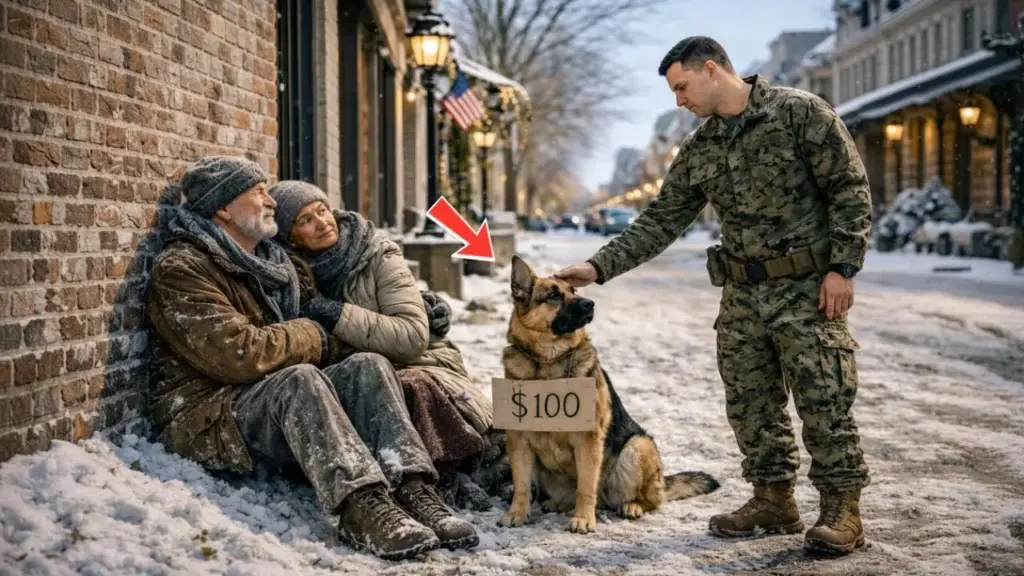
On a bitterly cold winter morning, an elderly couple stood motionless in the biting frost, holding a handwritten sign that bore a heartbreakingly simple message: German Shepherd, One Hundred Dollars. They were not selling their faithful companion because their love for him had faded. Quite the opposite.
They were letting him go to ensure he wouldn’t starve or freeze alongside them. People walked past, shaking their heads and whispering judgments like «too expensive,» turning away as if kindness were a luxury they couldn’t afford. The dog did not beg for attention, nor did he whine against the cold.
He stood tall and stoic, acting as a guardian for two trembling pairs of hands that had raised him like a son. Then, a former Navy SEAL stopped. He hadn’t come looking for a dog, but an unsettling feeling in his chest forced him to pause. What he decided to sacrifice that day would alter the course of not just one life, but an entire frozen season.
Winter had cast its bright, merciless light over the northern town of Brightwater. It was the kind of blinding sunlight that made the snowbanks glitter with a brilliance that hurt the eyes. The scene was beautiful in the way sharp, dangerous things often are: clean, reflective, and utterly indifferent to human suffering.
Temperatures hovered dangerously below freezing, yet the physical cold was not the heaviest burden. The true weight pressed down invisibly in the form of numbers printed on envelopes and glowing on screens. Heating bills were climbing week after week, and grocery prices edged upward, forcing silent, desperate calculations in kitchens all over town. For many of the elderly, this season had become a time of impossible choices: warmth or sustenance, dignity or survival.
At the windiest edge of the weekend market, where the gusts cut between the stalls like knives, Harold Finch and his wife, Mabel, held their ground. Harold was seventy-two, a man who had once been tall but was now slightly bowed. His sloping shoulders were not a sign of weakness, but of years of learned endurance. His face was a map of deep lines carved by wind and labor rather than age alone, his jaw set firmly beneath gray stubble he no longer had the energy to shave every day.
A persistent, rattling cough lived deep in his chest, a sound he tried to stifle behind his scarf. Mabel, seventy, was smaller and more composed. Her silver hair was pulled back neatly into a low bun beneath a thick knitted cap, her skin pale from the exposure, her eyes intelligent and sharp behind thin-framed glasses. She carried herself with the quiet authority of someone who had once maintained order in classrooms and libraries—someone used to being heard, even if the world listened less these days.
Between them, propped against a wooden crate and weighted down by a heavy stone, was a piece of cardboard. On it, written in the careful, elegant handwriting of a former teacher, were the words: GERMAN SHEPHERD A HUNDRED DOLLARS. Below, in much smaller print, were the strict conditions that sent most potential buyers walking away: Not for breeding. Not for guarding. Buyer must have a working heater. Visits allowed.
At their feet stood the dog. Oracle was a male German Shepherd, roughly five years old. His black and tan coat was dulled by malnutrition but still thick enough to ward off the winter chill, though his ribs were faintly visible beneath the fur. A distinctive pale, teardrop-shaped patch marked the center of his chest, and a thin, healed scar crossed the bridge of his nose.
His ears stood erect, and his amber eyes remained steady and alert. He did not pace restlessly or whimper. Instead, he positioned himself with deliberate precision, angling his body so that the brunt of the wind hit his flank before it could reach the Finches.
When Harold’s frozen fingers trembled too much to keep a grip on the sign, Oracle would lean subtly closer, offering his body heat without any fanfare. He did not beg. He simply waited.
Crowds passed them by. Some slowed just long enough to scoff at the price.
«Too much money,» one man muttered, pulling his coat tighter around himself.
«It comes with too many rules,» a woman remarked to her companion, shaking her head as if the conditions were a personal insult. Others didn’t bother to read the sign at all. A few offered apologetic smiles, the kind people give when they are relieved that the tragedy belongs to someone else.
No one asked the dog’s name. No one asked why the price was set exactly there. No one asked how long the Finches had been standing in the cold.
Harold did not call out to them; his pride kept his lips sealed. Mabel kept her gaze level, her gloved hands clasped neatly, treating this ordeal not as a sale, but as a test of endurance.
The wind tugged relentlessly at their coats. Oracle adjusted his stance again, moving ever so slightly to track the surroundings without tension. Lieutenant Nolan Cross walked past, having no intention of stopping.
At forty, Nolan moved through Brightwater with the efficiency of a man accustomed to being overlooked. He was tall, standing just under six-foot-one, with broad shoulders and a build that was compact and disciplined rather than bulky. His face was clean-shaven and angular, featuring a strong jaw and cheekbones that caught the stark winter light when he turned.
His dark brown hair was cut in a precise military fade, always neat—a habit carried over from years when appearance was a component of survival. His blue-gray eyes scanned the environment instinctively, not looking for trouble, but constantly mapping the space. He wore a long-sleeved camouflage top and matching trousers in muted greens, the fabric fitted but not tight, with a dark tactical belt cinched at his waist holding a pouch and a utility case.
His tan military boots crunched softly on the packed snow. A heavy metal watch with a black face rested on his wrist, catching a brief flash of the sun. He had learned long ago how to avoid drawing attention to himself.
That skill had remained with him long after the war ended and the uniform was put away. He was almost past the Finches when something broke his rhythm. It wasn’t a noise; it was the absence of one.
The dog was too still. Nolan slowed his pace, then came to a complete stop. Oracle’s gaze lifted and locked onto his.
There was no excitement in the dog’s look, no fear—just a steady, penetrating stare that made Nolan feel inexplicably as if he had arrived late to a meeting that had been waiting for him. He looked down at the sign, then read the smaller writing beneath it. He read it all twice.
«How much?» he asked, his voice low and even.
«A hundred,» Harold replied, clearing his throat. His voice was rough, raspy from the weather and the effort of restraint.
«But it isn’t about the money,» Nolan observed.
Nolan nodded, listening. Mabel explained the conditions calmly, her words measured and practiced, as if she had rehearsed exactly how to say them without sounding apologetic.
Nolan did not smile. He did not scoff. He did not try to negotiate.
He looked at Oracle again, noting the minute shift in the dog’s weight when a stranger passed too close, the way his ears flicked toward a distant engine, and the way his body remained a barrier between the Finches and the world.
«I need to think,» Nolan said finally. He meant it.
He was not a man who made impulsive decisions. When he turned to leave, he felt the physical weight of the dog’s eyes on his back, a presence that lingered far longer than it should have. He walked on, his boots steady and his breath controlled, telling himself it was nothing. He told himself he had seen worse things, and that walking away was sometimes the most rational option.
Two blocks later, Nolan stopped without knowing why. The noise of the market had faded behind him, but his chest tightened with a familiar pressure—not panic, but recognition. He realized he had been unconsciously counting his steps, a habit he fell into when something unresolved was following him.
He turned his head slightly, just enough to look back. Across the distance, Oracle was still standing exactly where Nolan had left him, head lifted, eyes fixed. He wasn’t pleading; he was waiting. The realization unsettled Nolan more than any bark could have.
Dogs didn’t wait like that unless they expected something. Nolan continued home, but the image remained burned in his mind. His house sat at the edge of town, modest and set back from the road.
The frozen lake beyond it stretched out, smooth and pale. Inside, everything was in its proper place. Nolan lived deliberately.
He shrugged off his jacket, hung it on the hook by the door, and moved through the narrow living room to a small wooden table near the window. Beneath it sat a metal box, scuffed and dented with age. He pulled it out and opened the lid.
Inside were a few items he rarely touched: an old photograph with curled edges, a folded letter, and a small, worn piece of jewelry that had belonged to his mother. She had not been wealthy, but she had been careful. She had taught him, without sermons, that keeping something safe did not always mean keeping it close.
Nolan closed the box, then opened it again. For the first time in years, he took the contents out and placed them on the table, arranging them as if they were options rather than sacred relics. Outside, the light faded, the cold deepened, and somewhere across town, an old couple stood with a sign and a dog who did not beg.
Nolan did not sell the keepsake that night, but he didn’t put it away either. He left it where it was, the past laid out in front of him, balanced on the edge of a decision that had not yet been made.
Nolan returned to the market the next morning with no stated intention of buying anything. He told himself this as he parked two streets away and walked the rest of the distance. His boots crunched softly over snow that had refrozen into ice overnight.