


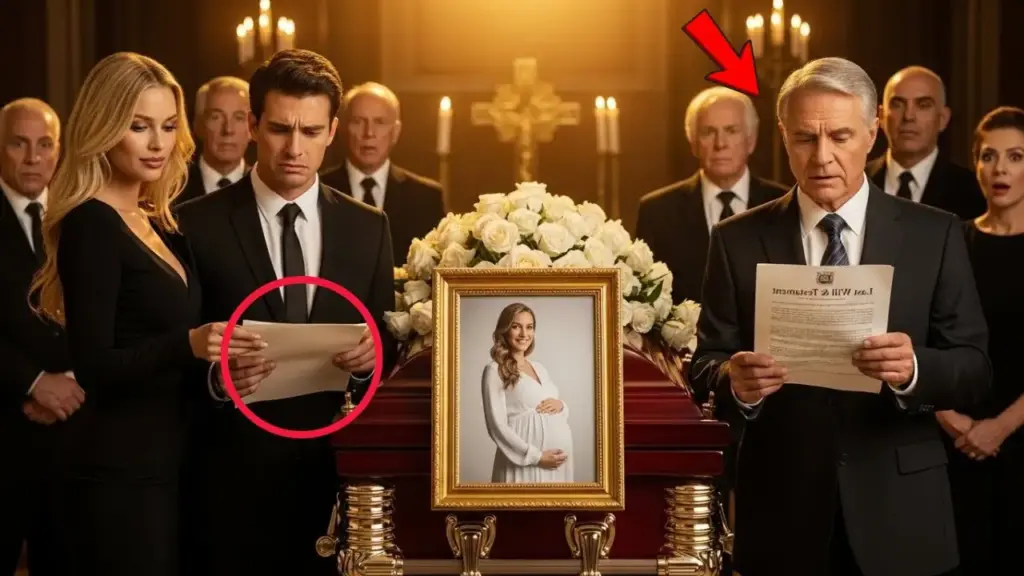
What would you do if your husband brought the woman he was seeing to your funeral? Just imagine a church filled with two hundred people and a mahogany casket holding a pregnant woman who passed away in a way that made no sense. Then the doors swing open.
Her husband walks in, holding hands with the woman he had been betraying her with for months. It wasn’t supposed to be like that. But here is the secret nobody in that church knew.
I have done nothing wrong. She was a genius. Everyone thought she was just a simple school teacher making crafts for her students. In reality, she was quietly building a $47 million empire.
While her husband was planning to take everything and disappear with his girlfriend, she was keeping a record of every single lie, every financial crime, and every betrayal. And she left a video. It was a video she arranged to have played at her own funeral, designed to reveal the truth to everyone who ever thought she was weak.
What you are about to hear is going to shock you. The final twist is something nobody could have predicted. Not even me. This story is about Rachel Morrison, and it is the story of how a seemingly powerless woman secured justice.
This story will teach you a powerful lesson. Never underestimate a quiet woman. Never mistake her silence for weakness. And never believe that someone who seems powerless cannot become the most strategic person in the room.
If you have ever felt overlooked, dismissed, or told you were nothing without someone else, this story is for you.
The mahogany coffin was at the front of St. Andrew’s Church, a beautiful and tragic sight. It was surrounded by countless white lilies and the soft glow of candles, which made shadows dance on the polished wood. Two hundred guests sat in the old church pews.
They were all dressed in black, their faces showing the kind of deep sadness that comes when someone passes away too young. The air was heavy with the smell of flowers mixed with expensive perfume. But underneath it all was a feeling of complete and utter disbelief.
At the heart of everything, inside that gorgeous coffin that cost more than what most people earn in a year, was Rachel Morrison. She was a 32-year-old elementary school teacher, a loving friend, and a mother-to-be. And now she was gone.
I was standing in the third row from the front, holding a tissue that was already completely soaked. My black dress felt tight across my chest, as if the grief itself was a heavy weight pressing down on me. My name is Claire Bennett, and the woman in that coffin was more than just my friend.
She was my sister in all the ways that count. We had been inseparable since we were seven years old. For twenty-five years, she was the person I told all my secrets to, my partner through every good and bad time life gave us.
A quarter-century of friendship, of late-night whispers, of drying each other’s tears, and sharing endless laughter. We had phone calls that lasted all night and Sunday brunches where we thought we could fix the world with mimosas and pancakes. Now, all of that was gone, ending here in this cold stone church with its high ceilings and stained glass windows that seemed to mock our sorrow with their bright colors of hope.
Rachel was eight months pregnant when she died, carrying a little girl she was going to name Hope. The baby actually survived. She was delivered by an emergency procedure as her mother’s life slipped away.
She was just four pounds and two ounces of pure fight, lying in the neonatal unit with no idea she would never meet the woman who already loved her more than anything. Rachel had sung to her every night and spent weeks choosing the perfect sunny yellow for her nursery.
The doctors said it was due to complications. They used vague terms like «an unexpected decline» and «rapid system failure.» They would just shake their heads and quietly say that sometimes these things just happen. They said that medicine doesn’t have all the answers and that they did everything they could.
But I knew something they didn’t. I knew that Rachel had been perfectly healthy throughout her entire pregnancy. I knew she had that special glow that expectant mothers have.
I knew she was strong and full of life, planning a future that should have lasted for many, many more years. And I knew, with a certainty that felt like a rock in my stomach, that something was terribly wrong with how fast her health had failed.
The priest was talking, his voice a soothing and practiced sound, as he quoted scripture to comfort the crowd. He talked about higher plans, about eternal peace, and the promise of seeing loved ones again. I could barely hear him.
My attention was locked on the coffin, on the arrangement of white roses on its lid, and on the framed picture next to it. It showed Rachel looking so happy and vibrant, smiling for the camera with one hand on her pregnant stomach.
That was the moment the heavy wooden doors at the back of the church creaked open. The sound echoed through the quiet sanctuary like a gunshot, stopping the priest mid-sentence. Every single person in the church turned around to see what caused the disturbance.
The bright afternoon sun streamed in through the open doors, making it hard to see at first, creating silhouettes of two people. Marcus Morrison walked into his wife’s funeral like he was attending a business meeting that he found slightly annoying.
He was dressed in a charcoal gray suit that must have cost at least three thousand dollars. His dark hair was perfectly styled, and he had the easy confidence of a man who, in his thirty-five years of life, had never been denied anything he wanted. He stood tall, walked slowly, and had an expression that could almost seem sad if you didn’t look closely into his eyes.
But it wasn’t Marcus who made everyone in the room let out a collective gasp. It was the woman standing next to him. Jessica Crane strolled into that funeral, holding Marcus’s hand as if she had every right to be there.
She acted like she belonged right by his side, as if she wasn’t the other woman. She was the person who helped dismantle a home while the wife was carrying a child. She was twenty-eight years old, with that expensive kind of blonde hair that takes hours at a salon to perfect.
She had a manufactured type of beauty that came from personal trainers, strict diets, and a skincare regimen that cost more than some people’s car payments. Her black dress was clearly a designer brand, probably Valentino, tailored to flaunt her figure while trying to look appropriate for a funeral.
Her high heels were red-soled Louboutins, and they clicked loudly on the marble floor with every step. The sound was jarring in the otherwise silent and sacred church. I just stood there and watched her walk down the main aisle on the arm of my dead best friend’s husband, and I felt a coldness spread through me.
Behind me, I heard Rachel’s mother make a sound I will never forget. Betty Johnson was sixty-one years old, a small woman who seemed even smaller because of all the hardships she had faced. She had worked double shifts at a diner near a truck stop in rural Tennessee for thirty years just so her daughter could have a better life.
She had driven for fourteen hours without stopping to get to this funeral, most likely in the same old Honda Civic she had owned since Rachel was a teenager. She had already buried her own mother and her husband, and now she was burying her only child.
Through every tragedy, she always carried herself with a quiet dignity and grace that impressed everyone who knew her. But seeing her son-in-law walk into her daughter’s funeral with his girlfriend just broke something inside Betty Johnson. She let out a sound like a wounded animal, a cry of pure pain that was louder than all the whispers and gasps.
Then, her legs gave out from under her. I managed to catch her right before she hit the floor. Holding her frail body in my arms, I could feel her shaking with sobs she couldn’t hold back.
In that moment, I learned something very important. I was standing there in that church, holding a grieving mother, while her daughter’s betrayer proudly walked his girlfriend past the coffin. When a person shows you their true self during the worst possible moment—a moment when common human decency should be the absolute minimum—you should believe them.
Marcus wasn’t being cruel because of his grief. This wasn’t because of shock or confusion. This was Marcus Morrison finally taking off the mask he had worn for years.
He was finally showing his real face to everyone who had ever mistakenly thought he was a good person. I have seen some terrible behavior in my life. I have seen people show their true colors in tough situations. But I have never, ever seen someone do it while wearing a $3,000 suit at his wife’s funeral with his girlfriend on his arm and a slight smile on his face.
Marcus led Jessica to the very front row of the church, to the seats that were meant for the family. He took them to the places of honor right in front of the coffin that held the woman he had promised to cherish for the rest of his life. He sat down without even looking at Betty, without a single glance at the woman who had raised the wife he was now burying.
Jessica sat down next to him, crossing her legs at the ankle as if she were at a fancy lunch. Her expression was carefully blank, except for the tiny smile playing on her lips. The whispering started almost immediately, spreading through the rows of people like a fire in a dry field.
I saw people taking out their phones from their bags and pockets, even though it was a funeral. I saw them openly recording, holding their screens at angles they must have thought were sneaky. By the time Marcus sat down, I was sure that the whole scene was already spreading all over the internet.
The gossip was already flying across social media, through text messages, and in hushed whispers, even as Rachel’s coffin sat cold just twenty feet away. The priest had gone silent. He just stood at the pulpit, looking completely lost.
His speech about higher plans now felt totally hollow because of the drama unfolding right in front of him. For what felt like an eternity, nobody moved. The air in the church was so heavy with tension I could almost taste it—like a mix of anger, shock, and anxiety.
That is when the lawyer, Thomas Whitmore, got to his feet. I had met him only once, three days before, when he had summoned me to his office to tell me things about Rachel that I never knew. These secrets made me wonder if I ever really knew my best friend at all.
I realized she had been playing a game none of us understood, and the final moves were about to be revealed. He was fifty-eight years old and had that classic wealthy Connecticut look, with silver hair brushed back from a high forehead and piercing blue eyes that took in everything but gave away nothing.
He had spent thirty years as a corporate attorney before switching to estate law, and he carried the quiet confidence of a man who had seen everything and was surprised by nothing. He walked toward the front of the church with steady, deliberate steps, his face set in a serious expression. The priest wordlessly stepped aside, giving the podium to this man who was not on the program.
«Ladies and gentlemen,» Whitmore said, and his voice filled the entire church without him needing to shout. Something in his tone made people sit up and pay attention. The whispers faded away, and it even made Marcus look up from his phone with the first flicker of worry I had seen on his face all day.
«Before the service ends, I have been instructed by Rachel to read her last will and testament here today, in front of all the people she held dear.»
He took a breath, his eyes scanning the crowd before settling on Marcus and Jessica in the front pew. His next words were spoken softly, but they landed with impact.
«And everyone who wronged her.»
Marcus’s confident posture changed just slightly. Next to him, Jessica’s perfectly painted nails dug into his arm, her knuckles turning white. Whitmore pulled a large, thick envelope from his jacket pocket, the official kind that lawyers use.