


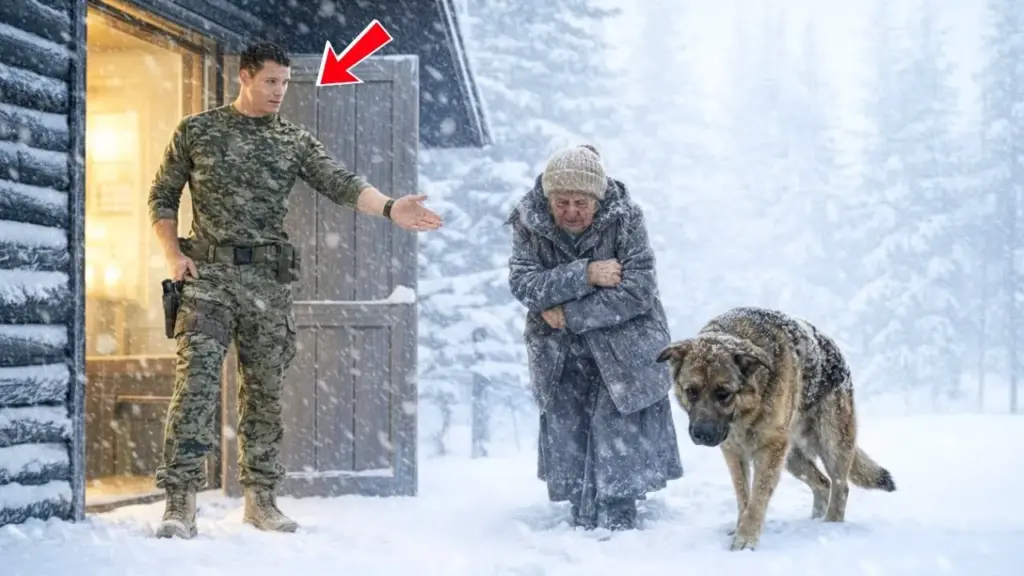
The snowstorm didn’t care that she was old, homeless, or running out of strength. An elderly woman and her dog wandered through the blizzard, carrying nothing but loyalty and fear. Every house was warm, every window lit, yet every door stayed closed.
That changed when her dog stopped in front of a lonely cabin on the mountain and refused to move. Inside lived a former Navy SEAL who had shut himself off from the world after losing everything he loved. One knock on the door would pull him back into danger, justice, and a fight no one expected.
The town below the mountain looked gentle from a distance, windows glowing, chimney smoke climbing into a hard, star-bright sky. Yet up close, the cold had teeth. It slipped under doors and into lungs.
It turned small mistakes into emergencies. On nights like this, people didn’t only gather around their stoves to keep warm. They gathered to keep the world out, to keep grief from finding a seat at the table.
Far above the town’s ribbon of streetlights, a lone cabin clung to the slope. A single square of amber light bled through a narrow window, as if the mountain itself was holding a match against the darkness. The man inside had chosen that cabin for the same reason he chose silence. It didn’t ask questions.
Mason Hale was forty and built the way disciplined years built a body. He was broad-shouldered, solid, and athletic in a controlled, practical way. He looked like someone who trained to function, not to impress.
His face had the clean, sharp structure of a man who’d learned to keep emotion from showing on the surface. He had a strong jaw, angular cheekbones, no beard, and no softness he couldn’t justify. His hair was dark brown, kept in a neat undercut that always looked freshly cut even in the middle of nowhere.
Cleanliness was one of the few comforts he still trusted. His eyes were blue-gray, steady, and watchful. They were eyes that had looked down corridors and into dust storms. They were eyes that had learned to read danger in a posture and mercy in a breath.
He wore what he always wore, even in winter, even in isolation. A fitted green camouflage long-sleeved top and matching camo pants, both cut close to the body, tactical and tidy. A dark tactical belt sat firm around his waist, with a pouch and a holster-like carrier that suggested tools were always within reach.
Tan military boots stood by the hearth when he was inside, thick-soled and made for unforgiving ground. A luxury metal watch with a black face and a steel band caught the firelight whenever he moved his hands. It was a small indulgence, a reminder that time still existed even when he tried to live outside it.
Tonight, Mason was doing what he did every night the weather turned mean: managing the cabin like a mission. He stacked split wood near the stove and checked the latch on the back door. He ran a cloth over the small framed photograph that lived on the mantle.
The picture was old enough that the corners had softened. A woman’s face smiled out from it, warm, brave, and tired in the way only mothers were tired. Her hair was pulled back, and her eyes held a calm certainty that made Mason’s throat tighten whenever he looked too long.
His mother had been his last true home. She had died while he was overseas, one of those cruel timing jokes the universe liked to play. It was the kind of joke that made a man believe in fate only to hate it.
He had returned to a house that felt like an empty shell. He had sold what he could. He had driven north until the roads narrowed, and the air smelled like pine and distance.
He didn’t hate people. He didn’t even hate the town below. He just knew silence was easier to manage than memory.
The fire popped. Mason sat with a mug that had gone lukewarm, staring into the stove as if it might show him a different life if he stared long enough. He didn’t. That was the bargain.
You traded miracles for predictability. And then the sound came. It was not the wind, nor the settling of old boards.
It was a knock, soft, almost careful. It sounded like someone who didn’t believe they had the right to ask for anything. Mason’s body answered before his mind did.
His shoulders tightened, and his breathing lowered. His attention sharpened into that familiar narrow beam. For a second, he hated himself for how quickly the past woke up in him.
Then the knock came again, followed by something quieter. A scrape against wood and a low, restrained whine that didn’t belong to the forest. Mason moved across the cabin without wasting motion.
He didn’t grab a weapon. He didn’t keep one displayed. But his posture changed the way it changed when he was about to open a door in a place where doors had been traps.
He paused with his hand on the knob. Cold bled through the metal. He listened.
There was breathing outside. Two patterns. One was shallow and unsteady. One was steady and low.
He opened the door. The winter lunged in, sharp and clean, carrying snow and pine and the smell of frozen earth. On the porch stood a woman, old enough that the cold looked like it had been chewing on her bones for years.
Edith Caldwell was seventy-two, small and stubbornly upright, though her shoulders trembled with fatigue and exposure. Her hair was silver-white, twisted into a low bun that had started to unravel. Loose strands clung to her forehead.
Her face was lined, but not fragile. There was pride in the set of her mouth and humor in her eyes, even as they watered from the wind. She wore a chestnut-brown wool coat that hung heavy over her thin frame.
Beneath it was a cream turtleneck, dark slacks, and old leather boots built for slick sidewalks and bad luck. A gray scarf was wrapped too tightly around her throat, the kind of knot a person made when they were afraid. A small crossbody canvas bag rested at her hip, light enough to mean she hadn’t carried much out into the storm.
Beside her stood a German Shepherd, male, about five years old. He was large and muscular, with a thick winter coat colored black and tan, so dark the black saddle swallowed most of his back. His ears stood upright like drawn blades.
His eyes were deep amber-brown, intelligent and steady. Snow dusted his muzzle. His chest was broad, his stance proud—the kind of posture that belonged to working dogs.
One front paw, his left, touched the boards with a faint hesitation. It was a subtle limp that said old injury, healed but remembered. Around his neck, not a full harness, but a scorched strap fragment hung like a relic.
It had burnt edges and a warped buckle, the kind of thing a dog didn’t need but kept anyway because it meant something. He stood slightly in front of the old woman, angled into the wind so it hit him first. He didn’t bark at Mason.
He didn’t rush. He only looked, directly, deliberately. He was measuring the man in the doorway the way Mason had measured strangers in other lifetimes.
Mason’s first instinct was to ask why. His second instinct was to not ask anything at all. Questions invited stories, and stories invited attachment, and attachment had once cost him everything.
Edith didn’t beg. She didn’t put on the trembling voice of someone performing poverty. She simply lifted her chin.
«I’m not asking for charity,» she said. «I’m asking for one night of heat.»
Her voice was thin but steady. It was the voice of someone who had lived long enough to understand the difference between pride and foolishness. Mason’s throat tightened, not with sympathy, but with recognition.
The dog shifted his weight, keeping his body between Edith and Mason. He was not threatening; he was protecting. Mason saw it immediately.
He had seen it in men, too. He stepped back and opened the door wider.
«Come in,» he said, and surprised himself with how calm it sounded.
Edith hesitated only long enough to make sure he meant it, then moved inside with careful steps. The German Shepherd followed, turning his head once to scan the dark porch and the treeline beyond. He stepped over the threshold like a sentry entering a post.
The cabin’s warmth wrapped around them. Edith’s shoulders sagged the moment the cold stopped biting her face. Mason guided her toward the stove without touching her, respecting the boundaries of someone who’d been forced to lose enough already.
He pulled a chair close to the heat, draped a folded blanket over her shoulders, and set a kettle on the stove. His movements were efficient and practiced. They were not gentle exactly, but careful.
The dog moved to the inside of the door and lowered himself there, back toward the wind. It was as if the door might open again without warning. He lay down, but he wasn’t relaxed.
His ears stayed up. His gaze tracked everything: Mason’s hands, Edith’s breathing, the corners of the cabin. The limp didn’t stop him from that vigilance.
«What’s his name?» Mason asked, because he needed something simple to say.
Edith glanced at the dog as if she drew strength from him. «Sable,» she replied.
There was affection in her voice, but also respect. «He’s… he’s the reason I’m standing.»
Sable’s eyes flicked to Edith when she spoke, then back to Mason. Mason didn’t like the way that gaze made him feel, like a man being asked to be good. He didn’t know if he still remembered how.
He moved through his small kitchen corner, pulling out a pot, canned broth, and dried vegetables. It was whatever he had that could become soup. He kept supplies for storms, not for company, but hunger didn’t care about intent.
Edith’s hands trembled around the mug of hot water he set near her. As the steam rose, color began to creep back into her cheeks.
«You live up here alone?» she asked, not prying, just observing.
Mason nodded once. «Easier,» he said.
Edith’s mouth twitched. «Easier is a strange religion,» she murmured.
Somehow it wasn’t an insult. It was a confession. Mason glanced at the mantle without meaning to.
The photograph caught the firelight. Edith followed his eyes, but she didn’t comment. The soup simmered.
Silence settled, not hostile, but cautious. They were two wounded animals circling the same warmth. Sable let out a slow breath through his nose, the kind that sounded almost like a sigh.
Mason noticed his paw, how it held itself a fraction off full weight. Old fracture, he thought. Cold made old injuries talk. He knew that too well.
When the soup was ready, Mason set a bowl in Edith’s hands. She took it like it was sacred. The first spoonful made her eyes close.
For a moment she looked like a child. Then she opened them again and became an old woman with pride.
«Thank you,» she said simply.
Mason nodded, as if gratitude was a thing he could accept without flinching. That was when it happened—the small, careless betrayal of paper. Edith shifted in the chair, reaching to adjust the blanket, and the strap of her canvas bag slid.
A thick envelope slipped out, hit the floor with a soft thud, and skidded toward Mason’s boot. Sable’s head lifted instantly. His ears angled forward.
His gaze sharpened, not toward Edith, but toward the envelope, as if the paper carried a scent. Mason froze. Not because of the envelope itself, but because the dog’s reaction didn’t fit.
Dogs reacted to food, to strangers, to threats. They did not react to documents. Yet Sable stared at the envelope the way he stared at the door.
Mason crouched and picked it up. The paper was stiff from cold. The top corner bore a neat logo: North Star Lending.
Beneath it, bold letters read: Notice of Foreclosure.
Mason’s fingers tightened. Something in his chest shifted—an old, deep hinge creaking open. He looked at Edith.
She had gone very still, the way people went still when shame entered the room. «It’s not what it looks like,» she said, but her voice betrayed her.
It was exactly what it looked like. Mason didn’t speak. He slid the envelope onto the table, face up, not as an accusation, but as reality.
Edith’s eyes flicked to it, then away. «My kids are gone,» she said quietly. «Not gone, gone, just… far. Work. Lives. They call. They love me.»
She paused. «But love doesn’t pay a winter bill when the roof caves and the furnace quits.»
Her humor tried to return, but it couldn’t cross the gap. «I thought I could handle it. I thought I could borrow a little, patch things, get through. And then…»
She swallowed. «And then the numbers changed. The papers changed. The door got chains.»
Mason listened. He didn’t interrupt. That was something the military had taught him, oddly enough. Sometimes the best way to keep someone alive was to let them speak.