


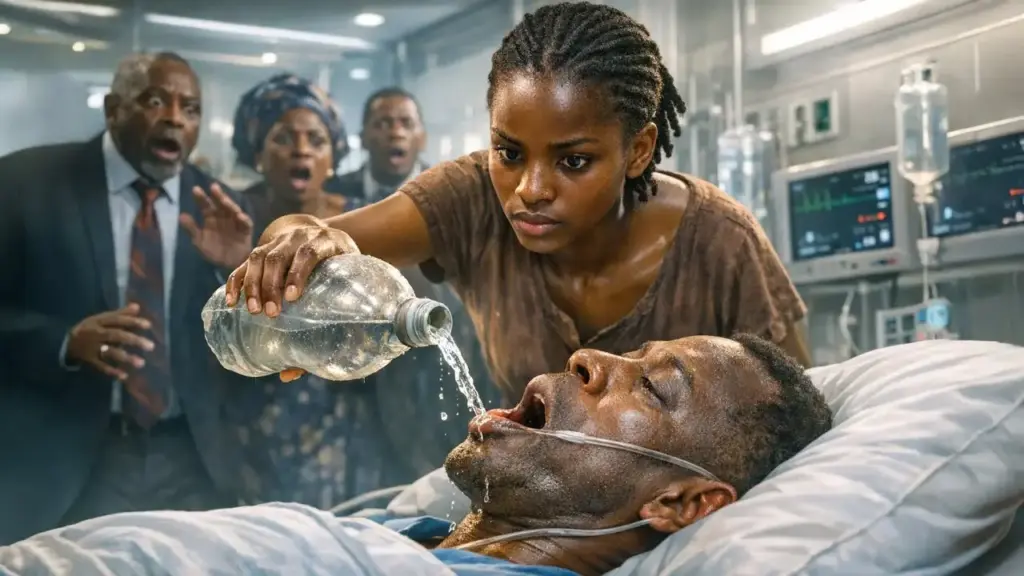
The private hospital wing smelled of antiseptic and money. Machines hummed while a doctor lowered his voice and said what no one wanted to hear.
«Two days,» he said. «Maybe less.»
On the leather couch, lawyers opened files. On the glass table, funeral plans began. Flowers were chosen, dates were penciled in, all while Kwesi Appiah still breathed.
His mother clutched her scarf and prayed. His half-brother watched the monitors with a patience that felt rehearsed. Then, the door opened.
A poor teenage girl, barefoot with rain on her dress, stepped inside holding a cracked plastic bottle of water. Like an offering. Security rushed forward until she spoke.
«This water,» she said softly, «is why he is dying.»
The room froze. She wasn’t asking for help. She was bringing truth, and it was lethal.
Amara Nkiru Okafor learned early that water could decide who lived and who was ignored. Every morning, before the city fully woke, she stood outside the iron gates of St. Bartholomew Private Hospital. A place so clean, it smelled unreal. The glass facade reflected the sky like it belonged to another country.
Inside, air conditioning whispered, and shoes never touched dust. Outside, where Amara worked, the pavement kept the heat from yesterday and the night before that, and her feet had grown used to it. She was 18, maybe 19.
No papers confirmed it. Her skin was deep brown, her frame thin from meals that came late or not at all. She balanced a tray of sachet water and a few plastic bottles, each wrapped in old newspaper to keep the sun from warming them too quickly.
The water was cheap, colder than the day promised, and bought mostly by drivers waiting in idling cars or visitors who didn’t want to walk back to their vehicles. Security guards tolerated her because she stayed quiet. She didn’t beg.
She didn’t sit on the hospital steps. She didn’t look people in the eye unless spoken to. Even so, they chased her away when the supervisors changed shifts or when a VIP convoy arrived and someone decided the sight of poverty was bad for business.
Amara would move across the road, stand near the jacaranda tree, and wait. She watched the hospital like a living thing.
Ambulances came screaming, then left quietly. Women arrived pregnant and hopeful; men arrived injured and angry. The VIPs came last.
Black SUVs, tinted windows, men in suits speaking into their wrists. Those patients never walked through the main doors. They were taken through side entrances, shielded from the world, and from people like her.
It was from one of the guards, a man who sometimes bought water and sometimes pretended she didn’t exist, that Amara heard the rumor.
«Big man upstairs,» he said to another guard, his voice low. «They say he won’t last two days.»
Amara didn’t need to ask who. Everyone knew. Kwesi Appiah.
His face had been on billboards, on magazines, on the television screens in electronics shops where she sometimes stopped to watch from the doorway. CEO, visionary, the man whose company built Rhodes Bridge’s water systems. The man people said had risen from nothing and then forgotten the meaning of the word.
Two days. The phrase stayed with her longer than the heat. She sold the rest of her water that morning slowly. Her eyes kept drifting to the upper floors where the windows were darker, where the curtains were heavier.
She imagined the room, the machines, the doctors’ quiet voices. She imagined the smell of medicine and money mixing the way it did inside. But she remembered another smell instead.
Rust. Stagnant water. The sharp sting in her nose when she leaned over a shallow stream near her old home and saw a rainbow shimmer on the surface that shouldn’t have been there.
Her chest tightened. Amara packed up early. She counted her coins twice, then tucked them into the cloth pouch tied beneath her dress.
From another pouch, this one tied close to her chest, she took out the bottle. It wasn’t special to look at. It was a scratched plastic bottle, the label long gone, the cap slightly warped.
She’d washed the outside so many times the plastic had dulled. Inside, the water looked ordinary, clear, innocent. She had kept it for years.
People asked her why, sometimes, when they noticed the way she guarded it, the way her fingers closed around it when crowds pressed close. She never answered. How could she explain that some things stayed with you not because you understood them, but because your body refused to let them go?
She crossed the road toward the hospital gates. The guard saw her immediately.
«Hey,» he said sharply. «Not today.»
«I need to go inside,» Amara replied. Her voice was calm, but her hands shook.
He laughed, a short sound. «Inside? Where? I see you. Look at you.»
«I need to speak to someone,» she said. «About the man who is sick.»
The guard’s face hardened. «Move along.»
Amara didn’t move. Around them, cars slowed. A woman in heels glanced over, frowned, then looked away.
A driver rolled up his window. The world did what it always did when discomfort appeared: it turned its head.
«He will die,» Amara said quietly. «And it won’t be natural.»
The guard stared at her. For a second, doubt flickered across his face. Then training returned.
«Get out of here,» he said, «before I call the police.»
That was when Nurse Halima Siddique noticed her. Halima had been working the early shift, her feet aching inside white shoes that never quite fit. She was tired in the way that sleep didn’t fix.
She was tired of watching money decide who got care first, tired of seeing families cry in corridors while others argued over room upgrades. She stepped outside for air and saw the girl standing straight in front of the guard, clutching something to her chest like a shield.
«Problem?» Halima asked.
«She’s causing one,» the guard said. «Says she wants to see the VIP patient.»
Halima looked at Amara properly then. Not at her clothes, not at the dust on her feet, but at her eyes. There was fear there, yes, but also something else. Urgency. The kind that didn’t come from hunger or desperation.
«What do you want?» Halima asked gently.
Amara swallowed. «I brought water,» she said. «It is important.»
Halima almost smiled, almost dismissed her. Then she noticed how Amara’s fingers trembled, how tightly she held the bottle, like letting go would make her fall apart.
«Whose water?» Halima asked.
«The one that made him sick,» Amara replied.
Silence stretched between them. Halima felt a chill that had nothing to do with the morning air. She thought of the charts she’d seen upstairs, the way the symptoms didn’t line up neatly, the way certain tests had been delayed without explanation.
She thought of the family arguing softly in the waiting room and the half-brother whose eyes never left the monitor.
«Come with me,» Halima said suddenly.
The guard protested, but Halima was already walking. Amara followed, her heart pounding so loudly she was sure everyone could hear it. The hospital doors slid open, and cool air washed over her skin.
For a moment, she hesitated. This place had rejected her kind her whole life. Then, she stepped inside.
They moved through corridors Amara had only seen on television. Past walls that glowed softly, past people who didn’t look at her until they did, and then looked away. Halima didn’t stop until they reached a quiet corner near the elevators that led to the private wing.
«Listen,» Halima said. «I can’t promise anything.»
«But if you’re lying…»
«I’m not,» Amara said. Her voice broke. «Please.»
Halima studied her one last time, then nodded. «Stay close.»
As the elevator doors closed, Amara felt the weight of the bottle press against her chest. Two days, they said. Maybe less.
She wasn’t here to beg. She was here because the water had followed her all the way to this moment, and she had finally listened.
Kwesi Appiah had spent his life outrunning the memory of thirst. Long before the boardrooms and private jets, before his name became a brand spoken with admiration or resentment, he had been a boy in a compound where water arrived like a rumor.
Some days the tap ran brown. Some days it didn’t run at all. His mother, Maame Afua Appiah, used to wake him before dawn to queue with plastic buckets.
Her wrapper tied tight, her voice calm even when the line stretched into the morning.
«Water is dignity,» she told him once when he complained. «When you control it, you decide who can stand tall.»
Kwesi never forgot that sentence. He just learned to translate it into numbers. He left home early. Scholarships. Hustle.
He had a mind sharp enough to see patterns others missed. While his peers chased quick profits, Kwesi studied infrastructure. The bones beneath the skin of cities. Roads, power, water.
He built a company that promised efficiency and scale, then another that promised access. Governments trusted him because he delivered on time. Investors trusted him because he spoke softly and counted precisely.
The newspapers trusted him because he didn’t need them. By the time he turned fifty, Kwesi Appiah was known across West and East Africa as a man who could turn chaos into order. He wore his success plainly.