


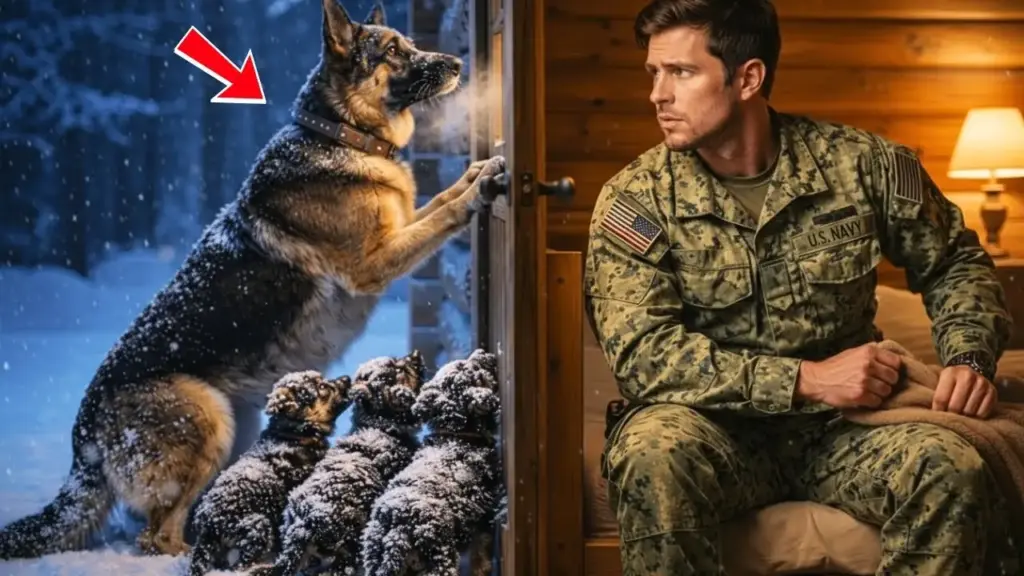
On the coldest winter night, with temperatures plunging to minus fifteen degrees, the town went silent. Only wind and heavy snowfall remained. Through that storm, a mother German Shepherd dragged her nearly frozen puppies toward the only light she could find.
She scratched at a cabin door like a prayer, begging whoever was inside to save her babies. A Navy SEAL opened the door and found her injured, shielding four puppies on the edge of death. He stayed awake all night, warming them by hand, refusing to lose even one.
By morning they were breathing again, but the truth behind their suffering was only beginning. At the edge of a northern town, where the land climbed into pine and rock, and the cold pressed down with a patient, methodical weight, Cole Archer kept his vigil beside the stove.
He was forty, tall at roughly six-one, broad-shouldered in the quiet, practical way of a man who’d trained because it kept him steady rather than because it made him look formidable. His face carried the kind of masculinity that did not ask for attention. It held sharp angles, a strong jaw, and was clean-shaven, with the faintest silver threading his dark brown hair at the temples where time had touched him first.
The hair itself was cut in a neat undercut, a habit he had never bothered to unlearn after leaving the teams. His eyes, blue-gray and deep-set, had learned to rest on rooms as if they were maps. He wore what he always wore: long-sleeved camouflage tucked into matching trousers, and a dark tactical belt with a pouch and a holster that suggested tools rather than weapons.
He wore tan high-collar boots built for ice and stone. On his wrist, a black-faced steel watch caught the firelight with a muted, expensive glint. The cabin was spare by design: table, chair, stove, and a narrow cot pushed against the wall.
Each object was placed with purpose, as if clutter itself were a risk. Outside, the wind combed the hillside, and the thermometer nailed beside the door had fallen to minus fifteen Celsius. Cole had learned long ago that cold like this did not shout.
It settled, and if you did not answer it correctly, it simply took what it wanted. He sat with one elbow on his knee, the other hand feeding a split log into the stove, listening to the soft clicks of metal as heat moved through iron. He did not think of his past in words anymore, only in habits.
He counted breaths before sleep, checking exits without looking, flinching only inwardly when the wind slammed the eaves. The cold made his right shoulder ache, a souvenir from a mission that had ended in a blast he could still feel when the weather turned mean. It had taught him, along with other losses he did not rehearse, the cost of waiting too long.
He had chosen this cabin because, from its small porch, he could see the lights of the town below like a handful of distant stars. They were close enough to belong, yet far enough not to intrude. The night was clean, moonlight painting silver lines across the snow, when a sound threaded through the storm.
It was thin, deliberate, and wrong for the wind. A scratch—not the frantic skitter of branches, not the dull thud of falling ice, but the small, patient drag of something alive. Cole’s posture changed before his thoughts did.
He stood, boots already on, jacket pulled from the peg, without turning on the light. The sound came again, softer, as if whoever made it were conserving energy. He paused with his hand on the latch, feeling the grain of the scarred wood under his palm, letting the moment tell him what it would.
He had learned to respect thresholds. Outside, the wind hissed like a held breath. He opened the heavy, frosted door.
Cold rushed in like a living thing, stealing warmth from the room behind him, snow stinging his cheeks. At first, he saw only movement and dark. Then his eyes adjusted, and the shape resolved.
A German Shepherd stood at the edge of the porch, large even in collapse. Her black and tan coat was dusted with frost, her ears struggling to stay upright through exhaustion. She had the disciplined stillness of a working dog, the squared muzzle, and the gaze that did not waste energy on noise.
She did not bark. She did not whine. She stood angled against the wind, her body forming a wall around four smaller forms at her feet.
They were puppies, barely weeks old, their fur wet with melted snow. Their bodies were drawn into themselves as if the cold had tried to fold them back into the dark. At first glance, they looked like they might already be gone.
Then Cole saw it. The smallest of motions, a tremor under fur, the faintest shiver that meant life had not yet been persuaded to leave. He crouched, keeping his movements slow, voice low and steady, as if sound itself could warm them.
«You found the right door,» he said, not because he expected her to understand the words, but because his own body needed the ritual of speaking to keep from rushing and making a mistake.
Up close, the damage was undeniable. The mother’s breath steamed in ragged bursts, and one foreleg quivered at an unnatural angle. Beneath the thick coat, he could make out the pale lines of old scars that spoke of restraint and hard training.
There was a raw band around her neck where a collar had once bitten too deep, healed into rope-like tissue. When his gloved hand brushed her flank, he felt the heat leaving her, the cold already winning. The puppies were worse, rigid with hypothermia, their tiny chests moving only when life remembered itself.
Cole did not think in panic. He thought in steps. Passive rewarming first; no direct heat that could shock bodies already struggling to keep rhythm.
He slid one arm under the dog’s chest and another beneath her hindquarters. She was heavier than she looked, all muscle and endurance, and utterly spent. For a second, his boot slipped on the packed snow, and he nearly went down with her.
Then his footing held. He carried her backward into the cabin and kicked the door shut with his heel, sealing the storm outside. The sudden quiet rang.
He lowered her near the stove, laying her gently on the wooden floor, spreading a blanket beneath her without restricting her movement. Her eyes stayed on him, dark and assessing, not pleading. There was intelligence there and something thinner but deliberate: trust, extended like a line he could choose to hold or drop.
He placed the puppies between layers of wool, not touching the iron, rotating them carefully. He rubbed their tiny bodies with the slow, firm strokes he had used once on men pulled from water too cold to forgive. He wrapped warmed water bottles in towels and tucked them near, not against, their cores.
He spoke softly, a dry humor threading through the urgency, because he had learned that calm could be contagious.
«No storms in here,» he told them. «Just a stove and some stubborn biscuits.»
The mother’s ears flicked. She did not resist when he tended her leg, did not snap when he adjusted the blanket. She only tensed and then forced herself into stillness, as if discipline were a language she trusted more than comfort.
He worked in cycles: warm, check, adjust. He counted breaths, watching color return in increments so small they would have been invisible to anyone not looking for them. Outside, the wind continued its assault.
Inside, time took on a different shape. At roughly a third of the night, when fatigue threatened to make his hands clumsy, the dog did something that broke his rhythm. She shifted, dragging her injured leg with care, and pressed her nose against his wrist, then angled her head toward the door.
The gesture was not frantic. It was precise, purposeful, as if she were pointing to a coordinate only she could see. For a heartbeat, the old instincts in him misfired.
Had someone followed her? Was there another body in the cold? He rose, listening.
The storm answered with its indifferent roar—no footsteps, no voices. When he knelt again, she watched him with that same measured focus, then relaxed, satisfied, as if the act itself mattered more than its outcome. It struck him then, with the quiet force of recognition, that this was not coincidence.
This was intent carried on failing legs through a night that would have turned most creatures back long before reaching this place. The thought did not arrive with mysticism, only with a kind of moral weight. He had opened a door.
Something had chosen him to be on the other side of it. The night wore on. He did not sleep.
He moved from puppy to puppy, rotating them through the warmest places, monitoring breath, watching for the moment when a body would stop fighting and require a different kind of help. The smallest one let out a sound like a thread breaking, then took a deeper breath and settled into a rhythm. Another’s gums went from gray to a tentative pink.
Cole felt the familiar tightening behind his ribs, the echo of nights when he had waited for signs like this from men who had no more words to give. He did not let the memories take over. He fed the stove, careful not to scorch the air.
He talked, not to fill the silence, but to shape it. «You’re here,» he told the dog, more to himself than to her.
The mother endured, jaw set, eyes fixed on some point beyond the ceiling. Pain was acknowledged and then put aside, as if it were simply another condition of the job. In the predawn, when the world outside went from black to a thinner blue, he noticed the change he had been working toward all night.
The puppy’s breathing had evened, each tiny chest rising and falling with a steadiness that felt like a promise. He sat back on his heels, experiencing the first true exhale of the night, leaving him in a long, controlled release. Outside, the wind still howled.
Inside, life had chosen to stay. He reached for another blanket, careful, almost reverent in the way he arranged it. The dog met his gaze, and for a moment there was something like understanding in the space between them.
Not sentiment, not magic, but the shared recognition of a line crossed and held. The cold had not won. Not tonight.
He did not know what would come in the morning, what questions would follow, or what truths might surface if he traced the scars on her neck back to their source. He only knew that when the sound had come to his door, thin as a thread in a blizzard, he had answered. And in the answering, something in him that had been held at arm’s length for years had stepped forward again, quiet and certain.
Morning broke without ceremony, the kind of pale northern light that made snow look less like grief and more like a page waiting for ink. Cole loaded the mother dog and her four pups into the back of his truck with the same deliberate care he had used all night. Each movement was measured so as not to jolt bodies that were still deciding whether they trusted the world again.
The road down from his cabin curled through pine and rock, and the town lay at its foot like a held breath. He drove with both hands steady on the wheel, eyes blue-gray and intent. The black face of his steel watch ticked away time he could not afford to waste.
The mother—large, black, and tan, with scars mapping a life that had asked too much of her—lifted her head once when the truck took a sharper turn, then settled. She guarded the bundled shapes that shifted faintly under the wool. The smallest made a thin sound like a thread being pulled through cloth.
Cole answered it without looking back. «We’re almost there.»
The clinic stood near the edge of town, a low building with wide windows that caught the morning and returned it in bands across stainless steel and pale tile. He carried the mother in first, then the puppies. His boots left half-moon prints on the mat as he crossed a threshold that smelled of disinfectant and something gentler beneath it.
Clean warmth, the promise of help. Avery Quinn met him at the door. She was in her late thirties, tall without being imposing, her build spare in the way of people who walked a lot and stood longer.
Dark brown hair was pulled into a low practical knot at the nape of her neck, a few strands already escaping as if they had never agreed to stay put. Her skin was pale but warm-toned, marked by the fine lines of long nights and longer days. When she focused, a faint crease appeared between her brows, the only visible sign of the weight she carried for the lives that passed through her hands.