


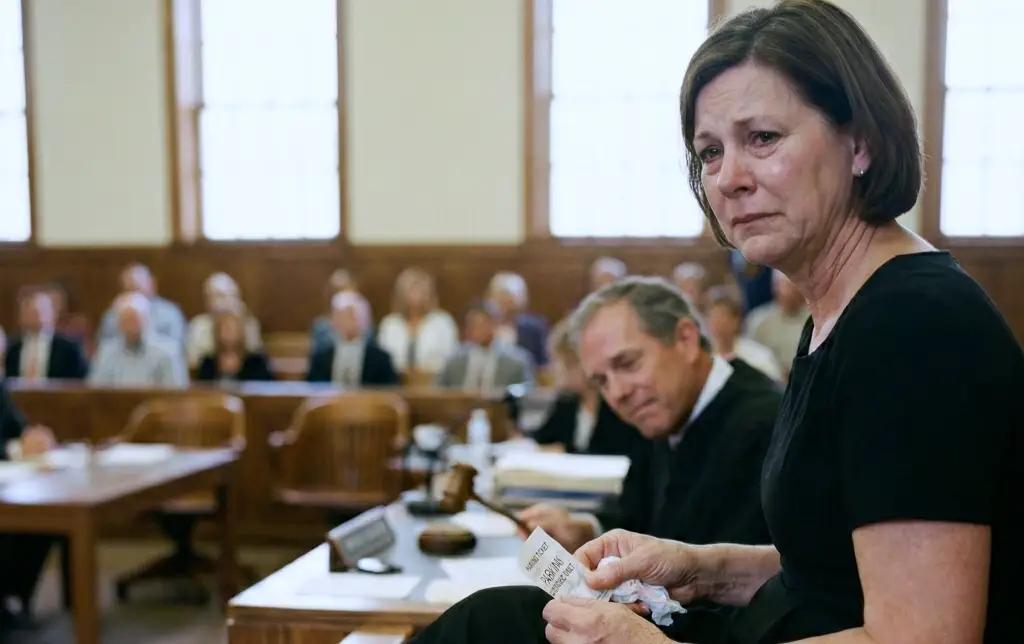
You know, after spending forty years on this bench, I honestly thought I had witnessed every variety of pain and every species of hardship that could possibly walk through my courtroom doors. But on that biting cold Tuesday morning in March, a woman walked in carrying a burden so heavy, so unimaginably cruel, that it didn’t just touch my heart—it broke something inside me.
What she shared with me about where she had been just twenty-four hours earlier, and what the universe had thrown at her in the precise moment she should have been allowed to grieve in peace, still brings tears to my eyes when I think about it.
When I heard the full scope of her story, when I truly understood the hand this poor soul had been dealt, I knew I had to make a decision that transcended the black-and-white letters of the law. I’ve been serving as a municipal court judge here in Providence, Rhode Island, since 1985. That is four decades of seeing people on their absolute worst days. It is forty years of listening to narratives that could shatter your heart into a million pieces or, conversely, restore your faith in the resilience of the human spirit.
My day always begins the same way. The alarm cuts through the dark at 5:30 in the morning. I make my coffee, strong and pitch black. No sugar. That is exactly the way my father taught me to drink it when I was just a boy.
My father arrived on these shores from Italy with nothing more than eight dollars crumpled in his pocket and a wild, desperate dream that his children would grasp opportunities he could only imagine. He worked construction his entire life, callousing his hands to build a future for us, and he taught me a lesson that has been etched into my soul. He used to tell me, «Frank, when you have power over people, that is the moment your character is truly tested. Use it wisely. Use it with mercy.»
I arrive at the courthouse every morning at 8:15 sharp. My clerk, Christina, has been by my side for twenty-three years, and I often joke that she knows my routine better than I do myself. She always has my case files organized meticulously on my desk. She knows I need those quiet, solitary minutes with my coffee to center myself before I zip up the robe. She also has this uncanny ability to read my mood just by the cadence of my footsteps coming through the door.
On that particular Tuesday morning, March 14th, I remember walking in and feeling the chill seeping right into my bones. It was one of those bitter, unforgiving New England mornings where the wind whips off the water and cuts right through your coat. Christina looked up when I entered and offered a soft good morning. She had that specific look on her face, the shadowed expression she wears when she knows we have some heavy emotional lifting ahead of us.
I asked her what we had on the docket for the day, and she handed me the stack of files. It looked like the usual fare—traffic violations mostly, a handful of parking disputes, nothing that seemed out of the ordinary on the surface. But then she paused and said something to me that I remember with crystal clarity.
«Judge,» she said, her voice dropping a distinct octave. «There is one case on the docket this morning that you need to be ready for. The woman just lost her husband. Yesterday was the funeral.»
I looked at her, and I felt my chest tighten in an instant. I asked what she was cited for, and Christina told me it was a parking violation. I remember sinking into my chair, the thought racing through my mind: This woman buried her husband yesterday, and today she has to drag herself to court for a parking ticket?
I sat down at my desk and leafed through the files until I found it. I saw her name, Sarah Mitchell, and I scanned the citation. It had been issued the day after her husband’s funeral. The very next day.
I felt a surge of anger rising in my throat—not at her, of course, but at the cosmic cruelty of the situation. I was angry at the timing, at the fact that in her darkest hour, she had to worry about a mundane bureaucracy like a court appearance. I made a sharp note on her file. I needed to hear her story directly. I wanted to look into her eyes and let her know that the law has room for compassion, that justice isn’t merely about enforcing rules, but about understanding the human beings standing trembling before you.
At nine o’clock on the dot, I walked into my courtroom. It isn’t a large, imposing chamber, not like the ones you see on television dramas with soaring cathedral ceilings and cold marble columns. It is modest and functional, filled with rows of wooden benches where people wait for their names to be called. The American flag stands proudly to my right, and the Rhode Island state flag to my left.
I have presided over thousands of cases in this room. I have witnessed people at their absolute lowest and at their surprising best. I have seen arrogance and humility, bald-faced lies and raw, unvarnished honesty. And over the years, I have learned that every single person who walks through that door carries a story, and that story matters.
I looked out at the gallery that morning and saw maybe twenty people waiting. Some looked nervous, tapping their feet; others looked annoyed, checking their watches; some looked simply resigned to their fate. My eyes moved across the sea of faces until they landed on a woman sitting in the third row. She was completely alone.
She wore a simple black dress and a cardigan that looked like it had been pulled on without much thought or care. Her hands were folded tightly in her lap, white-knuckled, and even from my bench, I could see she was trembling slightly. Her face was as pale as a sheet, and there were deep dark circles under her eyes that spoke of sleepless nights and endless tears. I knew immediately, without checking the docket, that this was Sarah Mitchell.
I started calling the cases. I handled a parking dispute between two neighbors who couldn’t agree on whose car was an inch over the property line. I dealt with a speeding ticket for a young man who swore up and down he was only going five miles over the limit. I listened to excuses and explanations, some genuine, some clearly fabricated. And all the while, I kept stealing glances at Sarah Mitchell sitting there so still, so alone, looking like she was holding herself together by sheer force of will.
At 10:45, Christina finally called her case.
«Sarah Mitchell,» she announced.
I watched the woman stand up slowly, moving as if her legs weren’t quite sure they could support her weight. She walked to the front of the courtroom with small, careful steps. When she finally stood before my bench, she looked up at me, and I saw in her eyes a depth of pain I will never forget. These weren’t the eyes of someone worried about a fine. These were the eyes of someone who had lost her entire world.
I looked down at the citation in front of me. I said, «Mrs. Mitchell, I see here you’ve been cited for parking in a restricted zone on March 13th. Is that correct?»
My voice was gentle. I wanted her to know from my tone alone that I wasn’t here to make her day any worse than it already was.
She nodded and said, «Yes, Your Honor,» so quietly I could barely hear her over the hum of the room.
I asked her to tell me what happened, to explain the circumstances. What she told me next, I will carry with me for the rest of my life. She took a ragged breath, and I could see her physically struggling to keep her composure.
She said, «Your Honor, March 12th was my husband’s funeral. We were married for thirty-two years. He had cancer. It took him in six months.»
Her voice cracked on that last word, and I saw tears start to stream down her cheeks. She didn’t reach up to wipe them away; she just stood there and let them fall. I felt my own throat tighten. I have heard thousands of stories in this courtroom, but there is something about a widow’s raw grief that cuts through every defense you build up as a judge.
She continued, and I could hear the immense effort it took for her to speak. «The funeral was at St. Mary’s Church. My son drove in from Boston. My daughter came down from Connecticut with her two children. We buried Michael at Swan Point Cemetery, the place where we used to walk on Sunday afternoons when things were good, back when he was healthy.»
She stopped and closed her eyes for a second, and I gave her time. I didn’t rush her. In my courtroom, people get the time they need to tell their truth.
«After the burial,» she went on, opening her eyes which were now swimming in tears, «everyone came back to our house. My house. I can’t call it ‘our’ house anymore, can I?»
She looked at me with such lost confusion that I felt my heart break a little. «People brought food. They told me stories about Michael. They meant well, I know they did, but all I wanted was for everyone to leave so I could just be alone with my grief. By evening, everyone was gone. My children wanted to stay, but I sent them home. I told them I needed to be alone.»
I leaned forward, resting my elbows on the polished wood of the bench, listening intently to every syllable she spoke. I said, «Mrs. Mitchell, I am so incredibly sorry for your loss. Please, take your time.»
She nodded, dabbing at her eyes with a crumpled tissue she had fished from her purse. «That night,» she continued, her voice trembling, «I couldn’t sleep. I couldn’t even bring myself to be in our bedroom. Everything in there reminded me of him. His reading glasses were still sitting on the nightstand where he left them. His robe was hanging on the back of the door. I felt like I couldn’t breathe in that room. The silence was suffocating. So, at two in the morning, I got in my car and I just drove.»
I understood that impulse immediately. It resonated deep in my gut. I have been married to my wife, Joyce, for forty-eight years. I cannot fathom the world without her. I cannot imagine that kind of hollow emptiness. I nodded slowly, encouraging her to continue.
«I drove to the places we used to go together,» she said, her eyes looking past me, into the memory. «I drove past the restaurant where he proposed to me forty years ago. I drove past the hospital where both our children were born. I drove past the park where we used to take them on weekends when they were little.»
She took a shaky, jagged breath. «And then… then I drove to the cemetery.»
She paused, and the silence in the room was heavy. «I parked outside the gates. They were closed, of course. It was three in the morning, but through the iron bars, I could see where we had buried him just hours before. I could see the mound of fresh earth.»
She looked down at her hands. «I sat in my car and I talked to him. I told him I didn’t know how to do this life without him. I told him I was scared. I told him I was sorry for every argument we ever had, for every time I was impatient or unkind. I told him I loved him.»
The courtroom was absolutely silent. I could hear the analog clock on the wall ticking away the seconds. I could hear someone in the back row sniffle quietly.
«I don’t know how long I sat there,» Mrs. Mitchell said, her voice barely a whisper. «Maybe an hour, maybe two. I lost all track of time. When I finally looked up, the sun was starting to rise.»
And that was when reality crashed back in.
«That’s when I saw the parking enforcement officer writing me a ticket,» she said. «I was parked in what I guess is a restricted zone right outside the cemetery gates. I got out of my car and I tried to explain. I told him I had just buried my husband. I told him I wasn’t thinking clearly. But he just said he was sorry, but rules are rules. He had to write the ticket.»
I felt something hot surge through my chest. Anger, pure and simple. I wasn’t angry at Mrs. Mitchell. I was furious at a system that could be so cruel, so inflexible in the face of such raw human suffering. I looked down at the citation on my desk again. The parking enforcement officer’s signature was scrawled at the bottom. The time stamp glared up at me: 5:37 in the morning on March 13th. That was less than twelve hours after she had put her husband in the ground.
I looked back up at Mrs. Mitchell and I said, «Ma’am, let me make sure I understand this correctly. You buried your husband on March 12th. That night, overcome with grief, you drove to the cemetery in the early morning hours just to be near him. And while you were sitting in your car, grieving, trying to find a way to go on, you were given a parking ticket.»
She nodded, a tear slipping off her chin. «Yes, Your Honor,» she whispered. «And the fine is seventy-five dollars. Which, I know, isn’t a lot of money to some people. But right now, with the funeral expenses and the medical bills we’re still paying off, it feels like a mountain.»
I sat back in my chair and I had to take a moment to compose myself. I have presided over thousands of cases. I have seen people try to manipulate the system, lie their way out of tickets, and make up elaborate excuses for why the rules shouldn’t apply to them. But I have also seen genuine hardship. I have seen people struggling against circumstances that would break most of us. And I have learned that my job isn’t just to enforce the law mechanically, like a robot. My job is to administer justice with wisdom and mercy.
I looked at Mrs. Mitchell standing there, looking so small and fragile before my bench. I thought about my own father’s funeral twenty years ago. I remembered standing at his grave after everyone else had left, not wanting to walk away because walking away meant accepting that he was really, truly gone. I remembered my wife finding me there hours later, just standing in the cold, unable to move my feet. I understood exactly what this woman had been going through.
I made my decision in that moment. There wasn’t a doubt in my mind. I picked up my gavel, but I didn’t strike it yet.
I said, «Mrs. Mitchell, I want you to listen to me very carefully. You did nothing wrong. Nothing. You were a grieving widow seeking comfort in the only way you knew how. You were trying to feel close to your husband one more time. That is not a crime. That is not something that deserves punishment. That is human. That is what love looks like when it has nowhere else to go.»
I saw her eyes widen slightly. I saw a tiny spark of hope flicker there for the first time since she had walked into my courtroom.
I continued, my voice firm but kind. «This citation is dismissed. You owe nothing. Not seventy-five dollars, not seventy-five cents, not one single penny. You have paid enough. You have suffered enough. This court will not add to your burden.»
I brought the gavel down with a sharp crack that echoed through the silent courtroom.
Mrs. Mitchell stood there, frozen, and for a moment, I wasn’t sure she had fully understood me. Then I saw her shoulders begin to shake. The tears that had been falling quietly became sobs, deep, wrenching sobs that came from the very center of her grief. But I could see they were different now. They weren’t just tears of sadness. They were tears of relief, of gratitude, of feeling seen and understood in a moment when she probably felt completely alone in the world.
Christina immediately stepped forward from her desk with a fresh box of tissues. Mrs. Mitchell took several and pressed them to her face, hiding her tears. I waited. I have learned over the years that sometimes people need a moment to let it all out, especially in a place where they thought they would find only judgment and punishment.
When she finally looked up at me, she said something I will never forget. She said, «Thank you, Your Honor. Thank you for understanding. Thank you for seeing me as a person and not just a case number.»
I nodded to her and I said, «Mrs. Mitchell, you are not a case number. You are a woman who loved her husband for thirty-two years and lost him too soon. You are a mother and a grandmother doing her best to hold it together when everything is falling apart. That is who you are.»
I leaned in closer. «And I want you to know something else.» I paused to make sure she was listening. «Your husband would be very proud of you coming here today, facing this, when I am sure all you wanted to do was stay in bed and hide from the world. That takes courage. You honor his memory with that courage.»
She smiled through her tears, a small, broken smile that somehow held a glimmer of light. «He always said I was stronger than I knew,» she whispered.
I smiled back at her. «He was right,» I said. «Now, you go home. You take care of yourself. You lean on your children and your grandchildren, and you take all the time you need to grieve and heal. This court case is over.»
She thanked me again, three or four times, and then she turned and walked back down the aisle. I watched her go, and I saw several people in the gallery reach out to touch her shoulder or her hand as she passed. They were small gestures of comfort from strangers who had witnessed something real and human in a courtroom.
After she left, I sat there for a moment before calling the next case. I thought about the parking enforcement officer who had written that ticket. I understood he was doing his job. I understood that rules exist for a reason.
But I also understood that rules without compassion become tyranny. Laws without mercy become oppression. My father taught me that. He said the letter of the law is important, but the spirit of the law is what matters. The spirit is about fairness, about decency, about recognizing that we are all human and we all stumble and fall sometimes.
I called the next case, and then the next, moving through the morning docket. But my mind kept returning to Sarah Mitchell. I kept seeing her face, the raw pain in her eyes, the way her whole body seemed to carry the weight of her grief. And I kept thinking about that parking ticket written at 5:37 in the morning outside a cemetery gate. What kind of society do we live in where that happens? What kind of system are we running?
At noon, the court finally broke for lunch. I retreated to my chambers, closing the heavy door behind me to shut out the hum of the hallway. I sat at my desk and unwrapped the sandwich Joyce had packed for me that morning—turkey on rye, just the way I like it. But as I stared at it, I realized I couldn’t take a bite. My stomach was in knots. I pushed the plate aside and just sat there, staring at the wall, my mind replaying the image of Sarah Mitchell standing in front of the bench.
A soft knock interrupted my thoughts. Christina poked her head in and then stepped inside. She looked at me, her expression serious.
«That was the right call, Judge,» she said quietly.
I nodded, rubbing a hand across my forehead. «I know it was,» I said. «But it makes me angry, Christina. It makes me genuinely angry that she had to come here at all. It makes me furious that nobody along the way—from the officer who wrote the ticket to the clerk who processed it—nobody stopped and said, ‘Wait a minute, this isn’t right.’ Why did it have to get all the way to me?»
Christina sat down in the chair across from me. She has been with me long enough to know when I need to talk something through, to vent the steam before it builds up too much pressure. «You can’t fix the whole system, Frank,» she said gently. «But you can make sure that in your courtroom, compassion wins. You did that today. That woman will never forget what you did for her.»
I knew Christina was right. She usually is. But I also knew I wanted to do more than just fix it on the back end. I wanted to address the source.
That afternoon, before the afternoon session began, I picked up the phone and made a call to the parking enforcement department. I asked to speak to the supervisor. When I got him on the line, I explained exactly what had happened. I want to be clear—I wasn’t angry, and I didn’t yell. Screaming rarely gets you anywhere. But I did make it very, very clear that citations like this one reflect poorly on our entire city.
«We have the discretion to be human beings first and enforcement officers second,» I told him. «Please, remind your people of that. Remind them to look at the context before they start writing.»
The supervisor listened, and to his credit, he promised to review their training and policies. I don’t know if anything truly changed after that call—bureaucracies are like large ships; they turn slowly—but at least I tried. Cases like Sarah Mitchell’s are exactly why I still put on these robes every morning after forty years. Because I have the chance to make a tangible difference in someone’s life. I can take a terrible situation and make it just a little bit better. I can remind people that the system isn’t all cold, unfeeling bureaucracy. There are still human beings making decisions, and those human beings have hearts.
That evening, when I finally got home, the house was warm and smelled of roasted chicken. Joyce asked me how my day was as we sat down at the kitchen table for dinner, just the two of us, like we have done for nearly fifty years.
I told her about Sarah Mitchell. I told her about the parking ticket stamped at dawn and the funeral in the cemetery. I saw Joyce’s eyes well up with tears. She reached across the table, past the salt and pepper shakers, and took my hand in hers.
«Frank,» she said softly, «that woman needed you today. She needed someone to tell her she hadn’t done anything wrong, that her grief was valid. She needed to know she wasn’t going to be punished for loving her husband.»
Joyce always knows exactly how to name what I am feeling before I can even find the words myself.
I thought about Mrs. Mitchell a lot in the days that followed. I found myself wondering how she was doing, if she was managing to eat, if she was finding her way through the thick fog of grief. I have learned over the years that grief doesn’t follow a logical timeline. It doesn’t care about your schedule or your obligations. It comes in waves—sometimes gentle, lapping at your ankles, and sometimes crushing, pulling you under. All you can really do is ride them out and trust that eventually, the waves will get smaller and the time between them will get longer.
About three weeks later, I was back in my chambers, wading through a stack of paperwork, when Christina came in holding a white envelope.
«Judge,» she said, «this came for you.»
I looked at the return address and saw the name immediately: Sarah Mitchell.
I opened it carefully, slicing through the top with my letter opener, and pulled out a handwritten letter on simple, elegant stationery. The handwriting was a bit shaky, but perfectly legible. I want to share part of what she wrote with you, because it meant more to me than almost any award or plaque I have received in my career.
She wrote: «Dear Judge Caprio, I hope you don’t mind me writing to you. I wanted you to know what your kindness meant to me. The morning I came to your courtroom, I honestly didn’t know if I could go on. I was drowning in grief and overwhelmed by all the things I suddenly had to handle alone. When that officer gave me the parking ticket while I sat at my husband’s grave, it felt like the universe was telling me it didn’t care about my pain. It felt like I still had to follow all the rules, even though my world had ended.»
I paused, swallowing the lump in my throat.
She continued: «I went to court that day expecting more of the same—more cold bureaucracy, more being treated like a number. But you saw me. You really saw me. You understood. And when you dismissed that ticket, it wasn’t really about the seventy-five dollars. It was about someone in a position of authority telling me I wasn’t crazy, I wasn’t wrong, and that my grief mattered. You gave me permission to be human in my darkest hour. I will never forget that.»
I had to stop reading for a moment. I took off my glasses and wiped my eyes with the back of my hand. I am not ashamed to tell you I cried reading that letter. After forty years on the bench, you would think I would have developed a thicker skin by now. But I don’t. And truthfully, I don’t ever want a thicker skin if it means I stop feeling the weight and the gift of this work.
Her letter went on: «I wanted you to know that I am doing better. Some days are still very hard, but I am finding my way. My daughter convinced me to join a grief support group at the community center, and that is helping. I am learning that grief is love with nowhere to go, and that is okay. It means I loved deeply, and that is not something to be ashamed of. You helped me understand that. Thank you for your compassion. Thank you for reminding me that there are still good people in the world who care. I will be forever grateful. Sincerely, Sarah Mitchell.»
I folded the letter carefully, creasing the paper with my thumb, and put it back in the envelope. Then I opened my bottom desk drawer—the one where I keep the things that matter most. It’s filled with letters from people whose lives I have touched, photos of my family, and a worn prayer card from my father’s funeral. I placed Sarah’s letter right on top. These are the things that remind me why I do this job, and who I want to be as a judge and as a man.
That night at dinner, I told Joyce about the letter. She listened with that patient, loving attention she has given me for nearly five decades. When I finished recounting it, she said something profound.
«Frank,» she said, «you showed her mercy. But more than that, you showed her dignity. You treated her like her pain mattered. That is what she will remember. Not that you dismissed a parking ticket, but that you acknowledged her suffering and responded with love.»
Joyce has always been wiser than me. Her words made me start thinking more broadly about the role of compassion in justice. I have been doing this for forty years, and I have seen the system work beautifully, and I have seen it fail miserably. The times it fails are usually when we forget that laws are meant to serve people, not the other way around. The times it succeeds are when judges, lawyers, police officers, and everyone else in the system remembers that we are dealing with human beings who are complicated, flawed, struggling, and worthy of dignity.
I thought about some of the other cases I have handled over the years where compassion made all the difference. I thought about the single mother who stood before me, terrified because she couldn’t pay her parking tickets. She was working two jobs just to keep food on the table for her kids. I didn’t just dismiss her fines; I connected her with social services that could help her get back on her feet.
I thought about the elderly man with dementia who kept getting lost and driving the wrong way on one-way streets. Instead of taking away his license immediately and leaving him isolated and confused, I worked with his family to arrange transportation and community support.
I thought about the young man with a heroin addiction who kept appearing before me for possession charges. He looked like a ghost of a person. Instead of just sending him to jail repeatedly—which clearly wasn’t working—I got him into a drug court program where he could get treatment. Last I heard, he has been sober for three years, holds down a steady job, and has his own apartment.
These cases remind me that justice isn’t one-size-fits-all. It can’t be. Every person who stands before me brings their whole life story with them. They bring their traumas and their triumphs, their strengths and their weaknesses, their good days and their absolute worst days. My job is to see all of that—to understand it as best I can—and to make a decision that serves both the law and the person standing before me.
It is a question I often wrestle with myself in the quiet hours of the night: does the legal system have enough compassion in it? Do I think judges should have the flexibility to consider individual circumstances, or should the law be applied the same way every single time, regardless of the context?
The thing is, showing compassion doesn’t mean ignoring the law. It doesn’t mean letting people off the hook for genuinely harmful behavior. It means understanding context. It means recognizing that not every violation is equal, that circumstances matter, that intent matters, and that the human story behind the action matters.
Think about it this way: When someone parks illegally because they are rushing into a liquor store to buy a case of beer, that is fundamentally different from someone parking illegally because they are sitting outside a cemetery gate grieving their spouse. The law might say both are violations—Section X, Paragraph Y—but justice requires us to see the difference. Justice requires eyes that can see the human being.
I have had critics over the years who say I am too soft. They say, «Judge Caprio, you let people manipulate you with sob stories. You aren’t upholding the law properly.» I hear those criticisms, and I understand where they come from. People want order. But here is what I know after four decades of doing this work: mercy and accountability aren’t opposites. You can hold people accountable while also treating them with compassion. You can uphold the law while also recognizing extenuating circumstances. You can be firm when firmness is needed without being cruel.
I have handled plenty of cases where compassion meant being tough. I remember a man who came before me for his seventh DUI. Seven times he had gotten behind the wheel drunk. Seven times he had endangered innocent lives. He stood there trembling, asking for one more chance, telling me he had a problem, begging for mercy.
I looked him dead in the eye and I said, «I am giving you mercy right now. I am giving you mercy by taking your license permanently and sending you to jail.»
He looked shocked, but I continued. «I am showing mercy for all the people you could kill the next time you drink and drive. I am showing mercy for your family who loves you and doesn’t want to bury you. And I am showing mercy for you, because you need to be stopped before you destroy yourself completely.»
That is compassion, too. Sometimes love means saying no. Sometimes mercy means protection, even when it feels harsh in the moment.
But Sarah Mitchell’s case was different. There was no public safety issue. There was no pattern of disregard for the law. There was just a grieving widow trying to feel close to her husband one more time, and a system that punished her for it without thinking. That is where discretion comes in. That is where a judge earns their robes—by thinking beyond the citation on the paper in front of them.
Several months after I dismissed Mrs. Mitchell’s case, I was invited to speak at a conference for municipal court judges from across the state. The organizers asked me to talk about judicial discretion and compassion. I accepted immediately because this is a subject that sets my soul on fire.
I prepared my remarks carefully. I decided to tell Sarah Mitchell’s story—with her permission, of course. I had reached out to her beforehand to ask if she would be comfortable with me sharing what happened, and she said she would be honored if it could help other judges think differently about their role.
Standing before a room full of my colleagues, row after row of serious faces, I told them about that freezing March morning. I told them about the parking ticket written at dawn outside the cemetery. I told them about Mrs. Mitchell standing in my courtroom, holding herself together by a thread. And I told them about my decision to dismiss the case.
The room was quiet when I finished. You could hear a pin drop. Then, a judge from Newport raised his hand.
«But what about the law?» he asked. «What about equal treatment under the law? If you dismiss her ticket, don’t you have to dismiss everyone’s ticket?»
It was a fair question, and I appreciated him asking it. It’s the fundamental tension of our job.
I said, «No. Because circumstances matter. Context matters. Equal treatment doesn’t mean identical treatment. It means each person gets the consideration and justice their individual situation requires. Mrs. Mitchell’s case was extraordinary. She wasn’t trying to cheat the system or avoid responsibility. She was grieving. The law must have room for human tragedy, or it stops being justice and becomes mere punishment.»
Another judge, an older man I had known for years, stood up then. He nodded slowly and said, «Frank, I think what you did was exactly right. We have gotten so caught up in efficiency, in clearing our dockets, in processing cases quickly, that we have forgotten to see the people before us. Thank you for reminding us why we took this job in the first place.»
Several other judges nodded in agreement. I felt grateful to be among colleagues who understood that our work is as much about wisdom as it is about statutes.
After the conference, during the coffee break, several judges approached me privately to share their own stories of cases where compassion had made the difference. A judge from Warwick told me about a veteran with PTSD who kept getting citations for an expired registration. Instead of piling on fines that would only increase the man’s stress, the judge connected the veteran with services that helped him get the support and organization he needed to get legal.
A judge from Pawtucket told me about a teenager caught shoplifting who was actually stealing food because her family was hungry. Instead of prosecution and a criminal record that would ruin her future, the judge arranged for the family to get emergency food assistance and job placement services.
These stories reminded me that I am not alone in believing justice requires a human touch. You know what keeps me doing this job after forty years? Moments like these. Knowing that I am part of a system that, at its best, doesn’t just punish, but also heals. A system that recognizes human dignity. A system that can look at a grieving widow and say, «We see you, we understand, and we are not going to make your life harder.»
I think often about what my father would say if he could see me now. He died twenty years ago, but his voice is still in my head, guiding me every day. He was a simple man, a construction worker who never stepped foot in a college classroom. But he possessed a wisdom that came from a hard life lived with integrity.
He used to tell me, «Frank, when you have the power to make someone’s day better or worse, always choose better. Always. It costs you nothing, and it means everything to them.»
I try to live by that principle in every case I handle. I have dismissed fines for people who genuinely couldn’t pay them. I have arranged payment plans for people struggling financially. I have connected people with social services, job programs, addiction treatment, and mental health resources. I have tried to see beyond the citation or the charge to the human being who needs help, not just punishment.
But I have also been firm when needed. I have thrown the book at drunk drivers who showed no remorse. I have been tough on people who showed a pattern of disregard for the safety of others. I have held people accountable for their choices. Because compassion doesn’t mean there are no consequences. It means the consequences are proportionate, fair, and delivered with respect for human dignity.
Sarah Mitchell’s case taught me something I should have already known but needed to be reminded of. Grief is not a crime. Suffering is not an offense. Being human in a moment of overwhelming pain is not something that deserves punishment. Our legal system sometimes forgets that. It gets so tangled in rules and procedures that it loses sight of the people those rules are supposed to serve.
I want to tell you about something else that happened about six months after I dismissed Mrs. Mitchell’s ticket. I was at the grocery store on a Saturday morning, pushing a cart and doing the shopping Joyce had asked me to do. I was in the produce section, squeezing avocados trying to figure out which ones were ripe, when I heard a familiar voice behind me.
«Judge Caprio?»
I turned around and saw Sarah Mitchell standing there with her own shopping cart. She looked different than she had in my courtroom. She still had sadness in her eyes—that kind of deep-seated sadness that never fully leaves after you lose someone you love. But she also looked lighter somehow, like she had found a way to carry the weight without collapsing under it.
I smiled and said hello. She came over and took my hand in hers.
«I wanted to thank you again,» she said. «Not just for dismissing the ticket, but for treating me like I mattered. I have thought about that day so many times, about your kindness. It helped me more than you know.»
I told her I was just doing my job the way it should be done.
She shook her head. «No,» she said firmly. «You did it the way it should be done. Most people just do their job. There is a difference.»
We talked for a few minutes there in the produce section, ignoring the shoppers bustling around us. She told me her daughter had just had another baby—her third grandchild. She told me she had gone back to work part-time as a librarian, surrounded by books, which she loved. She told me she had started volunteering at a grief support group, helping other people who were walking the same dark path she had walked.
«I figured if I could help someone else the way you helped me,» she said, «then maybe some good could come from all this pain.»
I felt my eyes get misty right there next to the avocados. This woman, who had stood in my courtroom six months earlier barely able to speak through her tears, was now using her pain to help others. That is the resilience of the human spirit. That is what we are capable of when we are treated with dignity and compassion instead of coldness and bureaucracy.
Before we parted ways, she said something I will never forget. She said, «Judge, you gave me back my faith that day. Faith that the world isn’t all cruel. Faith that there are still people who care. Faith that I could get through this. Thank you for that gift.»
I hugged her right there in the store—something I rarely do, but it felt like the right thing in that moment. When we stepped back, we were both crying a little, and I didn’t care who saw.
Driving home that day, the hum of the tires on the pavement provided a backdrop for my thoughts. I couldn’t stop thinking about the invisible waves we create with our actions. I had taken two minutes—literally one hundred and twenty seconds—in my courtroom to show compassion to a grieving widow. It cost me absolutely nothing. It cost the city nothing. But to her, it meant the world.
And now, she was taking that compassion and multiplying it, sharing it with others in grief support groups, passing it forward like a torch in the darkness. One small act of mercy had created ripples that would touch people I would likely never meet. That is the terrifying and wonderful power we wield when we choose kindness.
But my mind also drifted to the darker side of that equation. I thought about all the times the system doesn’t work this way. I thought about all the people who fall through the cracks because nobody takes the time to actually see them. I thought about all the cases that get processed mechanically, stamped and filed, without anyone asking, «Wait, what is the story here? What are the circumstances?»
I found myself wondering how many Sarah Mitchells are out there who didn’t have the luck to appear before a judge willing to exercise discretion. That thought made me sad, and it made me angry. We can do better. We must do better.
As my career has progressed, I have become more and more convinced that the best legal outcomes happen when we combine the head and the heart. The head understands the law, knows the statutes, and recognizes the need for order and consequences. The heart understands suffering, recognizes humanity, and sees the person trembling beneath the case number.
Both are necessary. A judge who operates only from the head becomes mechanical and cruel. A judge who operates only from the heart becomes arbitrary and loses credibility. But when you combine both, when you apply the law with wisdom and compassion, that is when justice truly happens.
I have trained younger judges over the years, and this is the core lesson I try to instill in them. I tell them to read every file carefully, to look beyond the charge to the circumstances. I tell them: ask questions, listen to the answers, look people in the eye, see them, and then make your decision based on both the law and your understanding of what is just in this particular situation with this particular person.
Some of them get it immediately. They understand that justice is an art as much as it is a science. Others struggle with it. They are so worried about being perceived as «soft» or being reversed on appeal that they apply the law rigidly, like a bludgeon, without consideration for context.
I understand that fear. Early in my career, I had it too. But I learned that the cases I am most proud of, the ones that let me sleep well at night, are the ones where I had the courage to use my discretion in service of true justice, even if it meant going beyond the strict letter of the law.
Sarah Mitchell’s case is one of those cases. I could have looked at that citation, applied the fine, and moved on. It would have taken thirty seconds. Nobody would have criticized me. But I would have added to the suffering of a woman who was already drowning in pain. And for what? To prove that rules are rules? To show that the law is inflexible? No. That isn’t justice. That is bureaucratic cruelty masquerading as law enforcement.
I want you to think about something for a moment. How many times in your life have you needed mercy? How many times have you made a mistake, been in a tight spot, or just had a terrible, no-good day and needed someone to give you a break? Most of us, if we are honest, can think of multiple times. I know I can.
I think about the teacher who gave me extra time on a test when my mother was sick and I hadn’t studied because I was terrified. I think about the police officer who gave me a warning instead of a speeding ticket when I was rushing to the hospital after my father had a heart attack. I think about the bank manager who worked with me when I fell behind on my mortgage early in my marriage, back when Joyce and I were struggling to make ends meet.
Those acts of mercy didn’t undermine the rules. They acknowledged that I was a human being having a hard time, and that rules should serve people, not crush them. Those people could have been rigid. They could have said, «Rules are rules, Frank, no exceptions.» But they didn’t. They saw me. They exercised discretion. They chose compassion. And I never, ever forgot it. Their kindness shaped how I try to treat others now that I am in a position of authority.
This is what I tried to do for Sarah Mitchell. I saw her. I understood her circumstances. I exercised the discretion I have as a judge and I chose compassion—not because I am some kind of saint, but because it was the right thing to do. Because the law allows for it. Because justice demanded it.
I have been asked many times over the years what I am most proud of in my career. People expect me to name some high-profile case or some legal precedent I set. But honestly, I am most proud of the small moments of compassion. The single mother whose fines I dismissed so she could feed her kids. The elderly man I helped get dementia care instead of just punishing his traffic violations. The young addict I got into treatment instead of just jail.
And Sarah Mitchell, the grieving widow I refused to punish for loving her husband. These aren’t the cases that make headlines. They aren’t the ones that will be taught in law schools. But they are the ones that matter. They are the ones that remind me why I became a judge in the first place—not to wield power, but to serve justice. Not to punish, but to make things right. Not to follow rules blindly, but to apply them with wisdom and heart.
Let me tell you something else about compassion in the courtroom: it isn’t weakness. I have heard that criticism before—»Judge Caprio is too soft.» But that is not accurate. Compassion is not the same as being a pushover. I have sent people to jail when they deserved it. I have imposed stiff fines when behavior warranted it. I have been tough when toughness was needed.
But I have always tried to see the full picture first. I have always tried to understand before I judge. And yes, when I see genuine hardship, genuine suffering, genuine human pain, I err on the side of mercy. Because I would rather face criticism for being too compassionate than face my own conscience for being needlessly cruel.
There is a sentiment I always carry with me, often attributed to the writer Frederick Buechner. He spoke about the capacity to imagine what it is like to be the person standing before you. To feel, even briefly, the weight they are carrying. And to make your decisions based on that understanding.
When Sarah Mitchell stood in my courtroom, I tried to imagine what she was feeling. The emptiness of losing a life partner. The exhaustion of planning a funeral. The pain of seeing his grave for the first time. The loneliness of sitting in a car at dawn with nowhere else to go. The humiliation of getting a ticket in that moment. The dread of having to appear in court the day after burying her husband. When I put myself in her shoes, even for a moment, the decision became clear. This woman needed compassion, not punishment.
I am eighty-two years old now. I have been doing this work since before many people were even born. And I have learned that at the end of the day, the only things that really matter are how we treated people and whether we made the world a little bit better or a little bit worse with our time here.
The cases I remember, the ones that stay with me, aren’t necessarily the most legally complex. They are the ones where I got to be fully human, where I got to use my position not to dominate, but to serve. Where I got to look someone in the eye and say, «I see you, I understand, and I am going to help.»
Sarah Mitchell gave me that opportunity. She walked into my courtroom carrying an unbearable burden, and I got to lighten it, even if just a little. I got to send her home knowing that the system wasn’t going to kick her while she was down. I got to remind her that there is still goodness in the world, still people who care, still hope even in the darkest times. That is a gift. She gave me as much as I gave her.
I also think about the message that case sent to everyone else in the courtroom that day. The twenty or so people sitting in the gallery who witnessed that interaction saw a judge treat someone with dignity and respect. They saw compassion in action. They saw that the legal system can work the way it should. Maybe some of them went home and told their families about what they had seen. Maybe some of them were a little kinder to someone that day because they had witnessed kindness. Maybe the ripples extended even further than I know. I hope so.
This is why I believe so strongly in the concept of restorative justice, in the idea that our system should be about healing and making things right, not just about punishment. Don’t misunderstand me—some people need to be punished. Some behaviors require serious consequences. But many cases, maybe most cases, are opportunities for restoration, for education, for compassion, for helping people get back on track rather than just knocking them down further.
Sarah Mitchell didn’t need to be punished. She needed to be seen and supported. The parking ticket wasn’t going to teach her anything except that the system is cruel. Dismissing it taught her that compassion still exists, that people still care, that she wasn’t alone. Which lesson is more valuable? Which one makes our society better?
I wish every judge, every police officer, every government official who interacts with the public would ask themselves that question: «What is this person really being taught by how I treat them? Am I teaching them that the system is fair and compassionate, or am I teaching them that the system is cold and punitive? Am I building trust or destroying it? Am I part of the solution or part of the problem?» These are the questions that keep me up at night sometimes.
I am going to tell you one more thing about that case, and then I want to leave you with my final thoughts.
About a year after I dismissed Mrs. Mitchell’s ticket, I was honored by the Rhode Island Bar Association for my years of service. It was a nice ceremony, with a lot of kind words and a plaque from my office. At the reception afterward, a woman approached me whom I didn’t recognize at first. Then I realized it was Sarah Mitchell. She was wearing a beautiful blue dress, and she had color in her cheeks. She looked like a person who had found her way back to life.
She told me she had read about the ceremony in the paper and wanted to come thank me in person one more time. But she also wanted to tell me something else.
She said, «Judge, I started a scholarship fund in my husband’s name. It is for people who are facing financial hardship due to medical bills or funeral expenses. We raised enough money to give out three scholarships this year to help people pay their bills and get back on their feet. And I want you to know the inspiration for that fund was you. The kindness you showed me. I wanted to pass it on. I wanted to multiply it.»
I was speechless. This woman had taken the compassion I had shown her and turned it into something that would help countless other people. She had taken her pain and transformed it into purpose. She had taken the mercy she received and magnified it. That is the power of compassion. It doesn’t just help the immediate recipient. It creates a ripple effect that extends far beyond what we can see or measure.
I hugged her again and I told her how proud I was of her, how her husband would be proud, and that she was honoring his memory in the most beautiful way possible.
She smiled and said, «I learned from the best.»
I don’t think I am the best, not by a long shot, but I am grateful that something I did on one random Tuesday morning ended up creating something so meaningful. That scholarship fund is still operating today, five years later. It has helped dozens of families who were drowning in medical debt or funeral costs. It has kept people in their homes. It has allowed parents to keep feeding their children. It has prevented financial catastrophe for people who were hanging on by a thread. And it all started because I chose compassion over bureaucracy in my courtroom one morning. That is what I mean when I say our small choices matter.
So here is what I want to leave you with. Whether you are a judge or a teacher, a police officer or a parent, a boss or a friend, you have power in people’s lives. You have the ability to make their day better or worse, to see them or ignore them, to show compassion or withhold it. Choose carefully. Choose wisely. Choose with your heart as well as your head. Because those choices ripple out in ways you will never fully see. They shape lives. They change trajectories. They teach lessons. They create the world we all have to live in.
I am Frank Caprio. I have been on this bench for forty years because I believe in something simple. We are all equal before the law. Every single one of us. Rich or poor. Powerful or powerless. And that law should be applied with wisdom, with discretion, and with compassion. Because we aren’t just enforcing rules. We are serving justice. And justice without mercy isn’t really justice at all. It is just punishment. And punishment alone has never healed anyone or made the world better.
Take care of each other. Show kindness whenever you can. And remember, respect costs nothing, but it is worth everything.