


The moment the stranger slipped that thin, unassuming envelope onto my cafe table and whispered, “You will need this tonight,” I felt the marrow in my bones turn to ice. I knew, with a sudden and terrifying clarity, that my quiet life was about to be dismantled. The cafe was perched on the ragged edge of town, right where the four-lane highway choked down into two narrow lanes and the pine trees pressed in tight on both sides, like they were trying to reclaim the asphalt.
I had been coming to this spot every single Thursday afternoon since my husband passed away. I came because the air always hung heavy with the scent of roasted apples and seasoned timber, and because the owner possessed the rare grace of never asking me how I was holding up. On that particular Thursday, I wasn’t alone. I was boxed into a booth that had been polished smooth by decades of elbows and spilled coffee, sitting across from my son, Lucas, and his wife, Marissa. Outside the plate-glass window, the Oregon sky hung low and slate-gray, threatening the kind of drizzle that chills you to the core, typical for late fall.
Inside, the tension was thick enough to cut. Marissa was stirring her tea without taking a sip, the spoon clinking against the ceramic rim with a rhythmic, hollow tap that made the muscles in my neck knot up.
“You really should think about downsizing, Eleanor,” she said finally. Her voice was light, sugary, but rehearsed. “That land is just too much responsibility for one person now.”
Lucas nodded, a little too quickly. He had my husband’s dark eyes, but he possessed none of his father’s steadiness. “We just worry about you, Mom,” he added, leaning in.
“The taxes, the maintenance… winter is coming around again,” Marissa chimed in, listing the obstacles like bullet points on a presentation.
I smiled, summoning the polite, hollow expression I had perfected over the last year of widowhood. “I have lived on that land for forty-one years,” I said, keeping my voice even. “I know how to take care of it.”
Marissa shot a quick, sharp look at Lucas. I caught it, because mothers always catch those looks. It was the look that said, not yet, but soon. They stood up to pay the bill together, leaning their heads close, whispering in that hushed, conspiratorial tone they had adopted lately. I remained seated, gathering my purse and folding my napkin with deliberate slowness, which is when I felt the presence beside me.
She appeared so suddenly that I startled, my hand jerking hard enough to knock my water glass sideways. The woman was in her early fifties, perhaps a bit older, with iron-gray hair pulled back tight against the nape of her neck. Her coat was dark wool and heavy, far too warm for the heated indoors, and her eyes did not wander or blink.
They locked onto mine with an intensity that suggested she had been hunting for me her entire life.
“Eleanor Hayes,” she said. It wasn’t a question.
“Yes,” I replied, my heart already hammering a frantic rhythm against my ribs.
She placed a thin manila envelope on the table between us. Her finger trembled slightly as she withdrew it. “You will need this tonight,” she whispered, her voice barely audible over the hum of the cafe. “Whatever you do, do not open it here.”
I opened my mouth to demand who she was, how she knew my name, and what on earth she meant, but she was already pivoting away. By the time I managed to stand, she had reached the door and slipped outside, swallowed instantly by the passing traffic and the mist.
I stood there frozen, staring at the beige envelope as if it were a live grenade. Lucas and Marissa returned moments later.
“Everything okay, Mom?” Lucas asked, his brow furrowed.
“Fine,” I said, the word coming out too fast, too sharp. I swept the envelope into my bag before either of them could spot it. My hands wouldn’t stop shaking.
The drive back to my farmhouse passed in a blur of winding road curves and suffocating small talk about the weather and fluctuating real estate prices. They dropped me off at the end of my gravel driveway, declining my offer to come inside. I watched their car’s taillights disappear around the bend, then stood there for a long moment, listening to the wind hissing through the fir trees, feeling suddenly, violently watched.
My house waited at the end of the drive. It was a sturdy structure with old white siding and hunter-green trim—the same home my husband and I had painted together years ago, laughing as we dripped paint on the porch. The land stretched out behind it, acres of dense forest and cleared fields that had been passed down through my husband’s family long before I had married into it.
Once inside, I locked the door behind me—something I hadn’t done regularly before my husband died. The envelope lay heavy in my bag, radiating a weight that felt wrong, like it knew it didn’t belong there. I placed it on the kitchen table and sat across from it for a long time without touching it. The house creaked softly, settling around me as the temperature dropped. Outside, the dusk slid seamlessly into night.
I didn’t know yet that the envelope would lead me to a truth buried deeper than the roots of my old oak trees. I only knew that for the first time since my husband’s funeral, I was afraid of the people closest to me. I waited until the house was completely dark before I touched it.
I don’t know why I stalled. Maybe part of me hoped that if I ignored it long enough, it would lose its power. Maybe I was terrified that once I opened it, there would be no turning back.
I made myself a cup of chamomile tea I had no intention of drinking and sat at the kitchen table, listening to the grandfather clock tick and the wind press against the windowpanes. At exactly 8:47 PM, I slid my finger under the flap. Inside was a small brass key wrapped in tissue paper and a narrow strip of lined notebook paper, folded once.
The handwriting was neat and deliberate.
“11:32 p.m. Answer. Do not call back.”
That was all. No name. No explanation.
My throat felt dry as sand. I checked my phone. 8:51 PM. I had almost three hours to wait.
I went around and locked every door and window, checking the latches twice, though nothing in my life had ever required that level of paranoia before. The land around my house was quiet, as it always was at night. Too quiet. No headlights cut the dark. No voices carried on the wind. Just the sound of the trees swaying in the pitch black.
At 9:30 PM, I tried to distract myself by folding laundry, my hands moving automatically over the fabrics. At 10:00 PM, I gave up and sat back at the table, staring at the key. It was old, heavier than modern keys, with a worn head smoothed down by years of friction. I turned it over in my palm, trying to imagine what lock it might open.
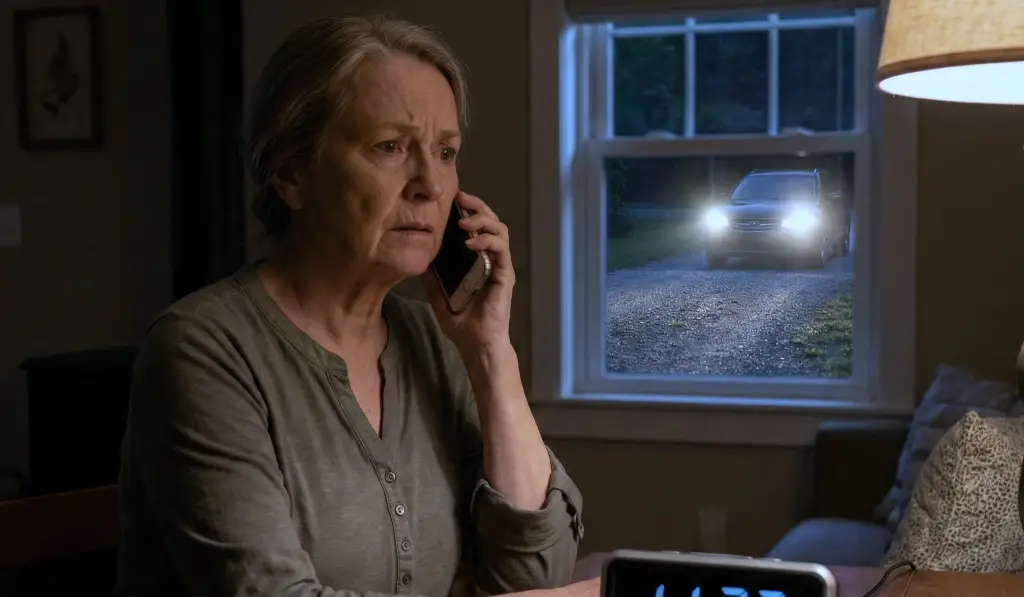
At 11:00 PM, I turned off every light except the small fixture above the sink. The yellow glow made the corners of the kitchen feel deeper, shadowing the familiar room. My phone lay on the table, face up, the screen dark.
11:31 PM. My heart began to pound so hard I could hear the blood rushing in my ears.
At 11:32 PM, the phone rang.
The sound cut through the house, sharp and sudden like a gunshot. I flinched hard enough that my chair scraped loudly against the floorboards. The screen showed no name. No number.
I answered on the second ring. “Hello,” I said, and my voice sounded thin, foreign to my own ears.
At first, there was only breathing—slow, controlled, close to the microphone. Then a voice came through, low and distorted, as if filtered through something electronic, but unmistakably familiar.
“Eleanor,” the voice said.
My knees went weak. I gripped the edge of the table. I had heard that voice for over forty years in kitchens and fields, in bedrooms and hospitals. I had heard it whisper apologies and laughter and promises.
It was my husband.
“No,” my mind screamed. “Impossible.”
“Do not trust Lucas,” the voice continued, urgent and rough. “Do not trust Marissa. And do not trust the local police.”
I pressed my hand to my mouth to keep from crying out.
“You are not safe where you are. The land is the reason. They want it empty.”
“Who is this?” I whispered. My voice shook violently. “This is not funny.”
A pause, a ragged breath. “I wish I could tell you everything,” the voice said, sounding pained. “I wish I could explain. But if I do not keep it short, they will find me.”
My heart slammed against my ribs, a trapped bird.
“My husband did not die the way they told you,” the voice said. “What happened was not an accident, and if you let them push you out, they will erase what I left behind.”
“Erase what?” I whispered.
At that moment, the line crackled violently. The voice cut out, static filling my ear, then returned for one final sentence.
“The truth is under your feet, Eleanor, and you have very little time.”
The call ended.
I sat frozen with the phone pressed to my ear long after the screen went dark. The house felt different now—charged and exposed, as if every wall had suddenly thinned to paper. I checked the call log.
Nothing. No record of the incoming call, as if it had never happened. But my hands were still shaking uncontrollably. My chest ached with a physical pressure. I did not sleep that night. I sat at the kitchen table until dawn, watching the first gray light creep across the linoleum floor, knowing one thing with terrifying clarity.
Whatever had killed my husband was still alive, and it was closer to me than I had ever imagined.
Lucas came back the next morning. He didn’t call first. He never used to do that. When my husband was alive, Lucas always called ahead, out of habit or respect, or maybe fear of interrupting something important. Now, he pulled his sedan into the driveway just after eight in the morning, parking casually as if the place already belonged to him.
I was standing at the sink when I saw his car through the window. My first instinct was to hide the envelope and the key, but I stopped myself. If I acted afraid, he would sense it. Lucas had always been predatorily good at sensing weakness.
He walked in carrying two coffees and wearing a tight smile that didn’t reach his eyes. “Morning, Mom,” he said, placing one paper cup in front of me. “You look tired.”
“I didn’t sleep well,” I said evenly, watching him.
He sat down across from me, glancing around the kitchen like someone conducting a quiet inspection. His eyes lingered on the door to my husband’s old office a second too long.
“We need to talk,” he said.
I waited.
“Marissa and I have been discussing your situation,” he continued, clasping his hands. “The property, your finances, your health.”
I wrapped my hands around the coffee cup for warmth, but I didn’t drink it. “My situation?”
“Yes,” he said gently, his tone dripping with faux sympathy. “You have been alone a long time now. This land is a burden. You do not need to prove anything anymore.”
There it was again. The same words. The same rehearsed concern.
“I am not a burden to myself, Lucas,” I said, staring him down.
He exhaled through his nose, a flash of irritation crossing his face. “Mom, this is not about pride. It is about reality. The taxes alone are climbing. Insurance, repairs… if something happens out here, no one would even know for hours.”
“Something like what?” I asked.
He hesitated just long enough for the silence to feel heavy.
“An accident,” he said finally. “A fall, a medical episode.”
The word accident made my stomach tighten into a knot.