


The milk pail rattled against Walter Bellamy’s boot when the truck hit a pothole outside the barn. He set it down before he spilled the morning’s work and went to see who was trying to bring a livestock trailer around his narrow turn.
Nothing that size had come to Relloran farm in years. The place held thirty-eight acres, a small herd of milk cows, and enough repairs to keep a sixty-eight-year-old man busy without a delivery.
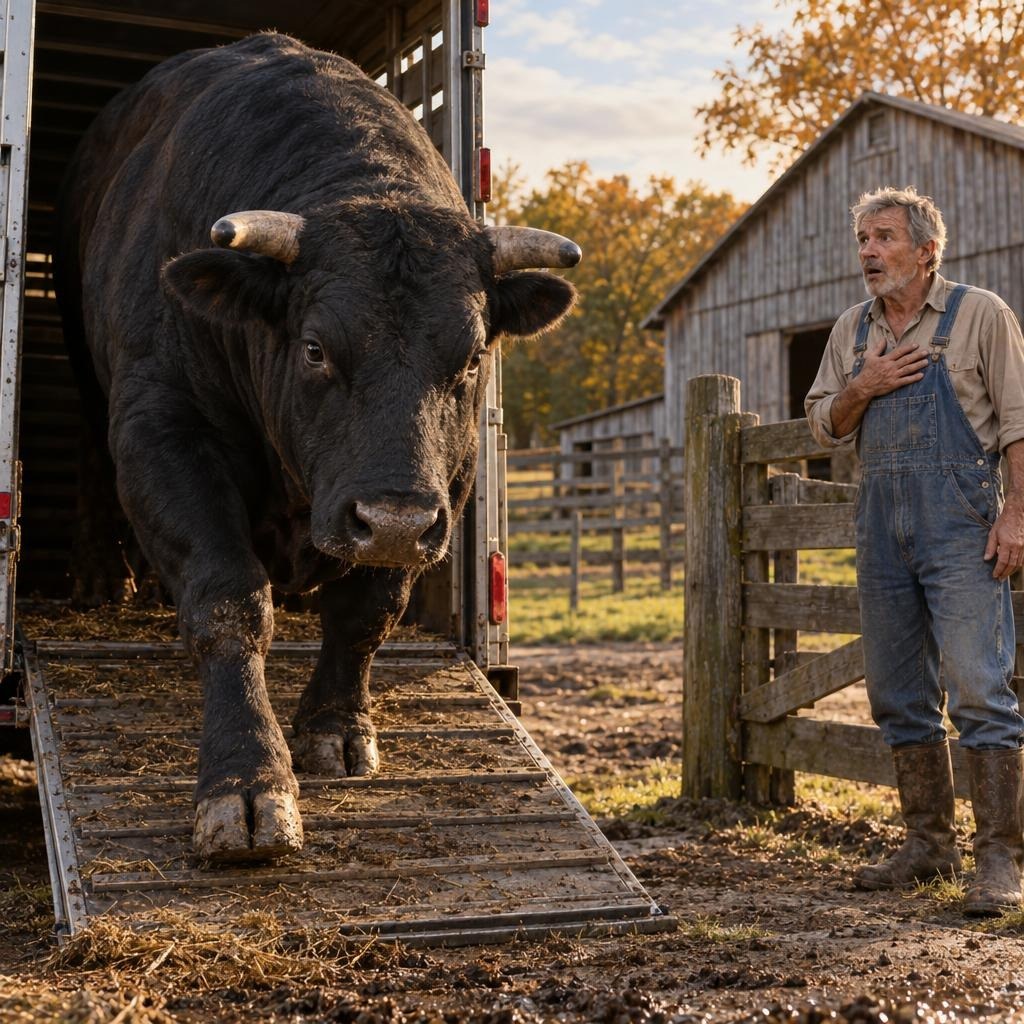
Walter raised one hand. The driver stopped beside the loading pen and climbed down, unfolding a creased shipping sheet against the hood.
“Please tell me you’re looking for directions,” Walter said.
“Relloran?” The man pointed at the paper. “Carroll County, Virginia?”
“That part’s right.”
“Then I’ve got your bull.”
Walter took off his glasses and cleaned them with his shirt. He put them back on. The truck was still there.
“My what?”
The driver, whose shirt pocket said Dale, showed him the destination. A gray Brahman bull named Atlas had come from Wyoming, with three days on the road behind him. Somewhere in the shipping paperwork, an incomplete address had become Walter’s address.
“I haven’t bought livestock,” Walter told him. “Not lately, and never a Brahman.”
Dale checked his phone, tried the number on the order, and got no answer. He looked toward the trailer when something heavy struck its side.
“He’s been standing too long. You’ve got a sound pen. Can we at least get him off while they straighten this out?”
Walter studied the latches. He had rebuilt that pen himself. Finally, he opened the outside gate.
The animal that backed down the ramp made the loading chute look undersized. His pale hide darkened along his neck; loose skin swung beneath his throat, and the high shoulder hump nearly filled the opening. According to the transport sheet, he weighed a little over twenty-six hundred pounds.
Walter stayed outside the fence.
Atlas turned slowly, taking in the dairy barn, the water trough, the cows watching from beyond a second gate. Then he stood with his head low while Dale secured the pen.
By the time Walter had found the right number to call about the mistake, Dale was handing him an envelope. The transport office would sort it out, he said. He had another job waiting and a long drive home.
Walter watched the empty trailer leave. Then he opened the envelope on the feed-room counter.
There were health certificates, registration papers, and copies of reports from three breeding facilities. Certain words kept appearing: charging, refusal, damage, unsafe. Someone had underlined a warning about handling him.
Outside, Atlas hadn’t moved.
Walter carried the papers back to the fence. “They’ve written quite a bit about you.”
One broad ear turned toward him.
“I’d like to hear your side, but I expect we’ll have to work up to that.”
The bull lifted his head. Walter had braced himself for restless pacing or a rush at the boards. Instead, the animal watched him with a stillness that bothered him more than the warnings had.
June used to bring home creatures that watched people that way. Dogs that flinched when a broom fell. A pony that wouldn’t enter a stall if a man stood behind him. His wife had always begun by giving them somewhere to stand without being bothered.
Walter checked the water and left the bull alone.
Nora Voss arrived before he finished cleaning the milking equipment. Her old pickup had hay caught beneath the rear bumper, and one of her rescued horses was calling after it from the adjoining property.
She came through the farm gate carrying the gloves she’d forgotten there the week before.
“Walter. Why is there a rhinoceros beside your barn?”
“Apparently he’s a bull. I’ve got documents.”
At fifty-three, Nora could still cross a pasture faster than most people walked down a hallway. She slowed when she reached the pen, though, and accepted the envelope without looking away from Atlas.
Then she found his pedigree.
“His sire was Sable Crown.” She turned a page, checked it again. “Do you know what people paid for that bloodline?”
“I know nobody’s paid me for boarding his son.”
Her smile disappeared as she read the behavior reports. Atlas had begun moving toward them. Walter reached for Nora’s sleeve, but she stopped well short of the fence and let the animal come at his own pace.
At close range, the marks were visible: an old rubbed ring around his neck, thin scars along his side, bare places where the hair had never grown back evenly.
Nora lowered her gloves.
“Oh, sweetheart,” she murmured. “They made every day an argument, didn’t they?”
She held her hand near the rail, not through it. Atlas stretched his nose toward her fingers and paused there, breathing across her palm.
Walter watched Nora’s face change. She had spent years coaxing frightened horses out of trailers; she didn’t mistake a lowered head for proof of safety. Still, she stayed beside him a long while.
“Maybe somebody finally made a useful mistake,” she said.
Walter went back for another bucket of water.
By Friday, three days after the delivery, the shipping office still hadn’t arranged a collection. Walter had put Atlas in the adjoining pasture, behind stout fencing, where he could see the milk cows and share their grazing without being crowded.
That afternoon, Walter was replacing a rotten post when Mabel, his oldest Holstein, stepped into a slack loop of discarded fence wire. She pulled back, tightened it around her lower leg, and bawled.
Walter dropped his hammer and reached for the cutters.
Atlas got there first.
The bull stopped beside Mabel instead of pressing into her. He nosed beneath the loose length of wire, raised it, and shifted his head. With the tension gone, Mabel pulled her foot free.
Walter stood holding cutters he hadn’t opened. Atlas stepped away while Mabel limped two paces, tested her leg, and went back to cropping grass.
“Well,” Walter said at last.
He gathered every scrap of wire before he picked up his hammer.
The story escaped the farm before supper. By the weekend, neighbors were finding reasons to stop by. One brought a borrowed wrench Walter couldn’t remember lending him. Another asked about hay, though his own shed was full.
Hank Pruitt leaned against his truck with a coffee flask tucked under his arm.
“Fellow I know says that bull put a man in the hospital out west. Nearly killed him.”
Walter pointed through the gate. Atlas was standing beside Mabel while she scratched her chin on a fence post.
“I can tell you what he did here,” he said, and told Hank about the wire.
Nora returned that afternoon with Dr. Elaine Mercer, who had been treating livestock around the county for most of her working life. At forty-six, Elaine had a permanently sun-faded veterinary bag and little patience for anybody who confused affection with good fencing.
She inspected the pen before she read the reports.
“Keep these latches fastened,” she told Walter. “Whatever else he is, he’s still a mature bull.”
Then she stood with them beneath the barn overhang, looking across the pasture. Atlas had settled under the spreading oak. The cows grazed nearby, switching flies away with their tails.
Elaine read an account of a destroyed handling gate, then another involving an injured worker.
“There’s serious history here.” She glanced up. “But this isn’t the animal I expected to find after reading it.”
Nora rubbed a bit of dried mud from her wrist. “You’ve seen my horses arrive with reputations. Sometimes the reputation belongs to whoever had them last.”
Elaine closed the folder.
“Rough handling, isolation, repeated restraint. Any of those can produce defensive behavior. Together, they can make an animal impossible to work around.”
Walter looked toward the old marks on Atlas’s neck. “And then the next place reads the warning and starts harder.”
“Yes,” Elaine said. “That can happen.”
After everyone left, Walter carried hay along the fence. Atlas came to the rail and waited. Walter offered a loose handful, keeping his fingers flat.
The bull gathered it with such care that Walter felt little more than warm breath.
June would have enjoyed that. He could almost hear her calling him outside to look, telling him to leave the dishes because this was worth seeing.
He stayed until the hay was gone.
The kitchen phone rang while he was washing up the next morning. The caller introduced himself as Garrett Vasken, owner of a breeding ranch in Wyoming.
“My transport records show a stop at your property. You have a registered Brahman called Atlas?”
Walter dried one hand on a dish towel. “I’ve been trying to get someone to explain where he belongs.”
“He belongs at the Relloran breeding facility. Not your place. They were holding him for an auction shipment tomorrow.”
Walter looked through the window. Atlas was following the cows toward the sunny side of the pasture.
“I can have a truck there this afternoon,” Vasken continued. “Don’t try loading him yourself. He’s caused enough injuries already.”
Walter wrote down the collection information. When the call ended, he remained beside the counter until water dripped from the towel onto his shoe.
At the fence, he found Atlas standing where June’s lilacs would bloom in another few weeks. The bull came close enough to rest the side of his face against Walter’s shoulder through the rails.
Walter braced one hand on the post.
“They’ve come to the end of their patience with you,” he said.
The animal stayed there, breathing steadily.
Walter went back inside, found the number on the shipping papers, and dialed.
“Vasken? Bellamy again. Cancel that truck. Tell me what you want for him…”
To read the rest of the story – CLICK the NEXT button 👇👇👇