


Elaine had already filled the good hayrack when the first kick struck the inside of the trailer.
She stood beneath the barn light with an empty feed scoop in her hand. Down the drive, the transport driver was backing his pickup clear of the hitch. The breeder’s trailer was supposed to stay overnight, but the boy had lowered its jack and disconnected it with a speed that suggested he didn’t intend to spend another minute beside it.
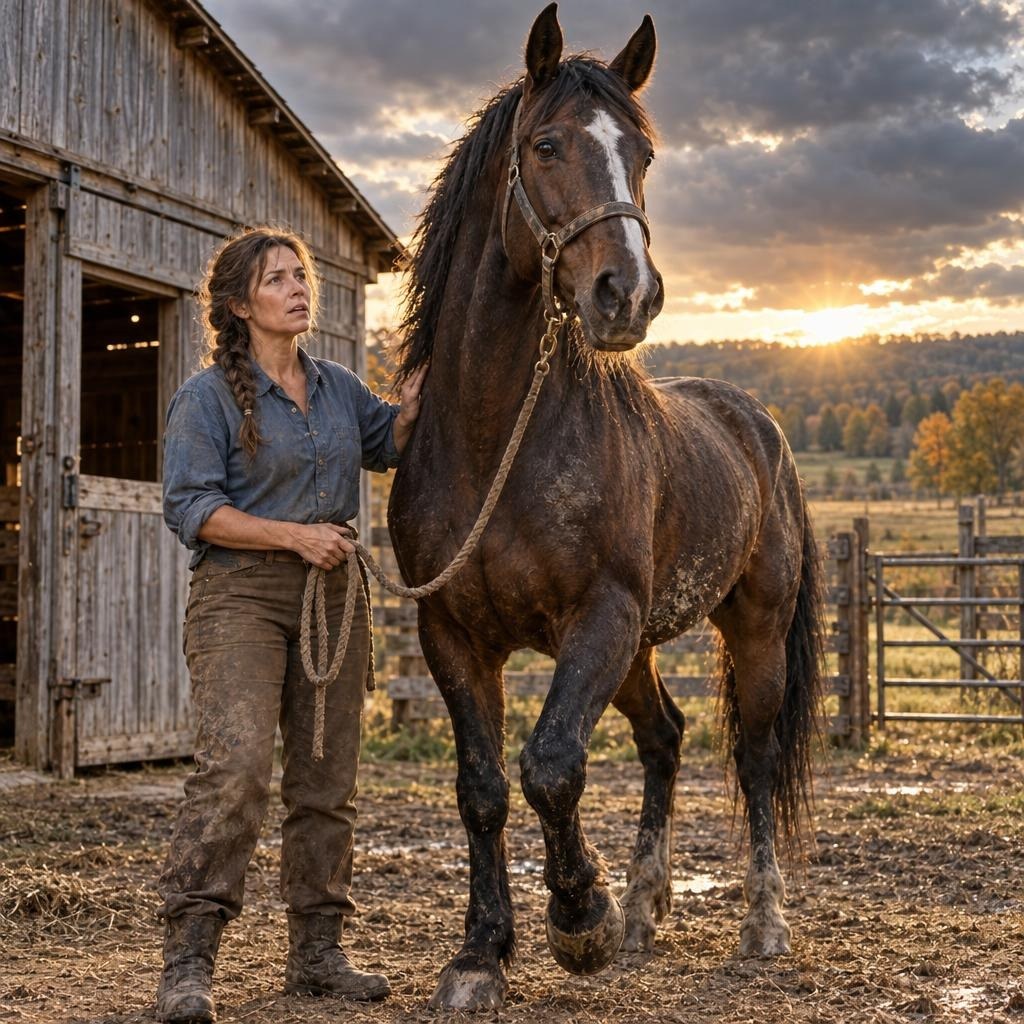
Another blow made the aluminum side jump.
“That isn’t Pudding,” Elaine said.
The boy wouldn’t look at her. Rain ran off his nose onto the collar of his sweatshirt. He hurried around the trailer, lowered the ramp, and pulled a length of cotton lead through an opening beside the door.
“Voss said you bought him. Said he’s not taking him back.”
He pushed the rope into her hands.
Elaine dropped the scoop. “Hold on. What horse have you brought me?”
But the boy was already retreating. His face, young enough to still be troubled by acne, had gone a sickly color.
“I’m not getting in there again.”
The pickup door slammed. Before she could reach the cab, its tires were grinding through the wet gravel toward the road.
For a moment she watched the taillights disappear into the November rain. Then something inside the trailer drew a long, rough breath.
Fourteen months after Daniel’s funeral, she had used the remainder of his insurance money to buy one dependable stallion. There were five mares left on their place outside Talvern, in southern Iowa’s Norwick County. Five mares, a tractor with a knock deep in its engine, and a mortgage that could no longer be paid by selling another piece of equipment.
Garrick Voss, a breeder several counties away, had described Pudding as a golden quarter horse with a record of healthy foals and the disposition of an old porch dog. Elaine had laughed at the name. A stallion a person could handle alone was worth putting up with a foolish name.
The plan required good pregnancies, a marketable first crop, and a lender willing to wait for them. It left no room for whatever was standing in that trailer.
She switched on her flashlight.
The horse had backed against the front wall. White sweat had dried and foamed again across his black chest. His hips stood out sharply, and his mane held burrs, knots, and a short piece of wire. Seventeen hands, she guessed, perhaps more. Too much horse for that narrow space, especially with his head thrown high and his eyes showing white.
She stayed to one side of the ramp.
“Easy. Nobody’s climbing in with you.”
He came out so suddenly that she barely had time to move. A shoe skidded on the metal; his hindquarters slid, and he landed badly in the mud. He scrambled upright and hit the end of the lead.
Pain shot through both her shoulders. She stumbled three steps before finding her footing.
Beyond the drive stood the old boundary fence. Beyond that was the county road, where grain trucks ran after dark. She couldn’t let him reach either one.
Elaine kept the rope clear of her legs and braced herself. The horse swung around her, breathing in short blasts. Whenever she faced him squarely, he flung his head away, so she turned a little sideways and stopped trying to bring him directly toward her.
In the flashlight’s moving beam, pale scars crossed his neck beneath the wet hair.
She let him travel a wider circle. When he slowed, she eased the pressure. When he stopped, she waited with him.
“Well,” she said, rain dripping from her chin, “somebody certainly got the order wrong.”
The barn was less than a minute’s walk away. Getting there took most of an hour.
She gained a few feet, lost some of them, and waited again. Her gloves grew heavy with water. The horse watched every movement of her hands. Once, when she raised an arm to wipe her face, he recoiled so hard she nearly lost him.
After that she left the rain alone.
The large foaling stall was ready for a different animal. Clean shavings covered the floor; a bucket hung full in the corner. Elaine led him through the door, worked the snap free, and backed out.
He wheeled before she had the door shut. A hind hoof struck the lower oak panel and opened a pale split through the wood.
She slid the bolt home with both hands.
Inside, he began pacing from wall to wall, turning hard each time. Elaine stood in the aisle until she could breathe without her teeth chattering. Then she went to the tack room and lifted the landline receiver.
Voss let it ring until his recorded greeting answered.
“The horse you delivered isn’t the horse I bought,” she said. “Send my money back and come get him. Otherwise I’ll take this to the sheriff.”
She held the receiver a moment after the recording beeped again.
The wire transfer was settled. There would be records of it, but records weren’t the same as getting her money returned. Voss knew she couldn’t afford a drawn-out civil fight. She had told him enough about her circumstances while asking for a price she could manage.
Back at the stall, she found the horse pressed into the far corner. His ears followed her footsteps. His nostrils fluttered.
She rested the flashlight on a shelf, pointing it away from his face.
“Havoc,” she said quietly. “That’ll do for now.”
He stared at her.
“I haven’t got anywhere else to put you.”
By morning the rain had frozen on the gate latches. Within a week, the churned mud had hardened into ridges that threatened an ankle with every step.
For two weeks Elaine couldn’t lay a hand on him.
Feeding became an exercise in waiting. She would move the stall door a fraction, and his teeth would come toward the opening. She shut it before he reached her, set the bucket down, and gave him ten minutes. Eventually he would withdraw far enough for her to replace the water and leave his measured feed and hay.
She carried five-gallon pails until her wrists hurt. She learned where to set her boots so he could see them coming. She stopped wearing the jacket whose sleeves rasped loudly when she bent her arms.
In the third week, she called Dr. Keene.
He had cared for Daniel’s horses for twenty years. Elaine could identify his old truck by the uneven idle before it rounded the shed. He came into the barn smelling of tobacco, disinfectant, and the cold air trapped in his coat.
He watched Havoc for several minutes without speaking.
Then he said, “Have him put down.”
Elaine kept her hand on the door latch. “That’s everything I had for a breeding horse.”
“You won’t get a breeding horse out of this.”
Keene turned to her. Havoc struck the bars behind him with his chest, snapping at the shoulder of his coat. The veterinarian stepped clear without hurrying.
“See those marks above the front fetlocks? Pinfiring. And the damage along his back? Somebody kept a saddle on him when they had no business doing it. I’d say he came off a track, then went through the bottom end of the sale circuit.”
Elaine looked at the horse’s front legs.
“They worked him sore,” Keene continued. “Then punished him when he wouldn’t work. That explains him. It doesn’t make him safe.”
“He wasn’t born doing this.”
“You don’t know what temperament you’d be breeding, either. And if he catches you in there, you could end up buried beside Daniel.”
Her hand tightened on the latch.
“Leave Daniel out of it.”
Keene put his gloves back on. “I knew him too, Elaine.”
“Then you know he didn’t need anybody speaking for him. Send your bill.”
She waited until the truck had gone before returning to the stall. The mares were outside in the sheltered lower field, and the barn had settled into its small daytime noises: a loose pane ticking in the wind, a mouse working somewhere behind the grain bin.
Havoc stood with one forefoot advanced, ready to move. Even resting seemed beyond him. Elaine knew that way of holding herself, the jaw sore each morning from clenching through the night.
She went into the tack room. Behind Daniel’s old saddle was a folding chair with faded canvas stretched across its aluminum frame. She took it down, tucked a battered mystery paperback into her coat, and returned to the stall.
When the door opened, Havoc swung his hindquarters toward her.
Elaine kept the doorway clear behind her. She set the chair just inside and sat down…
To read the rest of the story – CLICK the NEXT button 👇👇👇