


Nolan Kessler had a week’s pay folded in his coat pocket when he crossed the yard to dismiss Evelyn Mercer. He had chosen the amount before breakfast. It seemed fair, and fairness was the one part of the conversation he felt prepared for.
Then he saw where his chestnut gelding had put his head.
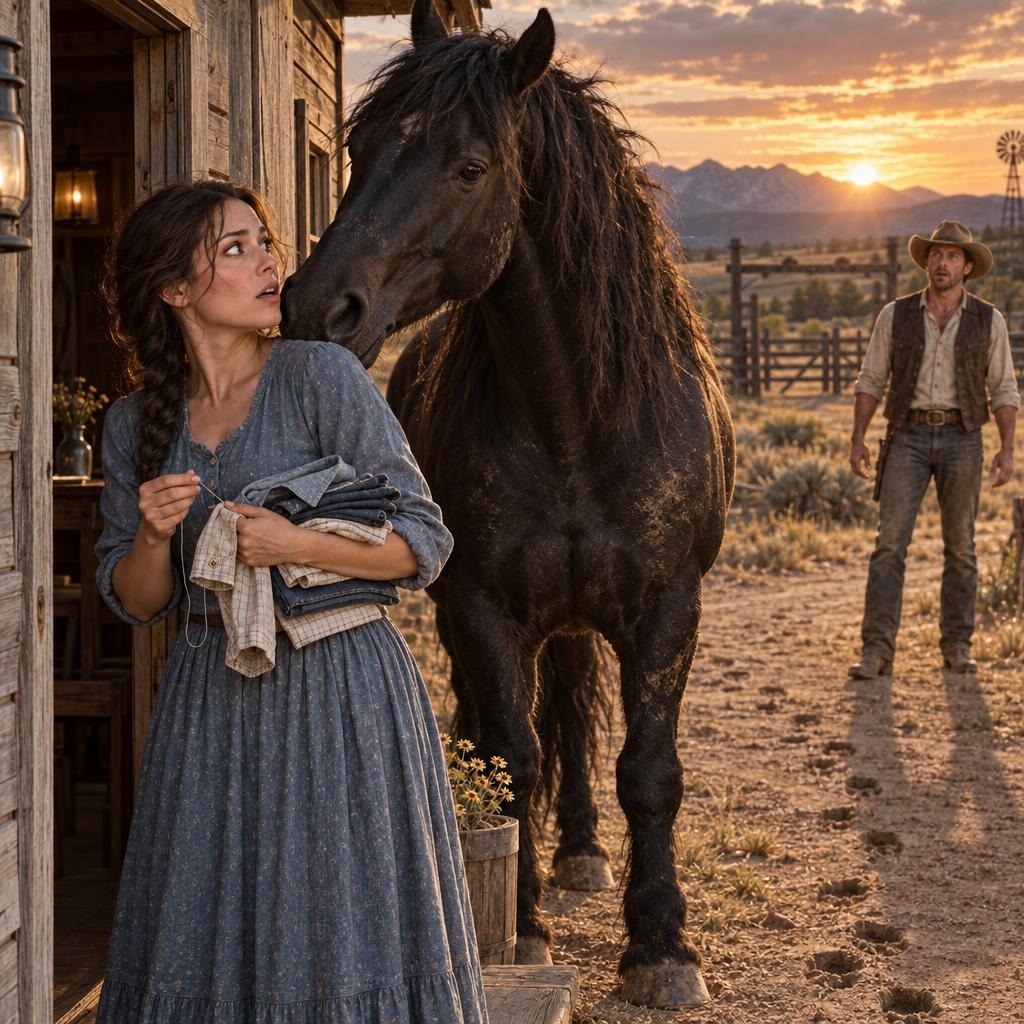
Flint’s muzzle rested against the front of Mrs. Mercer’s apron. Her fingers moved slowly along the hard bone above his nostrils, and a low, wandering hum came from somewhere behind her closed lips. The horse stood square on all four feet. Not a twitch in his flank. Not an ear pinned back.
For four months, every man who approached that animal had measured the distance to the nearest fence.
Nolan stopped beside the pump. The folded money stayed in his pocket.
Two mornings earlier, he had watched her lift a covered sewing machine from a stagecoach and wondered whether he had just hired more trouble than his autumn work could accommodate.
The trouble had begun with a letter.
Silas Dodd, his foreman, had heard about a capable widow while collecting feed bills in Elmrath. The postmaster’s wife said Mrs. Mercer had worked for respectable households in Helena and had made a ruined dress wearable while its owner waited.
“Does she mend work clothes?” Nolan had asked.
“Likely doesn’t consider a torn shirt beneath her talents.”
Silas was sixty-four, narrow through the shoulders, with hands that looked permanently stained by harness oil. He had worked for Nolan long enough to answer the question behind a question and ignore the one spoken aloud.
Nolan told him to write.
The reply arrived on stiff paper, without a wasted line. Mrs. Mercer could begin on September twenty-second. She required wages paid regularly, a room set aside for her work, and the courtesy of her proper name. She would not answer to a shout of “sewing woman” across a yard.
Nolan read the letter again after putting it down.
“Agree to it,” he told Silas.
Now she stood beside the stage with a battered trunk, a carpetbag, and the machine in its fitted wooden base. She was thirty-two, though he learned that later. Her dark hair was tucked under a traveling hat, and the loose stitching at one cuff had been repaired so neatly he noticed only because one replacement button was pale where the others were brown.
She was also beautiful. Nolan registered that fact with the same unwelcome clarity with which he registered a storm beyond the northern ridges.
“Mrs. Mercer.” He offered his hand.
Her grip was brisk and assured. “Mr. Kessler. I trust the letter arrived.”
“It did. Silas has your cottage ready.”
“Then perhaps he can take my trunk there while you show me the workroom.”
“You might prefer to settle in.”
“I’ll settle more easily once I’ve seen the room.”
Behind her, Silas bent to the trunk. His mouth disappeared beneath his mustache.
The ranch lay in the Montana foothills, beyond a town that took most of a morning to reach by wagon. September had browned the exposed slopes, and the men were bringing cattle down from the upper grazing before the weather closed over them. Seven hands had work enough for twice that number. Three weeks remained before the drive.
A sack of torn clothing waited beside the kitchen passage. Nolan led Mrs. Mercer past it into a room with a broad worktable and an east-facing window.
She put down her carpetbag, pressed on the chair seat, and watched one leg lift from the floor.
“I’ll use another chair.”
“That one can be repaired.”
“Certainly. Meanwhile, I’ll need one that won’t throw my back out before dinner.”
He rubbed his thumb along the doorframe. “There’s another in the study.”
“And the window must stay clear while I’m doing the morning stitching.” She looked outside at a stack of empty crates. “Please tell the men before they find that wall convenient.”
“They’re usually out working.”
“So am I. Dark cloth takes good light. If I spend a morning squinting, I may spend the following day unable to sew.”
Every request was reasonable. That did not make receiving them less disconcerting.
“I’ll speak to Silas.”
“Much obliged.”
She removed the machine’s cover and tested the crank. Nolan found himself dismissed from a room he owned without anything discourteous having occurred.
By the following noon, the sack had lost most of its bulk. Six shirts hung from pegs. Two pairs of trousers were folded with their hems restored, and Hank’s winter coat had a lining where previously there had been mostly holes.
Hank discovered it on his bunk and wore it to supper despite the mild evening. He offered no opinion. He did, however, keep touching the inside pocket to make certain it was there.
Passing the workroom, Nolan heard the small mechanical clatter stop. Mrs. Mercer drew a seam across her fingers, checked it against the light, and put the garment on the finished stack. There was no searching for scissors, no untangling, no reaching twice for the same thing.
He went on to the barn.
At supper, Owen made a remark about the advantage of carrying torn shirts to the cottage. Two men laughed. Nolan let the first remark die on its own. When another followed, he set down his fork and looked down the table.
Owen found something requiring attention on his plate.
Nolan had enough to think about without the hands making fools of themselves. He had enough to think about without joining them.
By morning, he had decided that whatever the quality of her stitching, the arrangement ought to end before it became more difficult to end. He had not yet found a satisfactory way to explain that to Silas. Silas had watched him fold the money and had gone out looking unusually solemn.
Before Nolan could follow, shouting broke out near the horse pens.
Flint’s gate latch had failed twice already that month. The post was sound, but the fastening had been poorly placed, and Nolan kept postponing the proper rebuilding until after the drive. In the darkness before sunrise, the gelding had worried it loose.
By the time Nolan reached the porch with his coffee, Silas was calling for men.
Hank appeared holding a rope. Jesse Vale came behind him barefoot, hopping once on the cold ground. Owen stepped out too far, saw eleven hundred pounds of chestnut horse bearing toward him, and flattened himself against the trough.
Flint passed close enough to splash water over Owen’s trousers.
Nobody had ever called the gelding lazy. He was eight years old, deep through the body, strong enough for hard cattle work. Nolan had kept him because a horse built that well ought to be useful, and because he disliked admitting that three thrown riders might have settled the matter.
The animal wheeled at the far end of the yard. Hank lifted his loop.
The cottage door opened.
Mrs. Mercer stood on the threshold with her apron over one arm and a sewing basket in her hand. She glanced from the rope to the scattered men, then toward Flint. After a moment, she stepped down, turned, and reached back toward her door.
Flint followed.
No charge. No striking forefoot. He walked after her as though she had called him to breakfast.
She paused when she heard him. The gelding stopped a few paces away, lowered his neck, and breathed out so fully that Nolan could see the dust move beneath his nose.
“Put the rope down,” she told Hank. “You’re giving him something else to worry about.”
Hank’s hand descended.
Nolan left his cup on the porch rail. “What brought him over there?”
“I stopped coming at him.” She set her basket down. “That seems to be a novelty.”
She waited for the horse to stretch toward her hand. Later, when his forehead rested against her apron, Nolan stood beside the pump with his prepared speech reduced to a collection of useless words.
Eventually she eased away. Flint remained beside the cottage while she crossed to the abandoned tack near the pen.
Owen had been preparing to try him again that morning. His saddle lay on the ground, the blanket still beneath it.
Mrs. Mercer lifted it, turned it over, and braced the horn against a fence rail. Her fingers traveled under the skirt. She pressed once, shifted her hand, and pressed again.
“Was this the saddle the other riders used?”
“Yes,” Nolan said.
She drew the lining aside as far as the stitching allowed. “Hold this for me.”
He caught the saddle while she pushed against the wood beneath its covering.
A narrow edge moved where no edge should have moved.
“The tree’s split,” she said…
To read the rest of the story – CLICK the NEXT button 👇👇👇