


The wind off the highway that late November morning carried the bitter, sharp promise of winter, rattling the single-pane windows of Miller’s Diner as if demanding to be let inside. The roadside establishment had stood like a stubborn sentinel on Route 47 for thirty-three years. It was a weathered, modest place, defined by its chipped red vinyl booths and a long formica counter that had silently absorbed decades of spilled coffee, cigarette smoke from bygone eras, and the quiet, crushing desperation of the early morning working class. Fluorescent tubes hummed a low, erratic electrical tune overhead, casting a pale and unforgiving glow across the black-and-white checkered floor. In the pre-dawn hours, the shadows stretched long and thin, pooling in the corners where the light surrendered.
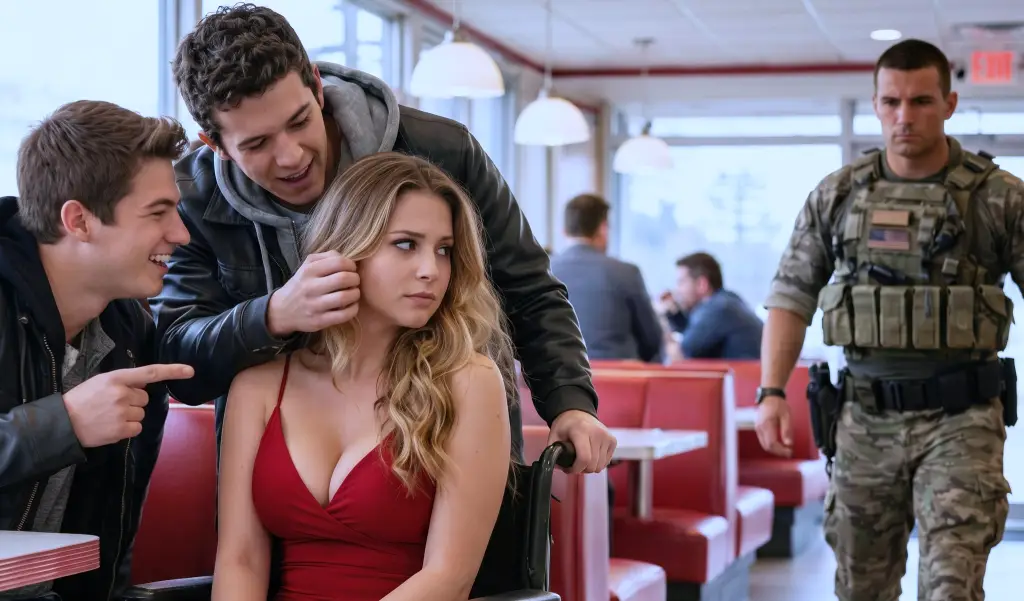
Sloan Hart sat in the booth farthest from the glass door, her spine pressed firmly against the faux-wood paneling of the back wall. It was an old habit, a survival instinct honed over six grueling years of navigating a world that suddenly felt dangerous. She had learned the hard way that positioning mattered, that keeping the room entirely within her line of sight was a small act of self-preservation that added up to feeling safe. The scarred table before her held a simple, unassuming breakfast.
A plate of scrambled eggs, two slices of dry wheat toast, and a tall, condensation-beaded glass filled with a strawberry milkshake. The milkshake was an indulgence, a sweet, cold anchor to the summers of her youth—the summers before the agonizing screech of twisting metal, before the endless white ceilings of hospital rooms, before she had been forced to learn exactly how breathtakingly cruel strangers could be when they looked at someone who no longer fit their narrow, comfortable definition of whole.
She was thirty years old, though the soft, unlined contours of her face often led strangers to guess she was younger. Her auburn hair fell in loose, natural waves around her shoulders, framing hazel eyes that carried the profound, heavy stillness of someone who had survived the kind of nightmare most people only watched in movies. She wore dark, fitted jeans and a heavy gray cashmere sweater, garments specifically chosen to help her blend in, to disappear into the mundane background of everyday life. Her crutches leaned against the edge of the booth. They were made of medical-grade aluminum, sleek and utilitarian, the padded grips worn smooth and shiny from the constant, heavy friction of her palms.
Beneath the table, hidden by the shadows and the drape of her jeans, her left leg ended abruptly just below the knee. The prosthetic attached to her residual limb was a marvel of modern science. It was advanced, breathtakingly expensive, and engineered with absolute precision by her own company’s elite research and development team. Yet, for all its AI-driven microprocessors and carbon-fiber perfection, it could not erase the phantom sensations. It could not silence the persistent, ghost-like memory of toes that no longer existed, an ache her brain stubbornly refused to let go of.
Her company, Hart Technologies, was currently valued at slightly over four point seven billion dollars. She had built an empire of adaptive medical devices, accessibility technology, and intelligent prosthetics that helped thousands of people navigate a world that had been built without them in mind. Sloan had sketched the initial blueprints for that empire from a sterile hospital bed, her notebook paper stained with tears and fueled by a white-hot fury that still burned quietly in her chest six years later. But this morning, sitting in Miller’s Diner with her eggs congealing on the plate, she wasn’t a billionaire CEO. She was simply a woman desperately trying to carve out fifteen minutes of absolute peace before the relentless demands of the day swallowed her whole.
The diner held perhaps a dozen other early risers, silent ghosts scattered across the worn booths and counter stools. An elderly couple sat near the window, communicating entirely through the familiar passing of sugar packets. A heavy-set truck driver methodically turned the pages of yesterday’s newspaper. A woman in rumpled green scrubs stared blankly into her mug, wearing the hollow exhaustion of a night shift at the county hospital.
And sitting at the counter, hunched over a mug of black coffee that had gone tepid twenty minutes ago, was Declan Ryder. He was thirty-two, though the deep grooves framing his mouth and the heavy exhaustion shadowing his dark eyes suggested a man who had lived much longer. His dark hair was slightly too long, falling into eyes that couldn’t stop tracking the room, and the rough shadow of stubble along his jaw indicated a man who had left the house long before the sun even considered rising. His heavy work boots, resting on the chrome footring of the stool, were caked with a permanent patina of grease and dark brake dust.
His faded denim jacket had seen far better days, the cuffs frayed to white threads, and the thermal flannel shirt beneath it was deeply wrinkled, likely pulled straight from a laundry basket in the dark. He had the broad, solid shoulders of a man forged by years of punishing physical labor, and rough, calloused hands that knew their way around a shattered engine block far better than most elite surgeons knew human anatomy. Those hands trembled imperceptibly now as they wrapped around the thick ceramic of the coffee mug. It was a tremor he despised, one he tried to mask by gripping the cup until his knuckles strained white against his tanned skin.
Declan had been awake for twenty-six hours straight. A loyal customer’s transmission had catastrophically failed at nine o’clock the previous night. He had looked at the panicked face of the elderly woman, knowing she needed that battered sedan to get to her dialysis appointment by sunrise, and he had made a promise. So, he had worked straight through the freezing night at Ryder’s Automotive, the three-bay concrete block garage his father had built with his bare hands forty years ago. It was the same garage Declan had inherited two years prior, a bittersweet legacy that came chained to a suffocating mountain of debt. It was a weight that rested squarely on shoulders already carrying entirely too much.
The nightmares had been creeping back lately, worse than they had been in years. They came in violent flashes of sun-bleached sand, the deafening roar of explosives, and the blood-slicked faces of good men who were never coming home to their families. Ten years as a Navy SEAL had carved something raw and permanent into his central nervous system.
The military had completely rewired him, leaving him with a set of hair-trigger reflexes that were fundamentally incompatible with quiet civilian life, and a shattered right shoulder that throbbed with a dull, sickening ache whenever the barometric pressure dropped. He had taken a medical discharge at thirty after a piece of jagged shrapnel from an improvised explosive device had torn through his shoulder, leaving him breathing but broken in fundamental ways the military surgeons couldn’t quite put back together.
The Veterans Affairs doctors had handed him amber bottles of pills and a pamphlet with a therapist’s phone number. He had taken the pills and thrown the number in the trash. Instead, he had retreated home to Harrison County, seeking refuge in the grease-stained garage his father had loved more than cheap whiskey, more than his own failing heart. Vernon Gallagher, the sixty-five-year-old master mechanic who had wrenched beside Declan’s father for three decades, had handed Declan the shop keys with wet eyes and a grim warning trembling on his lips.
The bank was circling like vultures. His father had died owing the creditors far more than the cinderblock building was worth. Now, Declan had exactly fifty-eight days before the foreclosure finalized. Fifty-eight days to somehow conjure a hundred and eighty thousand dollars out of thin air, or be forced to watch his father’s entire life get auctioned off to the highest bidder.
The thought of that failure sat in the center of his chest like a block of lead, heavy and freezing, making it physically difficult to draw a full breath. He had stopped at the diner this morning because going straight home meant facing his eight-year-old daughter’s bright, searching eyes, and he didn’t have any answers for her that wouldn’t terrify a child. It was easier to sit here in the muted, pre-dawn quiet, inhaling the smell of burnt coffee and frying bacon, pretending for just a moment that the world made sense, pretending he wasn’t slowly drowning in his own life.
That was the exact moment the two boys pushed through the glass door, letting in a sharp blast of November wind. They were teenagers, maybe seventeen, wrapped in heavy varsity jackets from Harrison County High School. The bright purple and gold wool of the coats looked aggressively loud, almost offensive against the diner’s muted, dreary palette. The taller boy had a shock of blonde hair stiff with too much styling gel, while his companion was built broader, carrying himself with a heavy, aggressive swagger and mean, restless eyes that scanned the room, actively searching for a target.
They didn’t approach the counter to order. Instead, they claimed a table near the entrance, sprawling into the chairs, scrolling mindlessly through their phones and barking harsh, sudden laughs at something Declan couldn’t hear. Declan watched them in the reflection of the pie case. He noticed the exact second their restless eyes landed on Sloan. He saw the cruel sideways glances, the poorly concealed pointing, the whispered comments shared behind a raised hand. It was the particular, piercing quality of attention that disabled bodies inevitably attract from people who have never, not for one second, had to question their own physical invincibility.
Declan’s calloused hands tightened convulsively around his coffee mug. The ceramic protested with a faint squeak. He told himself to look away. He told himself to mind his own business, to stay in his lane exactly as he had been doing for two exhausting years. Keep your head down. Avoid confrontation. Be the stable, boring, invisible father that an eight-year-old girl desperately needed.
Then the blonde boy spoke, pitching his voice just loud enough to carry over the hum of the refrigerators and the clatter of silverware.
“Dude, check it out. Cripple in the corner.”
The word landed in the quiet diner like a heavy stone thrown straight through a pane of glass…To read the rest of the story – CLICK the NEXT button 👇👇👇