


The late afternoon light filtered through the frosted safety glass of Little Lanterns Daycare, casting long, fractured shadows across the linoleum floor. Tessa Whitlock walked down the brightly decorated hallway, the familiar scent of industrial disinfectant and crushed graham crackers washing over her. Beside her, Bishop—a German Shepherd mix with intelligent amber eyes and a coat the color of burnt oak—padded quietly at her left hip. The rhythmic clicking of his nails against the floor was a grounding sound, a steady metronome that usually helped Tessa transition from the exhaustion of her workday to the demands of single motherhood.
The hallway walls were plastered with finger paintings and crookedly cut construction paper shapes, bursting with the chaotic joy of childhood. Today, however, Tessa barely registered the artwork. Her mind was already cataloging the evening ahead: pick up Hollis, navigate the rush-hour traffic, start the bathwater, and maybe, just maybe, steal a quiet moment on the porch after he went to sleep.
Miss Jenny, a college-aged assistant with a perpetually cheerful demeanor, met them at the threshold of the infant room. “Hi, Mrs. Whitlock,” she whispered, offering a warm, slightly tired smile. “Hollis had such a great nap today. He went down without a fuss.”
She gestured toward the dimly lit room, where a small speaker tucked onto a high shelf played a synthesized, lullaby rendition of a classical sonata.
The shift in Bishop was instantaneous.
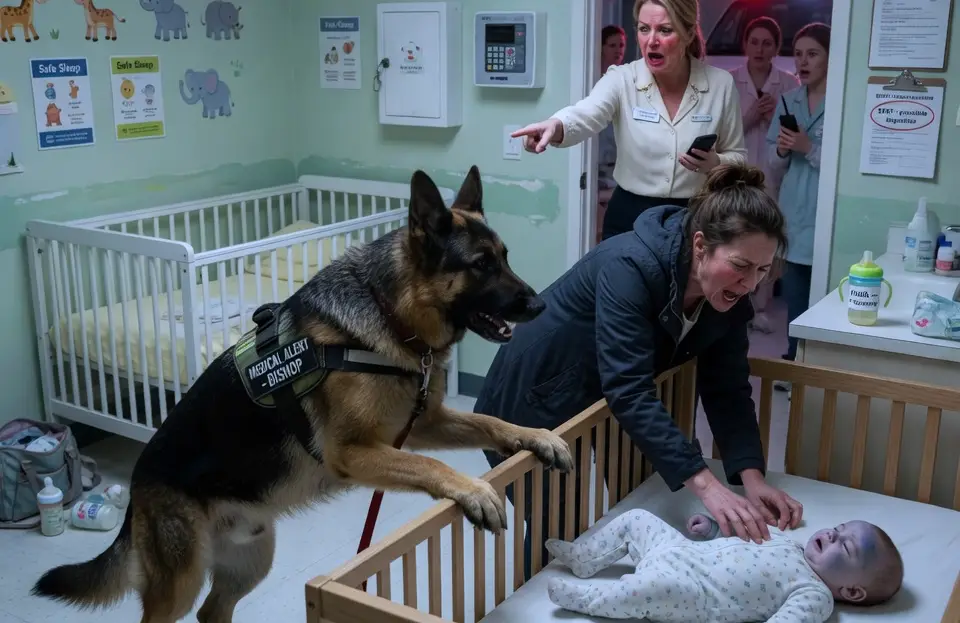
The moment they crossed the doorway, the relaxed drape of the dog’s posture vanished. The muscles beneath his dark coat coiled tight. His ears, usually pinned back in easy submission, snapped sharply forward. Tessa felt the sudden, rigid tension travel straight up the leather leash. Before she could process the change, Bishop surged forward, pulling her toward the back corner of the room.
“Bishop, wait!” Tessa hissed, instinctively tightening her grip.
Her command died in her throat. The heavy-set Shepherd planted his front paws firmly against the base of Hollis’s crib, his body a solid, immovable wall. A low, vibrating growl rumbled deep in his chest—a sound that sent a cold spike of adrenaline straight down Tessa’s spine. It was a sound she hadn’t heard since those long, grueling months in the backyard, when her late husband, Grant, had painstakingly put Bishop through his rescue and alert training.
“Hey, get that dog away from there!” a senior staff member snapped from across the room, abandoning a stack of folded blankets and rushing forward.
Bishop ignored the woman entirely. He didn’t bare his teeth. He didn’t snap. Instead, he lifted a heavy paw and struck the side of the wooden crib, the movement deliberate and frantic. He hit it again, harder this time.
Tessa’s heart hammered a frantic rhythm against her ribs. Bishop was a certified, extensively trained medical alert dog. Grant had poured his remaining months into that training, treating it like a sacred duty. Bishop did not break protocol. He did not act out. He only acted when the world was falling apart.
“Bishop, show me,” Tessa commanded. Her voice was terrifyingly steady, a leftover reflex from a past life.
The dog’s paw moved immediately, hovering deliberately over Hollis’s small chest, before his amber eyes locked onto Tessa’s face. The gaze was piercing. Absolute. It was the exact signal he had used to alert Grant that his oxygen levels were crashing in the weeks following the warehouse fire.
Moving blindly past the protesting daycare worker, Tessa reached over the wooden railing. The moment her fingers brushed her son’s cheek, the mother vanished, and the former EMT took over.
Hollis’s skin was unnervingly cool to the touch. Worse was his color. A subtle, grayish-blue tint bloomed around his tiny, parted lips. It was a color Tessa had seen in the backs of speeding ambulances, a color that made the blood roar in her ears.
“Something’s wrong,” Tessa announced. Her tone left absolutely no room for debate as she scooped the limp, eight-month-old infant from the mattress. Hollis’s head lolled against her collarbone. His breathing wasn’t just shallow; it was a fragile, thready flutter. “Call 911. Right now.”
“Mrs. Whitlock, please.”
Pamela Voss, the daycare director, materialized in the doorway, cutting through the rising panic of the room. Her blonde hair was perfectly lacquered, her tailored suit immaculate. She looked less like a caregiver and more like a corporate litigator, and her eyes were sharp, darting between Tessa and the dog. “That animal needs to be removed from the premises immediately. He is creating a severe disturbance.”
Tessa cradled her baby tightly against her chest, her free hand already fishing her phone from her pocket. “My dog just alerted me that my infant is in respiratory distress,” she said, her thumb sliding across the screen. “I am calling emergency services.”
Her fingers trembled violently, but years of emergency response training kept her voice locked into a clinical, detached cadence as the dispatcher picked up. “This is Tessa Whitlock. I am at Little Lanterns Daycare on Elm. I need an immediate bus for an eight-month-old male. He is in acute respiratory distress, presenting with cyanosis around the mouth, cold skin, and shallow respirations.”
The infant room erupted. Miss Jenny stood frozen by the rocking chair, her hands clamped over her mouth in horror, while the senior staff scrambled to herd the waking, crying toddlers into the adjacent hallway. Through the chaos, Pamela Voss stepped closer, her voice dropping to a harsh, demanding hiss.
“Mrs. Whitlock, I must insist. That animal is frightening the other children. Take him outside.”
“He stays,” Tessa fired back, dropping her phone to her pocket and resting her hand on the thick fur between Bishop’s ears. The dog hadn’t moved an inch from her leg, his eyes glued to the baby in her arms. “He’s a trained medical alert dog. He just did his job.”
She ignored the director, turning all her focus to Hollis. She counted the seconds between his frail, hitching breaths, pressing two fingers to the inside of his tiny wrist to find a pulse. It was there, but it was sluggish. Every agonizing second stretched into an eternity until the distant wail of sirens finally cut through the autumn air.
They burst through the heavy front doors of the facility with practiced, kinetic energy. Heavy boots squeaked on the linoleum, trauma bags swinging. Tessa recognized the lead paramedic instantly. It was a face from a lifetime ago.
“Tessa?” Mike Patterson paused for a fraction of a second, his professional mask slipping as he registered the woman standing amidst the chaos. “What have we got?”
She rattled off the vitals with the staccato precision of a veteran. “Infant male, eight months. Respiratory depression. Peripheral and perioral cyanosis. Skin is cool and clammy. No prior medical conditions, no history of asthma.” She swallowed hard, forcing the next words out. “My medical alert dog signaled the distress. I found him unresponsive in the crib.”
Mike nodded sharply, already snapping on purple nitrile gloves and moving in to assess the baby. Bishop shifted backward to give the men room, sitting squarely on his haunches, watching their every move with intense scrutiny.
“Sat levels are bottoming out,” Mike announced, ripping open a plastic package and pulling out a pediatric oxygen mask. It looked impossibly huge against Hollis’s pale face. “We need to transport. Now.”
“The dog can’t ride in the rig,” Mike’s partner stated flatly, grabbing the straps of the stretcher.
“He has to,” Tessa pleaded, the clinical wall finally cracking, letting a sliver of the terrified mother bleed through. “Please. He knew something was wrong before anyone else. He’s trained for this. I need him.”
Mike looked from Tessa’s desperate face to the German Shepherd, who was sitting perfectly still, radiating disciplined focus. “He rides up front with you, Jamie,” Mike ordered, waving off his partner’s objection. “We’ve run with service animals before. The dog stays with the family.”
As they transferred Hollis onto the gurney, securing the straps over his small body, Pamela Voss reappeared at Tessa’s elbow. The director’s composure seemed incredibly forced, a tight smile plastered over her face. “Mrs. Whitlock, I am certain this is just a misunderstanding. The change in weather… he’s likely just coming down with a severe bug.”
Tessa stopped dead. She turned slowly, her eyes locking onto Pamela’s. The air between them dropped twenty degrees. “My dog does not make mistakes about breathing patterns,” Tessa said, her voice dropping to a venomous whisper. “This isn’t a cold. And I think you know that.”
She didn’t wait for a response. She turned on her heel and followed the stretcher out the double doors. Bishop trotted right beside the wheels, hopping up into the front of the ambulance the moment the doors opened, settling onto the floorboards only after he saw Hollis safely loaded into the back.
Tessa climbed in, sitting on the bench and gripping her son’s tiny, limp hand. The heavy rear doors slammed shut, enclosing them in the harsh, fluorescent glow of the rig. As the ambulance lurched forward, the siren screaming into the evening, Tessa stared at the rise and fall of Hollis’s chest beneath the oxygen mask.
Bishop had bought them time. Precious, irreplaceable minutes. But as she watched Mike adjust the oxygen flow, a dark, heavy realization began to settle in her gut. Bishop’s alert hadn’t been random. He had smelled something. He had sensed a specific, dangerous shift. A healthy eight-month-old boy didn’t just stop breathing during an afternoon nap.
Something had happened in that room. And looking back at the facade of Little Lanterns fading into the distance, Tessa knew with bone-deep certainty that this was no accident.