


The Ashworth Country Club sprawled across forty acres of rolling, manicured hills in Westchester County, New York, an emerald canvas dotted with pristine white tents. The afternoon air carried the faint, elegant strains of a string quartet situated near the blooming rose garden. Sixty guests drifted across the lawn, their hands wrapped around crystal flutes of sparkling cider, politely nibbling on delicate finger sandwiches that cost more per plate than my entire weekly grocery budget.
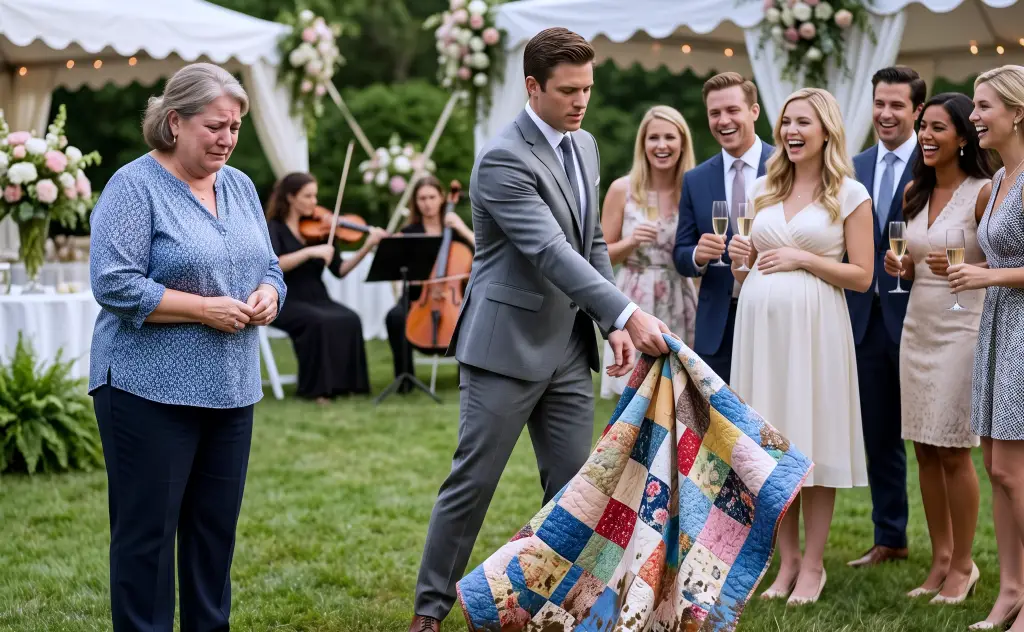
From the edge of the patio, I watched my daughter. Megan looked undeniably radiant. At seven months pregnant, she possessed a soft, ethereal glow, draped in a cream-colored maternity dress that easily ran a thousand dollars. She moved through the affluent crowd with a practiced grace, smiling and nodding as if she had been born into this glittering world of exclusive country clubs and catered weekend events.
She hadn’t been. She had been born in a cramped, two-bedroom apartment in Queens. The very first bed my daughter ever slept in was a hollowed-out dresser drawer that I had carefully lined with soft, worn blankets because a proper crib was simply out of the question.
Her husband, Bradley Ashworth, stood at her side, his large hand resting possessively on the small of her back. He was tall, with a sharp, square jaw and the kind of blindingly confident smile that made you want to hand over your life savings. He worked for his father’s insurance firm, Ashworth & Kline, managing high-value policies for outrageously wealthy clients across the tri-state area. As he reached out to shake a guest’s hand, the afternoon sun caught the face of a watch that cost substantially more than my car.
His mother, Diane Ashworth, had orchestrated the entire shower. She was the one who had selected the venue, curated the absurdly expensive menu, and aggressively gatekept the guest list. I had been allowed to attend, a gesture I was meant to understand was exceptionally generous on her part.
I stayed near the perimeter, waiting quietly until it was time for the gifts.
They seated Megan in a grand white wicker chair, practically swallowing her in a mountain of boxes wrapped in thick, designer paper and satin ribbons. She unwrapped a top-of-the-line Bugaboo stroller gifted by Bradley’s former college roommate. Next came an imported cashmere blanket set from Diane, followed by a heavy silver rattle from Tiffany’s. Every extravagant item was met with a chorus of polite, manicured applause.
Then, it was time for mine.
I had wrapped it in simple brown butcher paper because I appreciated the honest, rustic simplicity of it, securing it with a bow made of rough twine. As Megan picked it up, I caught the familiar, fleeting shadow that crossed her face. It was the exact same expression she wore whenever I showed up at an event where her new family might see me—a rapid, anxious scan of the room. Who is watching? She pulled the twine loose and let the paper fall away, unfolding the heavy fabric across her lap. It was a quilt. I had spent nine months of my life on it. Every single night, after completing my grueling shift at the Brookhaven Senior Center—where I spent hours on my feet cooking three square meals a day for eighty elderly residents—I would sit under the harsh overhead light of my tiny kitchen table and sew.
The quilt was made of thirty distinct squares, and every single one was a memory. I had painstakingly labeled each piece in tiny, precise embroidered letters. There was a patch from her first baby blanket in 1994. A vibrant piece of her Halloween butterfly costume from 1998. A swatch of the floral dress she wore on her fifth birthday in 2000. Thirty squares. Thirty pieces of our shared history, stitched together with aching love to keep her new baby warm.
Megan held it up by the corners. The chatter on the lawn abruptly died.
Diane Ashworth was the first to lean in. “Oh, my,” she murmured. She reached out, pinching a corner of the fabric between two perfectly manicured fingers as if she were testing a soiled towel for a communicable disease. “Is this… homemade?”
A hot flush of pink crept up Megan’s neck, spreading across her cheeks. She lowered the quilt, avoiding my eyes. “Mom,” she whispered, her voice tight with embarrassment. “We registered at Pottery Barn.”
I took a breath, stepping forward. I wanted to explain. I just needed her to understand the nine months of late nights, the calloused fingers, the stories woven into the very fabric she was holding.
But Bradley was faster. He snatched the quilt from her hands with a careless flick of his wrist.
“Your mother’s a lunch lady, babe,” he said. He flashed that brilliant, devastating grin at the surrounding guests, treating the moment like an inside joke they were all smart enough to get. “What did you expect? A gift card to Bergdorf’s?”
He dropped my quilt onto the gift table. It landed in a crumpled heap, right on top of a pile of discarded, torn wrapping paper, like a used napkin.
Laughter rippled through the crowd. It wasn’t loud or explosive, which somehow made it worse. It was polite. Measured. The specific, suffocating kind of laughter designed to remind you exactly where you stand, and that you do not belong among them.
Megan didn’t reach for the quilt. She didn’t attempt to fold it. She didn’t look up to find my face in the crowd. She simply turned her attention to the next silver-wrapped box—a designer diaper bag from one of Bradley’s senior colleagues—and the afternoon seamlessly moved on.
I remained in my spot for ten excruciating minutes. Not a single person met my eye or spoke to me. Across the lawn, I watched Diane lean in to whisper to another woman holding a champagne flute. The breeze carried a single word in my direction: cafeteria.
I walked quietly to the gift table. I picked up the quilt and smoothed out the wrinkles. I folded it exactly the way I fold everything—with patience, and with profound care. I placed it gently into my tote bag, turned my back on the white tents, and walked to the parking lot.
My ten-year-old Honda Civic was parked at the absolute farthest edge of the asphalt, practically touching the service entrance, dwarfed by a gleaming sea of BMWs and Mercedes-Benzes. I unlocked the door, slid into the driver’s seat, and set the quilt on the passenger side.
I sat there for a long time, staring out through the windshield. I didn’t shed a tear. I had officially stopped crying over my daughter’s desperate choices three years ago, on the rainy afternoon she called to ask me not to attend her engagement party because my presence might make Bradley’s aristocratic family feel “uncomfortable.” I had gone anyway. She had spent the entire evening introducing me to her new friends as a distant friend of the family.