


Frank Hale died on a Tuesday in October, leaving behind a television still murmuring the morning news and a mug of black coffee that had not yet lost its heat. Margaret found him in his worn leather recliner, his head tilted back against the headrest as if he had simply closed his eyes to listen to the weather report. The paramedics, when they finally arrived to shatter the quiet of the house, told her it was his heart. Margaret could have told them that without a stethoscope. His heart had been a failing engine for years. She had spent the better part of a decade watching the vibrant color drain from his cheeks, watching him surrender to the staircase, watching him abandon his daily walk to the mailbox, and finally, watching him drop the exhausting pretense that he was fine.
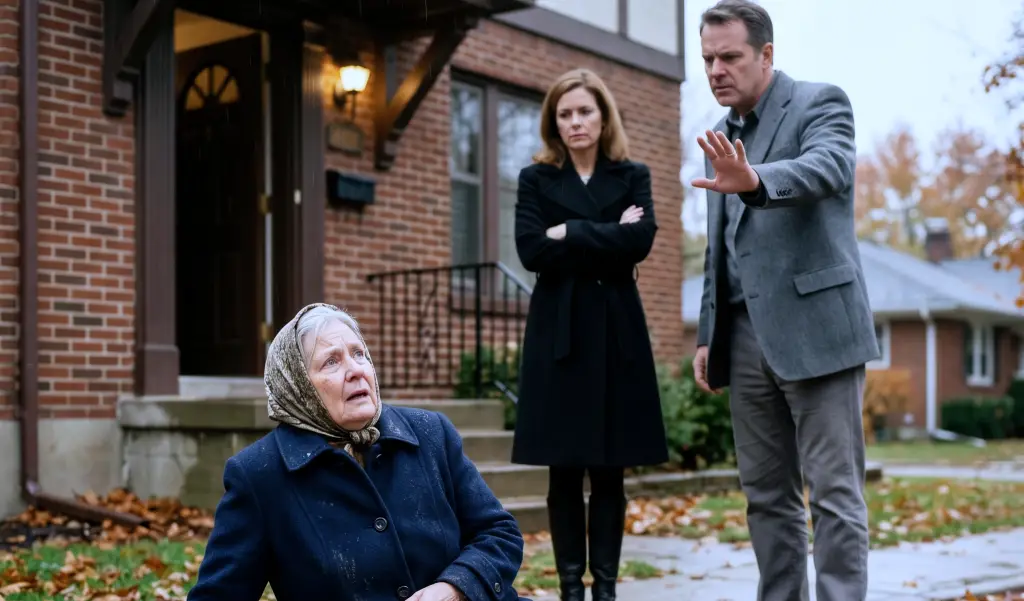
The funeral was an exercise in tasteful restraint. David, their forty-seven-year-old son, made absolute sure of that. He ran the insurance agency his father had built from the ground up, and he managed the memorial service like a high-stakes corporate mixer. Clad in a tailored charcoal suit, David shook every offered hand, his voice pitched to the perfect frequency of managed grief. Beside him stood Karen. At forty-four, Margaret’s daughter had perfected the art of appearances, wearing a tailored black dress and a string of pearls, occasionally pressing a pristine tissue to eyes that never actually spilled a tear.
Three hundred people filed past the casket. Margaret stood for hours, her feet aching terribly in her sensible pumps, thanking each face that swam into her vision. Her chest felt entirely hollowed out, a cavern where her life used to be. But she remained standing. She stood because that was what a wife did. You stood, and you endured.
Two weeks later, David called a family meeting. He used those exact, clinical words over the phone, as if they were gathering to discuss a timeshare or a Thanksgiving menu. Margaret drove to his sprawling suburban home, the very same house she and Frank had drained their savings to help him buy fifteen years ago. She took a seat at his heavy mahogany dining table, resting her hands in her lap, and looked across the polished wood at her two children.
Karen had a thick manila folder. David had a legal pad. They had been busy.
“Mom, we need to talk about Dad’s estate,” David said, folding his hands over his notes.
Margaret gave a slight nod. She had expected this. Frank had built a solid, comfortable life. The mortgage was paid off. The insurance agency was highly profitable. There was a substantial cushion in savings, plus the investment and retirement accounts she and Frank had contributed to for decades.
“We’ve been going over the paperwork,” Karen said, her tone brisk. She opened the folder, spreading a fan of documents across the table like a dealer at a casino. “The house, the accounts, the agency. We want to make sure everything is handled properly.”
“Of course,” Margaret said quietly.
David cleared his throat, adjusting his posture. “The house? Dad put my name on the deed twelve years ago. We discussed it after his first hard episode. It was a practical decision. Estate planning.”
Margaret looked at him, her expression unreadable. “I remember.”
“So technically, the house is mine,” David said. He did not look away, but a faint flush crept up his neck. “I’m not kicking you out, Mom. But I’ve been thinking about it, and Heather and I could really use the space. The kids are getting bigger, and then there is the question of maintenance, property taxes, upkeep. It’s a lot for you to manage alone at your age.”
Margaret felt a cold, heavy stone settle in the pit of her stomach. “You want me to leave the house.”
“Not leave. Transition,” Karen interjected smoothly, leaning forward. “I found a beautiful assisted living community in the suburbs. It has lovely gardens…”
“I am seventy, David,” Margaret said, her voice dropping a register. “I am not eighty-five.”
Karen jumped back in, her tone shifting to patronizing sweetness. “Mom, nobody is saying you can’t take care of yourself. We just think it would be easier. Safer.”
“And the bank accounts?” Margaret asked, refusing to let them steer the current.
Karen glanced sideways at her brother. “We moved the funds into a trust for estate management purposes. David and I are co-trustees.”
“You emptied the accounts.”
“We secured the accounts,” David corrected defensively.
Margaret sat perfectly still, listening to the hum of the central air conditioning. Forty-two years of marriage. Every single dollar she and Frank had carefully saved. Every late night she had spent sitting at the kitchen table doing the accounting for the agency while Frank built the business. Every vacation they had skipped, every new dress she had left on the rack. Her children had neatly divided and swallowed forty-two years of her sacrifice in a single afternoon.
“And the car?” Margaret asked, her voice dangerously calm.
“Karen is going to take it,” David said, shuffling his legal pad. “You don’t drive much anymore anyway. It just sits in the garage.”
“I drive every day, David.”
“We will arrange rides for you. There are transport services.”
Margaret looked deeply at her children. She studied the faces across the table—the faces she had wiped clean of tears, the foreheads she had kissed through childhood fevers, the children she had read to until her throat went dry. David had Frank’s stubborn jaw and her own eyes. Karen had her smile, though Margaret suddenly realized she could not recall the last time Karen had actually offered that smile to her.
“Is there anything left?” Margaret asked, the silence ringing in her ears.
David and Karen exchanged a brief, fleeting look.
“Well, there’s Grandpa Henry’s farm,” Karen said. A short, dismissive laugh escaped her lips. “The one in Kentucky. Dad always said it was completely worthless. The county sent letters about back taxes a few years ago. We just threw them away.”
“How much in back taxes?” Margaret asked.
David checked the top page of his pad. “About eleven thousand. The property is assessed at less than the taxes owed. Nobody in their right mind would buy it. It’s just sitting out there rotting.”
Margaret nodded slowly, feeling the phantom weight of brass in her coat pocket. “I’ll take it.”
David blinked, completely thrown off his script. “Take what?”
“The farm. I will take the farm.”
Karen leaned across the table, her brow furrowed. “Mom, there is nothing there. The house is falling apart. There’s no water, no electricity…”
“You said it is mine. My father left it to me. Not to a trust. Not to you. To me.”
“It’s worthless,” David repeated, shaking his head.
“Then you won’t mind if I keep it.”
Neither of them argued. Why would they? They had systematically stripped away everything of value. The colonial house, the cash, the car, the thriving agency. The old Kentucky farm was nothing but a punchline to them, a yellowed piece of paper representing a debt nobody wanted to pay.
Margaret left David’s house that evening carrying only her purse, her wool coat, and her father’s pocket watch. She had kept that watch in her purse since Henry died twenty-two years ago. It was a heavy brass timepiece, deeply engraved on the back with four numbers she had always assumed were a date. Her father had pressed it into her palm during her final visit to the farm, back when she was forty-eight and he was suffocating from emphysema.
“Keep this,” Henry had wheezed, his rough hands trembling over hers. “You’ll know when you need it.”
She had never known what he meant. But she had kept it all the same.
Margaret endured David’s guest bedroom for three excruciating weeks. They made sure she felt her displacement every single day. Heather, David’s wife, would let out a long, theatrical sigh whenever Margaret so much as boiled water in the kitchen. The grandchildren were constantly shushed and told to keep it down because Grandma needed rest, a thinly veiled translation for the fact that Grandma was in the way. David left glossy brochures for assisted living facilities on her nightstand. Sunrise Gardens. Peaceful Meadows. Places with manufactured names designed to help you forget you were being warehoused.
On the twenty-second day, Margaret packed her belongings. She owned exactly one suitcase now. Everything that mattered fit inside it.
She took a Greyhound bus from Columbus, Ohio, to a speck of a town called Dawson in rural Kentucky. The ticket cost her thirty-seven dollars. The cabin smelled strongly of diesel fumes and ancient, dusty upholstery. Margaret took a seat by the streaked window and watched the flat, paved geometry of the Ohio suburbs give way to the rolling, untamed hills and bare timber of Kentucky. She did not shed a single tear. She had done all her crying in David’s guest bedroom, pressing her face into a decorative pillow at three in the morning when the house was silent. She was entirely done with crying now.
Dawson was barely a town. It consisted of a two-block main street offering a hardware store, a faded diner, a post office, and a brick church. The bus deposited her at a gravel gas station on the absolute edge of the county line. She dragged her suitcase inside and asked the attendant for directions to the old Hale farm.
The teenager looked at her as if she had asked for the quickest route to Mars. “Henry’s place? Ma’am, that’s about four miles east on County Road Nine. Nobody has been out there in decades. You family?”
“I am his daughter,” Margaret said, lifting her chin.
“Huh.” The boy scratched his neck. “Didn’t know Henry had family. He kept to himself.”
Margaret walked. She marched for four miles along a winding two-lane road that offered absolutely no shoulder, her heavy suitcase bumping bruised against her calf with every other step. It took her nearly two hours. Midway through, a rusted pickup truck slowed down, and the driver, a heavyset woman in a faded feed cap, rolled down her window.
“You need a ride, hon?” the woman called out over the idling engine.
“I am almost there,” Margaret called back, wiping sweat from her brow.
“Where’s there?”
“The Hale farm.”
The woman’s eyebrows shot up into her hairline. “That old place? You sure?”
Margaret nodded firmly. The woman gave a slow shrug, rolled up the glass, and drove on, leaving Margaret in a cloud of fine brown dust.
When the farm finally materialized, it was vastly worse than she remembered. The driveway had been entirely reclaimed by nature, choked with knee-high weeds and aggressive saplings that had punched their way through the gravel over the last twenty years. The house sat silently at the end of the path, a two-story wooden structure that had once proudly worn white paint. Now, the paint had flaked away to expose gray, weathered wood on nearly every wall. One of the upstairs bedroom windows was shattered. The front porch sagged dangerously on the left side where the support beams had succumbed to rot.
Behind the house stood the barn. It had been a vibrant red during her childhood, but now it was the color of a winter sky. The roof had partially caved in on the southern end, the beams jutting out like broken ribs. And there, hanging heavy on the main sliding doors, was a thick steel padlock, rusted orange but stubbornly intact.
Margaret dropped her suitcase at the end of the driveway and took a long, deep breath. Eleven thousand dollars in back taxes. A farmhouse that might buckle under the weight of the first winter snow. A barn her father had kept fiercely locked away her entire life.
She picked up her bag and walked toward the front door.
It was unlocked. It had always been unlocked. Henry Hale never locked the front door of his house, reserving all his security, all his paranoia, for the barn out back.
Margaret pushed the heavy wooden door, the swollen hinges groaning in protest. Inside, the air was thick, carrying the sharp, stale scent of trapped time and dry rot. Dust layered every visible surface like a gray, woolen blanket. She set her suitcase down in the narrow front hallway, her footsteps echoing hollowly against the hardwood as she wandered through the rooms of her childhood.
In the kitchen, through the hazy light filtering in from the dirty windows, she saw plates stacked in the glass-front cabinets. They were the same sturdy ceramic dishes with the faded blue flower pattern she remembered from when she was ten years old. In the living room, her father’s worn leather recliner still sat exactly where he had left it twenty-two years ago, angled precisely so whoever sat in it would have a clear, unobstructed view of the barn. In the fireplace, a pale mound of ash rested cold on the grate. Twenty-two-year-old ashes.
She found the fuse box in the hallway and pushed the heavy main breaker switch. A dull metallic clack sounded, but no lights flickered to life. The house remained dead. She walked to the kitchen and twisted the cold water knob on the tarnished sink. Nothing but a dry, rattling wheeze came from the pipes.
Margaret walked back to the living room, lowered herself onto the very edge of her father’s leather chair, and looked out the window at the weathered gray siding of the barn. She was seventy years old. She had forty-seven dollars in her purse. She possessed no vehicle, no cellular phone plan, no income, and no immediate prospects. Her own flesh and blood had systematically stripped her of a lifetime of security, leaving her with this neglected ruin.
Yet, as she sat there breathing in the dust, a strange, profound calm washed over her. For reasons she could not entirely articulate, sitting alone in a lightless, waterless house felt infinitely more like a home than David’s immaculate, temperature-controlled guest bedroom ever had.
That first night, Margaret slept on a bare, yellowed mattress in her father’s old ground-floor bedroom. The ticking smelled faintly of damp wool and old cedar, but the springs held her weight without complaint. She pulled a heavy, patchwork quilt from the cedar closet, running her fingers over the mismatched squares of fabric. Her mother had stitched it together entirely by hand before Margaret was even born. The seams were fraying at the edges, the colors muted by decades of storage, but it trapped her body heat perfectly.
She woke at dawn to the sharp, clear calls of birds. They were real, wild birds, singing close to the glass, entirely unlike the muffled, distant traffic sounds she had tolerated in the suburbs for four decades. Margaret lay perfectly still for a long time, watching the morning light crawl across the cracked ceiling plaster. Then, she pushed the heavy quilt aside, tied her gray hair back, and got to work.
She scrubbed and swept for three days straight. She pushed a broom across every plank of flooring, wiped down every counter, and scraped thick, black mold from the bathroom tiles using an old butter knife she found in a drawer. She hauled endless armloads of dead leaves, dried vines, and abandoned animal nests out the back door, piling them into a massive heap near the old fire pit. Her lower back throbbed, her knuckles bled, and her shoulders ached with a fiery intensity, but she did not stop. It was a physical purge, a cleansing of both the house and her own grieving spirit.
On the afternoon of the second day, a neighbor driving a rusted pickup half a mile down the road spotted the smoke from her burn pile and turned down her long driveway.
“You actually living here?” the man asked, leaning his arm out of the truck window, eyeing her soot-stained clothes.
“I am,” Margaret said, wiping her forehead with the back of her wrist.
“County shut the water off years ago,” he noted, glancing at the house. “You’ll need to call them to get it flowing again. Electric, too.”
“Do you know how much that will cost?”
“Couple hundred for the deposits, probably,” he said, shifting his truck into gear. “Good luck to you.”
Margaret thanked him and watched him drive away. Two hundred dollars. It might as well have been two million. She had exactly forty-seven dollars left. That deposit was a brick wall she simply could not climb over.
But the next morning, when she walked to the end of the driveway to check the rusted rural mailbox, she found a plain white envelope sitting inside. There was no return address. She tore the flap open. Inside rested fifteen crisp twenty-dollar bills and a small piece of lined paper with shaky, cursive handwriting.
Henry was a good neighbor. Welcome home.
Margaret stood frozen at the edge of the county road, clutching the cash in her bruised hands. She looked up and down the empty stretch of asphalt. She did not know who had sent it, and she decided right then that she would never ask. She walked to the neighbor’s house that afternoon, politely asked to borrow his telephone, and arranged for the county to restore the utilities.
By the end of her first week, the farmhouse was functional. It was certainly not comfortable, and it was far from pretty, but it was a shelter that lived and breathed. The plumbing coughed up brown sludge for the first twenty minutes before running cold and clear. The electricity hummed to life in every room except the upstairs bathroom. In the root cellar, she discovered rows of ancient canned goods—peaches and beans with labels so faded they were entirely white. She threw the commercial cans away, but tucked in the back corner were heavy glass mason jars filled with preserved vegetables, the wax seals still impeccably tight. Her father’s careful preservation work, untouched by time.
She cooked her first hot meal on the finicky gas stove. It was nothing more than white rice, salt, and a can of crushed tomatoes she had purchased at the hardware store in town. She sat alone at the kitchen table, chewing slowly, her eyes drifting inevitably out the window.
The barn.
Her father had never permitted her to step foot inside it. Not once during her entire childhood. “That is my workshop, Maggie,” he would say, his voice brooking absolutely no argument. “Nothing in there for little girls.”… To read the rest of the story – CLICK the NEXT button 👇👇👇