


The cold in northern Montana doesn’t simply arrive; it settles in like a long-term guest with cruel intentions. By early winter, the frost had completely wrapped the timberline in a pale, relentless shroud of white. I lived alone in a small wooden cabin tucked deep within that snow-bound forest, a place where the wind moved through the ancient pines with the sharp, hissing sound of a drawn blade. At forty-two, having survived a lifetime of combat as a Navy SEAL, I had deliberately chosen this profound, unyielding isolation. It wasn’t a hatred of society that drove me into the woods, but rather the sheer exhaustion of carrying ghosts. Silence, I had found, was infinitely easier to manage than memories.
My days were built on the scaffolding of strict routine. I chopped wood until my shoulders burned, checked my snare lines, and maintained the cabin’s weatherproofing. These tasks demanded physical exertion but asked absolutely nothing of my heart. They provided structure without the dangerous requirement of feeling. I had learned the hard way—first overseas, where a compromised extraction had cost the lives of men I loved, and later on a rain-slicked highway that took my wife, Emily—that hope and attachment were liabilities.
That particular evening, the snow had been falling heavily for hours. It wasn’t a violent blizzard, just a thick, mesmerizing curtain that muted the world, making the forest feel as though it were pressing intimately against the cabin walls. I was sitting in my worn armchair near the cast-iron stove, cradling a mug of coffee that had long since gone lukewarm. My mind was drifting in that numb, familiar twilight between absolute nothingness and the crushing weight of everything I had lost. I told myself that the emptiness was a fortress. It kept me safe.
Then, the silence broke.
It was a sound so faint it barely registered over the crackle of the fire—a muted, desperate scrape of claws against the wet wood of the front porch, followed by a low, ragged whine. My body reacted before my conscious mind could process the anomaly. Shoulders rigid, breath instantly shallow, my senses sharpening into the hyper-aware state born of years in hostile territory. Out here, hesitation was a death sentence. I set the mug down silently and crossed the room, placing each footstep with deliberate care, feeling the icy draft bleeding through the floorboards. I rested my hand on the heavy iron latch. It had been an eternity since anyone had knocked on my door. An unfamiliar, tight sensation coiled in my chest as I pulled the door open.
The bitter cold rushed in immediately, a wall of pure winter carrying the sharp, clean scent of crushed pine needles and fresh powder. In the pale wash of the cabin’s lantern light, I found myself staring down at an impossibility.
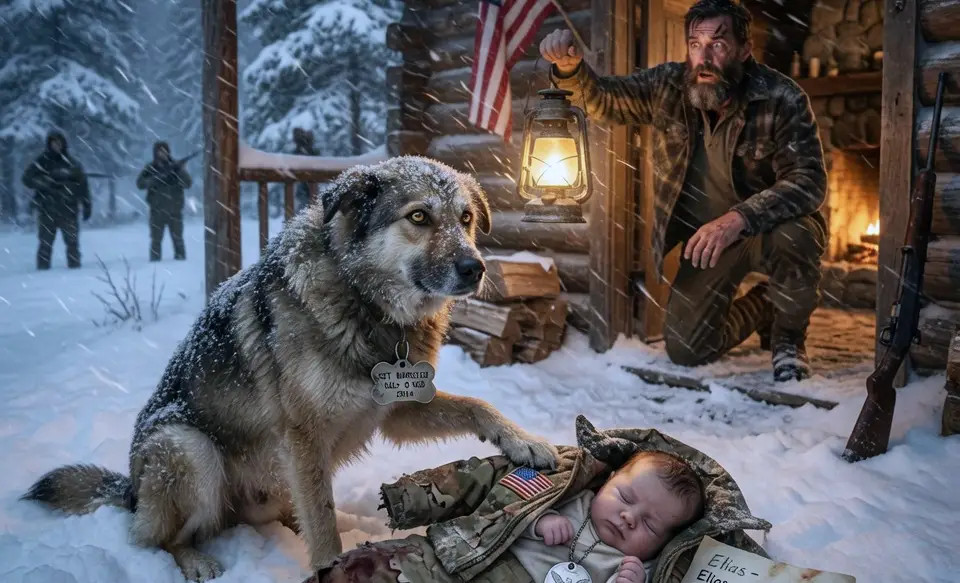
Standing on the snow-swept boards of my porch was a German Shepherd. She wasn’t a stray scavenging for scraps; she possessed the lean, powerful build of a working dog, though she was perhaps four or five years old, her dark muzzle dusted with a premature frost of white hairs. Her thick coat was matted with ice, but she stood completely alert. It was her eyes that stopped my breath. They were fixed on me with a desperate, piercing intelligence, radiating an urgency that felt entirely human.
Held gently between her jaws was a small, precarious bundle wrapped in a soaked, paper-thin blanket. And from that bundle came a sound that bypassed every defensive wall I had spent years erecting—a fragile, reedy cry that cut through the Montana wind like glass.
Pressed tightly against the mother’s trembling hind leg was a second impossibility: a German Shepherd puppy, no more than a few months old. The pup’s fur was a lighter tan, and he was shaking violently from the freezing temperatures and sheer terror, his oversized paws shifting anxiously as he looked from his mother to me, waiting for a command. My tactical training screamed at me to assess the perimeter, check for threats, and maintain a safe distance. But there was no ambush here. There was only the raw, undeniable plea of survival.
Slowly, showing immense, deliberate physical control, the mother dog stepped forward. She lowered her head and placed the damp bundle directly onto the porch planks at my boots. Then, she took one calculated step backward, positioning her body to shield her puppy while maintaining absolute, unwavering eye contact with me. I had seen that exact look before. I had seen it in the eyes of my men when the radios went dead and everything hinged on a single, impossible command. She was passing the burden of life into my hands.
I dropped to my knees, ignoring the ice seeping through my denim, and reached for the bundle. I peeled back a corner of the soaked fabric, and my heart hammered against my ribs. It was a newborn. The baby was terrifyingly small, her delicate skin flushed a dangerous, mottled violet from the cold, her tiny lips quivering as another weak, breathless cry slipped out. That sound resonated deep in my marrow, waking a dormant, agonizing instinct to protect.
Without a second thought, I scooped the child into my arms. The mother dog did not flinch or growl; she merely watched me retreat into the golden warmth of the cabin. I kicked the door shut against the storm, suddenly aware that the quiet, empty existence I had so carefully curated was over.
I moved with the methodical efficiency of a medic in a combat zone. I cleared the sturdy wooden table near the stove and stripped off my heavy canvas jacket, laying it down as an insulated barrier against the wood. I placed the shivering infant onto the jacket and began peeling away the damp, freezing layers of the blanket. The child’s fingers and lips were tinged blue, her eyes sealed tightly shut against the trauma of the cold. Weakness like this demanded immediate, flawless action.
I stoked the fire with dry cedar, watching the flames roar to life, pushing back the shadows. Rummaging through my pantry shelves, my hands surprisingly steady, I found a sealed, emergency tin of powdered milk and a small aluminum pot. As the water heated over the stove, I glanced out the frost-edged window. The mother dog had taken up a sentry position directly outside the door, her broad back angled to take the brunt of the wind, her body a living shield for her puppy. She hadn’t scratched to come inside; she had surrendered the child and taken her post. The weight of her trust was staggering.
Testing the warm milk on the inside of my wrist—a forgotten echo of a life I might have had—I took a clean, soft cloth, dipped it into the liquid, and gently pressed it to the baby’s lips. For a terrifying minute, there was nothing. Then, her tiny mouth twitched. She latched onto the damp cloth, swallowing with a desperate, exhausted determination. I let out a jagged breath I didn’t know I was holding. It was the same exhalation of pure relief I used to make when a trauma dressing finally held, and the bleeding stopped.
Slowly, agonizingly, the blue tint faded from the baby’s extremities, replaced by a soft, living pink. Her breathing deepened, settling into a quiet rhythm. I sat heavily in the chair, cradling the warm bundle against my chest, staring down at the sleeping face. The cabin was utterly silent now, save for the snapping of the fire, but my mind was deafening. I thought of Emily. I remembered the way her auburn hair would escape her ponytail, the dusting of freckles across her nose that darkened in the summer sun, her warm, bell-like laugh that used to chase away the shadows of my deployments. She had always believed my instinct to protect was a gift. When I lost her on that rain-slicked asphalt, I buried that gift with her. Yet here I was, holding a fragile, beating heart in the palm of my hands.
I couldn’t call for help; the storm had likely taken down the lines, and a rescue crew would never make it through the drifts before dawn. I assessed the variables, adapted to the crisis, and held the line. I built a makeshift bed from folded wool blankets, testing the distance from the stove over and over until the ambient heat felt perfect. I laid the baby down, my body angled over her like a canopy. Opening the front door just a crack, letting the bitter wind bite my face, I met the gaze of the mother dog. I gave her a single, solemn nod. She blinked once in return… To read the rest of the story – CLICK the NEXT button 👇👇👇