


The November air in Southern California carried a deceptive warmth, a gentle breeze coming off the Pacific that felt entirely at odds with the rigid military formality gripping Naval Base San Diego. Inside the main auditorium, the atmosphere was heavily pressurized with tradition. It was exactly fourteen hundred hours, the designated moment to honor a lifetime of duty. Two hundred attendees sat shoulder-to-shoulder. The room was a sea of immaculate dress blues and pristine whites, the overhead fluorescent lights catching the crisp edges of collar devices and the vibrant, multicolored geometry of ribbon racks.
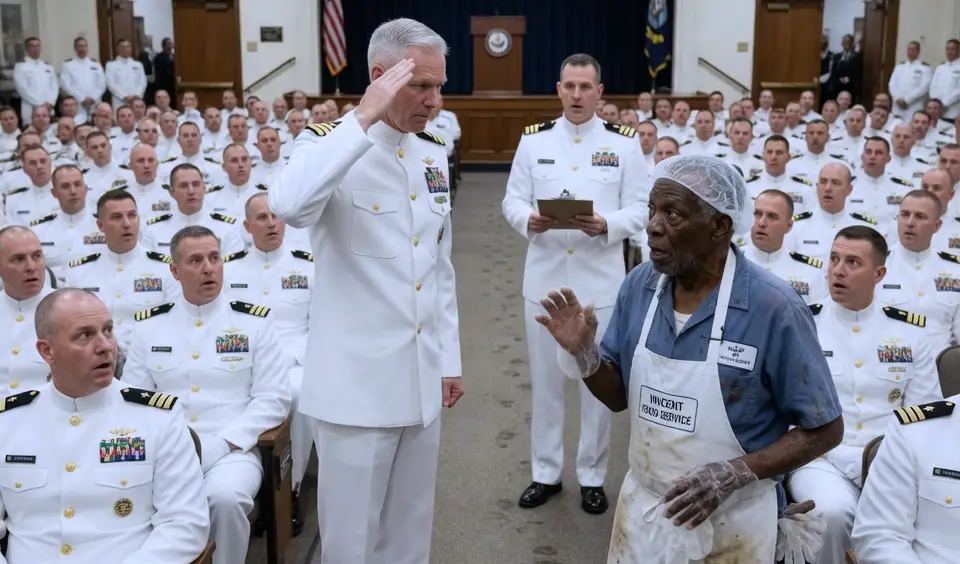
It was a retirement ceremony for Captain Stephen Walsh, a man who had dedicated twenty-eight grueling years of his life to the Navy. The front row remained conspicuously cordoned off, an expanse of velvet ropes and printed place cards strictly reserved for senior flag officers and their families. The air smelled of heavy starch, polished leather, and the faint, nervous perfume of spouses who had spent decades waiting for their husbands to return from the sea.
A quarter-mile away, completely insulated from the applause and the gleaming brass, the base cafeteria kitchen pulsed to an entirely different, relentless rhythm. Vincent Palmer stood at the edge of the industrial dishwashing station, his seventy-nine-year-old hands plunged into the familiar heat of soapy water. His skin was the color of worn mahogany, mapped with the deep, permanent creases of a man who had spent a lifetime under harsh suns and heavier burdens.
His hair was cropped into a short, disciplined brush of iron gray. He wore the standard-issue uniform of base food service: dark navy-blue trousers, a sensible short-sleeved shirt, and a stark white apron tied securely around his thin but still sturdy waist. A cheap, plastic name tag was pinned unevenly to his chest. It simply read, Vince.
For fifteen years, Vincent had moved through this massive industrial kitchen like a phantom. He served endless lines of mashed potatoes, wiped down sticky Formica tables, and gathered discarded plastic trays, utterly invisible to the thousands of young men and women who passed his station every single day. They saw the stained apron, they saw the white hair, and their eyes slid right past him to the menu boards. They had no way of knowing that the quiet, weathered man handing them their Friday meatloaf was actually retired Master Gunnery Sergeant Vincent Palmer.
They didn’t know about his twenty-eight years of active duty in the United States Marine Corps, or the Silver Star locked in a dusty cedar box in the back of his closet, earned in the suffocating heat of a conflict most of them only knew from history books. They didn’t know about his three brutal tours in Vietnam, or his two deployments to the Gulf War. To the base, he was just Vince. And Vincent preferred the quiet anonymity.
Back in the auditorium, a hush fell over the restless crowd as the heavy oak doors at the back of the hall swung open. Admiral Richard Bennett strode into the room at exactly thirteen fifty-five. At fifty-eight years old, the three-star vice admiral possessed the kind of effortless command presence that shifted the gravity of any room he entered. He was exceptionally fit, his posture rigid and uncompromising, his silver hair clipped to strict regulation length.
He wore his dress whites, the uniform so immaculate it almost seemed to emit its own light under the house fixtures. His chest was a heavy, awe-inspiring tapestry of valor and survival: the combat action ribbon, the Navy Cross, the Bronze Star. He was a walking monument to a career of distinguished service.
Bennett moved down the center aisle with measured, deliberate steps. He reached the cordoned front row and located his assigned seat, clearly marked with a printed placard, the second chair from the left.
But he did not sit down.
He stopped beside the velvet-cushioned folding chair, planted his feet shoulder-width apart, and locked his hands firmly behind his back.
Commander Lisa Crawford noticed the irregularity immediately. At forty-two, she was the base’s premier ceremony officer, a woman of ruthless efficiency who thrived on schedules, spreadsheets, and flawless protocols. She had coordinated fifty of these high-stakes events, and her internal clock was already ticking in loud protest. She smoothed the skirt of her uniform and approached the standing admiral with brisk, quiet steps.
“Admiral Bennett, sir,” Crawford whispered, leaning in close so her voice wouldn’t carry to the microphone standing ready on the stage. “We are ready to begin. Please be seated.”
Bennett did not even blink. He did not shift his weight. Instead, his piercing gaze swept methodically across the massive room. He looked at the front row, then the second, scanning the faces of the two hundred attendees, his eyes raking over the officers, the enlisted personnel, and the civilian families. He was searching for a specific face.
“Admiral?” Crawford repeated, her professional smile faltering just a fraction as a bead of anxiety formed at the nape of her neck.
“We don’t start yet,” Bennett replied. His voice was low, barely a murmur beneath the ambient noise of the crowd, but it possessed a firm, immovable quality that made the hairs on Crawford’s arms stand up.
Crawford instinctively checked her wristwatch, though she already knew the exact time. “Sir, Captain Walsh is ready and waiting in the wings. All the attendees are seated. We are perfectly on schedule.”
“Not everyone is seated,” Bennett countered, his eyes still roaming the sea of uniforms.
Crawford turned her head, surveying the room in bewilderment. Every single folding chair was occupied. There were even junior officers stacked two-deep, leaning against the pale blue walls at the back of the auditorium because the facility had simply run out of seating.
“Sir, I’m afraid I don’t understand,” Crawford said, trying to keep the frantic edge out of her tone. “Every single person invited is currently in this room.”
“No,” Bennett said softly, his jaw tightening. “Someone is missing. And we do not begin this ceremony until he arrives.”
The collective awareness of the room was beginning to shift. Two hundred people were subtly adjusting in their seats, their eyes darting between the empty stage and the front row. The murmurs started, low and confused, rippling through the rows like wind through dry grass. Why was the three-star admiral just standing there? Up on the raised stage, Captain Walsh had stepped out from behind the heavy velvet curtain, his brow furrowed in deep confusion as he looked down at the stagnant front row. The ceremony was supposed to start, but Bennett absolutely refused to take his seat…
To read the rest of the story – CLICK the NEXT button 👇👇👇