


The suds in the wash basin had long since gone gray and tepid, but Ruth kept scrubbing the same porcelain plate. Her hands, rough and cracked from years of harsh lye soap, moved with mechanical precision.
“Every girl your age has already left, Ruth.”
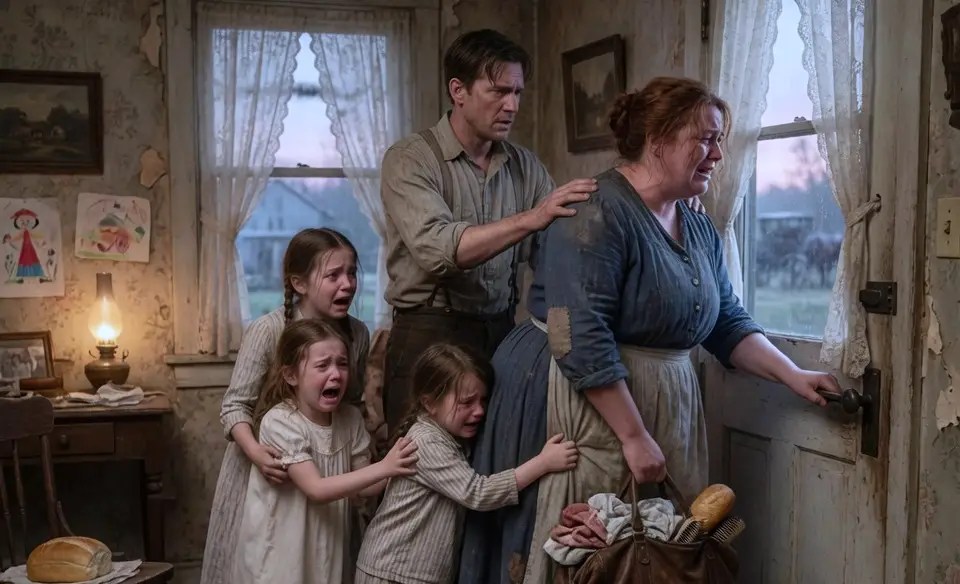
The boardinghouse matron stood in the kitchen doorway, her arms crossed firmly over her chest. The older woman’s voice wasn’t overtly cruel, but it carried the blunt, heavy weight of an undeniable fact. They were married. Chosen. They had found somewhere to go, someone to build a life with.
The matron let the silence stretch before looking Ruth up and down, her gaze taking in the plainness of Ruth’s sturdy frame, the unremarkable cut of her faded dress, the sensible, heavy shoes.
“Tell me,” the matron pressed, her tone dropping a fraction. “Aren’t you fit for any man?”
Ruth’s hands went entirely still in the greasy water. The words hit her chest like a physical slap, stealing the air from her lungs.
She had heard those exact words before. The memory rushed back, violent and immediate, transporting her to a wind-swept train platform two years ago. She had traveled for three grueling days, her heart hammering with terrified, fragile hope, to meet a man who had placed a marriage advertisement in a distant paper. She had worn her only good dress. She had practiced her introduction in the window glass of the railcar.
But when she had finally stepped down onto the wooden planks, the man had simply stared at her. He didn’t reach for her small travel bag. He didn’t even ask for her name. A harsh, barking laugh had escaped his throat before he shook his head.
“You’re not what I ordered,” he had told her, his eyes cold and dismissive as they swept over her curves. “You’re not fit for any man.”
Ruth had turned around, walked to the ticket counter, and taken the very next train back. That singular, devastating sentence had unpacked its bags and moved permanently into her mind, echoing in every quiet moment.
Now, the matron was tapping her foot against the floorboards, waiting for an answer.
Ruth slowly pulled her hands from the water and dried them on her apron. She didn’t look up.
“No, ma’am,” Ruth said quietly, the resignation in her voice tasting like ash. “I suppose I’m not fit for any man.”
The matron offered a tight, satisfied smile. “Then you’d better start looking for work. This house closes in two weeks.”
When the woman’s footsteps faded down the hall, Ruth stood completely alone in the damp kitchen. She mentally tallied her life’s savings. She had exactly seventeen dollars to her name. No family. No prospects. Nowhere on earth to go.
But that evening, as she walked past the local church, a flutter of white paper caught her eye. It was a handwritten notice tacked to the community bulletin board. The handwriting was rushed, the letters pressing into the paper with a heavy, frantic hand. It was barely legible, but the words were a raw wound pinned to the wood.
Desperate. Widower. Three children. Need help. Send word.
Ruth stood in the fading light, her fingers tracing the rough edge of the paper. She unpinned it carefully, smoothing the creases against her skirt. That very night, she walked to the telegraph office. She sent a brief wire, walked to the station, and bought a train ticket with her last seventeen dollars. She didn’t buy a return fare. There was nothing to return to.
The locomotive pulled into the dusty station of Redemption Creek late on a Friday afternoon. The sun was dipping low, casting long, golden shadows across the platform. Ruth stepped down, her small woven bag clutched tightly in her hand, and froze.
She wasn’t the only one who had answered the call.
Four young women were already gathered on the platform. They were everything Ruth was not: pretty, delicate, and brimming with the effortless confidence of women who knew their own value. They stood in a circle, adjusting their fashionable hats and laughing openly together about the sheer desperation of the widower’s advertisement.
Ruth shrank back against the brick wall of the station house, her heart sinking. She looked toward the far end of the platform.
A man stood near a battered wooden wagon. He was tall, his broad shoulders slumped with an exhaustion that seemed to seep straight into his bones. A work-worn leather hat was pulled low over his eyes. Grouped nervously behind his legs were three children. They were terribly thin, their clothes slightly too small, and they were far too quiet. They possessed the eerie, unnatural stillness of prey trying not to be seen.
The four young women approached the man like royalty descending upon a peasant, their postures radiating the belief that they were doing him a profound favor.
The tallest of them, a striking blonde with a parasol, spoke first, her tone brisk and businesslike. “What are the wages, Mr. Hartley?”
The man removed his hat, revealing dark hair and eyes completely hollowed out by exhaustion. “Room and board, ma’am. Plus ten dollars a month.”
The blonde let out a sharp, incredulous laugh. “Ten dollars? For three children? I’d need twenty, at the very least. And my own room with a heavy lock. And Sundays entirely off.”
Another woman, this one smoothing a pristine silk skirt, chimed in. “I would require a generous clothing stipend. This kind of rural work will absolutely ruin my dresses.”
A third woman leaned around the blonde, her gaze dropping to the three little faces peering from behind their father’s legs. Her lip curled with barely concealed disgust. “Are they well behaved? I won’t tolerate wild, unruly children under my feet.”
James Hartley’s jaw tightened. The muscle feathered in his cheek as he gripped the brim of his hat. “They’re grieving,” he said, his voice a low, gravelly rasp. “Their mother died four months ago.”
“That’s very sad,” the blonde said flatly, entirely unaffected. “But your offer simply isn’t acceptable. Good day.”
They turned in unison, their skirts rustling in the dry breeze, and walked away. Within seconds, they were laughing again, the sound bright and sharp in the quiet afternoon.
James stood paralyzed by the wagon, his shoulders dropping another inch. He looked like a man who had finally run out of air. Behind him, the smallest child—a little girl with messy, dark braids—had squeezed her eyes shut. Silent tears were cutting clean tracks through the dust on her cheeks.
Ruth’s heart cracked wide open. The sound of it breaking in her chest was deafening.
She stepped forward before her mind could invent a reason to stay hidden. The heavy thud of her sensible shoes drew the attention of the last departing woman. The woman, a sharp-featured redhead, paused and looked Ruth up and down, her eyes widening in theatrical shock.
“What in the world are you doing here?” the redhead asked.
Ruth ignored her. She kept her eyes fixed forward and walked straight to James Hartley.
“Mr. Hartley,” she said, her voice clear in the quiet air. “I’m Ruth Brennan. I sent you a telegram.”
James looked at her. He really looked at her. He took in her considerable size, the faded fabric of her plain traveling dress, the rough, work-worn skin of her hands gripping her bag. Ruth braced herself. She locked her knees, waiting for the familiar, crushing expression to cross his face. The disappointment. The sneer. The rejection.
It didn’t come. He just looked terribly, unbelievably tired.
Behind her, the red-headed woman let out a cruel, barking laugh. “Oh, this will be good. You actually think he wants you? Look at yourself.”
Ruth’s face burned, a hot flush of humiliation creeping up her neck. The old shame rose up in her throat, thick and choking. She wanted to run. She wanted to melt into the floorboards. But she forced herself to keep looking at James. She forced herself to speak the ugly truth that had been beaten into her soul for years.
“I am not fit for any man,” Ruth said, her voice shaking violently. “I know that. I’ve known that for a long time.”
The platform went dead quiet. Even the red-headed woman stopped laughing, stunned by the raw honesty.
Ruth looked past James’s exhausted face to the three children. She looked at the little girl with tears on her face, at the young boy clutching his sister’s hand for dear life, at the older girl whose chin was trembling with the effort of trying so hard to be brave.
“But I can love your children,” Ruth said, and miraculously, her voice steadied. The shaking stopped. “I can care for them. I can make them feel safe. I can be what they need, even if I’m not what anyone wants.”
James Hartley stared at her. The moment stretched out, painful, suspended, and entirely endless. The dusty wind blew between them.
Then, he asked a single question.
“Will you stay?”
Ruth’s breath hitched in her chest. “Yes,” she whispered fiercely. “I’ll stay.”
James nodded once. It wasn’t a celebration; it was a surrender. He turned to his youngest daughter, stooped down, and gently scooped her up into his arms. He stepped toward Ruth and placed the little girl directly against her chest without a single word of instruction.
The little girl was as light as a hollow-boned bird, her tiny frame vibrating with tremors. Ruth caught her automatically, her instincts taking over. She wrapped one strong arm carefully around the child’s back and brought her other hand up to cradle the back of her head…
To read the rest of the story – CLICK the NEXT button 👇👇👇