


Five thousand sailors stood frozen under a punishing California sun that had long since baked the asphalt into a searing griddle. Not a single body moved. The stillness was absolute, heavy with the suffocating weight of military discipline and collective shock. Admiral Thorne towered over the woman he had just struck across the face, his hand still suspended in the thick, humid air. His voice, ragged with misplaced authority, cut through the suffocating silence of the parade ground.
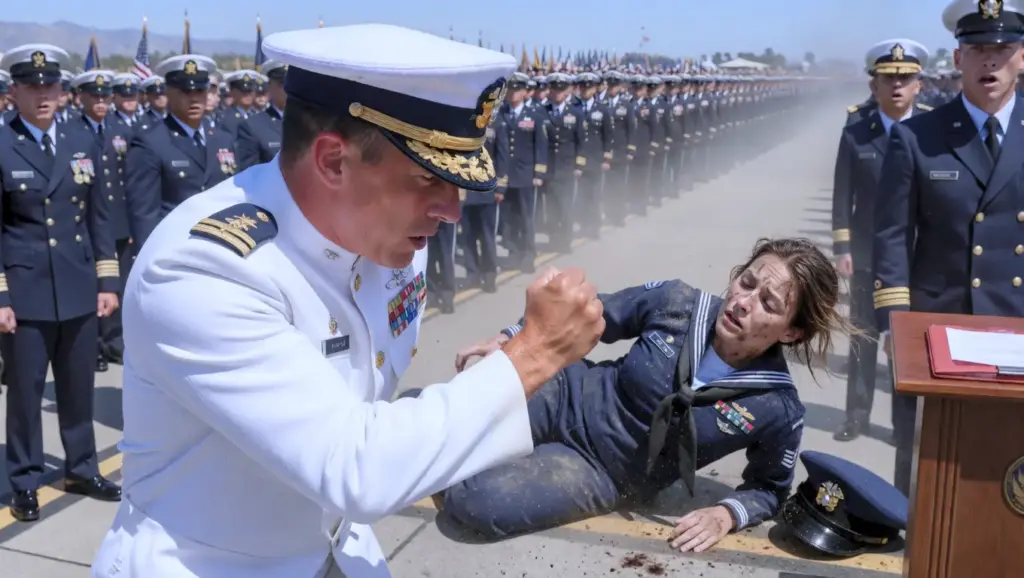
“Dead weight,” he spat. “You are everything wrong with this uniform.”
She did not fall. She did not flinch.
A thin, vibrant line of crimson traced its way down her chin from a split lip, but she simply straightened her spine. She squared her shoulders, bringing her gaze forward to stare perfectly through the man who had just assaulted her. In the front row of the formation, a junior officer went deathly pale. He recognized the specific, terrifying way she had absorbed the physical blow. It was not the flinch of a victim. It was the terrifyingly still absorption of someone who had survived unimaginably worse and simply kept moving forward. Her left hand rested perfectly motionless against the seam of her trousers. The rhythm of her breathing never shifted.
“Permission to retrieve my personnel file, sir,” she said. Her voice was terrifyingly calm.
Admiral Thorne let out a sharp, mocking laugh. The thousands of men and women in the formation did not join him. Because in that exact moment, the junior officer in the front row was already mentally searching a name he couldn’t quite place, and the realization of who she actually was made the blood drain entirely from his face.
The digital numerals on the bedside clock dissolved from 4:46 to 4:47. No alarm had sounded in the stifling dark of the room. Briony Hale was already awake.
She rose in the pitch blackness of the bachelor enlisted quarters, her movements entirely economical and stripped of any morning grogginess. The building was silent, save for the distant, metallic hum of the ventilation systems and the muffled footfalls of early morning watch changes echoing through the corridor outside her door. She moved through her morning routine without a single hesitation, each physical action measured out to the exact second.
Her hands reached out in the dark, finding the familiar texture of the bandage roll resting on her footlocker. With practiced, mechanical care, she wrapped her damaged left ear. Her fingers paused only briefly at a specific point where a jagged landscape of scar tissue permanently disrupted the natural curve of the cartilage. The entire wrapping process took exactly forty-three seconds. She had timed it often enough in the dark to know the rhythm by heart.
In the cramped bathroom, the shower ran ice-cold for the first thirty seconds. She stood directly under the freezing stream without a single flinch, letting the frigid water trace erratic patterns across her collarbones and stream down the long, vertical surgical scar that anchored her spine. When the base boilers finally kicked in and steam filled the small space, she washed with the detachment of someone performing maintenance on a machine. Shampoo. Rinse. Repeat. Soap applied in rigid, geographical sections. The routine never varied, not by a single motion. Predictability was her anchor. Predictability was control.
She dressed in her logistics corps uniform, her movements sharp, deliberate, and entirely devoid of vanity. The stiff fabric settled across her frame with textbook military precision. Her fingers worked the dark buttons without needing to look, deep muscle memory guiding every motion. She allowed herself to check her reflection only once. The face staring back from the fogged glass was aggressively unremarkable. She was in her early thirties, her skin stripped of makeup, her eyes holding an engineered blankness. Her dark hair was pulled back into a regulation bun, twisted tight enough to easily survive a grueling twelve-hour shift. The clean white bandage around her left ear was barely visible beneath the sharp edge of her cover.
Three specific objects sat waiting on the flat metal lid of her footlocker.
She stood in the pre-dawn dimness and studied them. The first was a heavy brass compass, its edges deeply tarnished with age and salt water. The initials that had once been proudly engraved on its face had been aggressively filed away, leaving behind only faint, angry scratches where a name used to be. She picked it up, turning the heavy metal over in her palm. A date was etched into the back. Halo. 7/14. March 21. The brass felt dead and cold against her skin.
A sealed manila envelope lay directly beside the compass. Multiple forwarding stamps completely covered its weathered surface, each ink mark documenting a long, complicated journey through various military postal systems across the globe. The final date stamp was exactly six months old. She had never opened it. The thick paper had already begun to yellow slightly at the corners, holding secrets she refused to let into the room.
The third object rested out of sight, tucked at the bottom of a thick gray wool sock. It was an old, heavy dive watch. Unreasonably expensive. Strictly tactical grade. It was the kind of specialized timepiece engineered to withstand crushing ocean depths that most ordinary people would never see in a lifetime. She kept it hidden, wrapped carefully so the heavy steel wouldn’t click against the metal footlocker whenever she moved it.
She reached out and touched the compass once more, her fingertips tracing the rough, filed-down surface where the initials used to live. She did not open the yellowed envelope. She did not retrieve the heavy dive watch. After exactly thirty seconds of standing there, she gently closed the lid of the footlocker and secured the heavy combination lock. The metal dial spun under her thumb with three sharp, definitive clicks.
Dawn was just breaking over Naval Air Station Coronado as she stepped out into the morning. The coastal air tasted sharply of ocean salt and burning jet fuel. A thick marine layer of morning mist clung stubbornly to the vast stretches of asphalt, diffusing the harsh security floodlights that illuminated the pathways between the massive concrete buildings. Far in the distance, military helicopters moved across the pale sky like dark, heavy insects against the brightening horizon. Their massive rotors created a deep, rhythmic thump that carried across the base, a vibration you could feel in your teeth.
She walked toward the mess hall entirely alone. Other base personnel moved in loose, relaxed groups, their casual voices carrying easily through the morning stillness. Briony kept her distance, her chosen path taking her deliberately along the extreme outer edge of the main thoroughfare rather than straight through the center. She moved with quiet purpose, but without any frantic hurry. Yet beneath the brim of her cover, her eyes constantly tracked everything. She logged the emergency exits. She noted the sweep of the security cameras. She monitored the patrol patterns of the military police. She even registered the subtle shift in the direction of the wind coming off the Pacific. She absorbed details most people never knew existed.
The massive mess hall smelled aggressively of burnt coffee and industrial-grade scrambled eggs. She moved through the serving line, filling her plastic tray with practiced efficiency. Plain oatmeal. One banana. Black coffee, absolutely no sugar. She carried her tray to a small, isolated corner table near the rear emergency exit—the exact same table she occupied every single morning. From this specific chair, she had a clear, unobstructed sightline to both main entrances and roughly ninety percent of the room. Old habits died hard; some never died at all.
She ate methodically, viewing the food purely as fuel. Oatmeal consumed first. The banana sliced into precise, even sections. The bitter coffee consumed in measured sips between each bite. As she ate, her eyes never stopped their slow, sweeping assessment of the room. She watched the endless flow of personnel, quietly noting the clusters of ranks and behavioral patterns. A tight group of SEALs sat three tables over, their conversation loud, boisterous, and universally confident. They wore their gold warfare pins on their chests like gleaming badges of honor. Not a single one of them bothered to look in the direction of a solitary logistics specialist.
Suddenly, a violent, metallic clatter erupted from the serving line. Someone had fumbled and dropped a metal tray onto the hard tile floor.
The sound echoed through the cavernous space with the sharp, cracking intensity of a gunshot.
Briony’s body bypassed her conscious brain entirely. She tensed, her right hand moving in a blindingly fast, instinctive arc directly toward her right hip—reaching for a holstered sidearm that simply wasn’t there.
She caught herself mid-motion, freezing her arm and forcibly willing her rigid fingers to relax. She forced a slow breath into her lungs. The entire visceral reaction had taken less than a fraction of a second. The vast majority of the room hadn’t noticed a thing.
But someone had.
A young SEAL lieutenant, standing near the metal beverage station, had frozen with his coffee cup halfway to his mouth. He was staring at her with narrowed, intensely calculating eyes. His sharp gaze flicked from her perfectly blank face down to her trembling right hand, then slowly back up again. A faint spark of recognition flickered across his tanned features, followed immediately by deep uncertainty. He opened his mouth as if to call out to her.
Briony immediately stood up and cleared her tray. She walked directly past the young lieutenant without ever making eye contact. Her physical movements were fluid, balanced, and perfectly precise. She navigated through the crowded tables and around moving personnel with the kind of hyper-tuned spatial awareness that only came from years of elite, life-or-death training. She was entirely too fluid. Too precise.
The lieutenant turned his body to watch her go. His hand drifted slowly down to his pocket, reaching for his phone, before he hesitated and let his arm drop. He just stood there for a long, silent moment, staring blankly at the empty doorway where the quiet woman had disappeared.
The main supply warehouse occupied a sprawling, cavernous concrete structure at the far edge of the naval base. Inside, massive rows of heavy metal shelving stretched endlessly toward the high ceiling, packed tight with crates of equipment and crucial materials. The stagnant air inside smelled thickly of corrugated cardboard and machine oil. Industrial fluorescent lights hummed a low, buzzing note overhead, casting everything in a harsh, unforgiving white glare.
Briony worked the inventory manifest with quiet, relentless efficiency. She scanned the barcodes, checked the physical quantities, and cross-verified the complex lot numbers. The work was meant to be straightforward, entirely repetitive—exactly the kind of mindless task expected of a low-level logistics specialist.
But the way she physically organized the supplies told an entirely different story.
Instead of filing the heavy crates in alphabetical order, she had been systematically breaking them down and rearranging the equipment strictly by operational priority. She moved the heavy night-vision batteries directly to the front shelves for immediate access. She grouped the complex medical supplies meticulously by trauma classification. She restacked the heavy communication gear according to statistical deployment frequency. The complex system made flawless tactical sense for a combat loadout. It made absolutely no sense for routine, stateside warehouse inventory.
Petty Officer Drummond noticed immediately. Drummond was a heavy-set, flushed man with fifteen long, comfortable years in the logistics corps, and he harbored loud opinions about absolutely everything. He stomped over to the aisle where Briony was quietly reorganizing a heavy shelf of radio equipment.
“What exactly are you doing?” His voice carried the particular, whiny irritation of a middle-manager whose comfortable, lazy system had just been disrupted by someone making it vastly more efficient.
Briony did not stop working. She didn’t even look up. “Optimizing.”
“Efficient for what?” Drummond snapped. “We go alphabetical. That’s the system. It’s always been the system.”
“This way, critical trauma and communication items are accessible first,” Briony replied, her voice an even, unbothered monotone. “If there is a sudden emergency mobilization, our physical response time improves by approximately forty percent.”
Drummond just stared at her, his face reddening. “When was the last emergency mobilization here? September 2019. That was five years ago, correct?”
Briony finished securing a heavy nylon strap around a crate and moved silently to the next section of shelving.
Drummond shook his head, a sneer forming on his lips. “You trying to play operator or something, Hale? You are logistics. We sit in the back. We follow the system.”
Briony said nothing. She simply continued working. Her bare hands moved with practiced, surgical precision, checking the heavy equipment with the kind of thoroughness that suggested an incredibly intimate familiarity. She examined the tiny expiration dates on the night-vision batteries with intense, absolute focus, her calloused fingers testing the delicate connections and waterproof seals. She didn’t need a manual. She knew exactly what to look for. She knew what catastrophic equipment failures looked like out in the dark, long before they actually happened.
Drummond watched her work for another tense moment, clearly unsettled by her complete lack of intimidation, before he finally turned and walked away, muttering under his breath about arrogant new personnel who thought they knew better than the Navy…
To read the rest of the story – CLICK the NEXT button 👇👇👇