


“Marrying a plumber? How embarrassing!”
Those were the final, venomous words my mother spoke to me before she turned her back, the sharp click of her designer heels striking the hardwood floor like a gavel finalizing a sentence. Beside her, my older sister let out a high, melodic laugh, tossing her perfectly styled hair over her shoulder as she casually asked who in their right mind would be caught dead at a wedding like that. They walked away without a backward glance, the heavy mahogany door of my childhood home closing with a definitive thud that seemed to rattle the very bones in my chest. They left me to walk down the aisle alone.
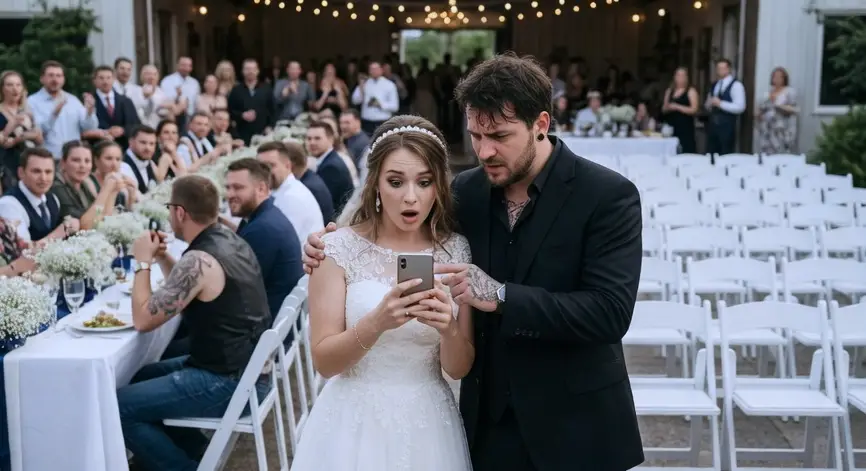
Standing there in the humid Atlanta heat, encased in the delicate white lace of my wedding dress, a violent tremor took hold of my body. Against my hip, tucked discreetly into a hidden pocket of the gown, my phone began to buzz. It was a rhythmic, relentless vibration, a notification that was about to shatter the remaining fragments of my heart. Yet, as the tears threatened to spill over my carefully applied mascara, a strange, retrospective clarity washes over me now. In that agonizing moment of abandonment, my family had absolutely no idea what they were walking away from.
They had no idea that within twenty-four hours, my humble, calloused-handed husband would be the face broadcasted on every news channel in America. They had no idea that the man they had so casually dismissed as a blue-collar disgrace was about to become the most powerful, untouchable person they had ever known. And when the truth finally breached the walls of their curated reality, I would wake up to the pathetic flashing of one hundred and twenty-nine missed calls.
At twenty-eight years old, I had spent my entire life trying to shrink myself to fit into a mold that was never cast for me. My name is Nia. I work as a landscape architect, a profession born from a desperate, deep-seated need to design spaces where people could find the peace and grounding I was perpetually denied in my own home. For as long as I could remember, I was the invisible daughter. I was the girl who was never quite ambitious enough, never ruthless enough, never quite elite enough to satisfy my parents, Desmond and Patrice Vance.
They reigned over the upper echelon of Atlanta society, existing in an insulated bubble where your last name, your zip code, and your corporate job title carried infinitely more weight than your moral character or the kindness in your heart. Yesterday was supposed to be the most beautiful, sacred day of my life. Instead, it became the exact moment the blinders were ripped from my eyes, the day I finally understood that to my family, my personal happiness would always be collateral damage in the war to maintain their pristine public reputation.
The air in the garden was dense and intoxicating, heavy with the sweet, suffocating scent of blooming jasmine and ancient magnolia trees. I had designed this entire space with my own two hands. Over the course of several exhausting months, I had painstakingly transformed a small, neglected plot of overgrown land into a lush, vibrant sanctuary. It was modest, undeniably so, but it was ours. It was a physical manifestation of the life I wanted to build: rooted in the earth, honest, and entirely authentic.
From somewhere beyond the dense foliage, a string quartet began to play. The opening notes of Canon in D drifted through the warm afternoon air, a sweeping, melancholic melody that I had dreamed of walking down the aisle to since I was a little girl playing with tulle in my bedroom. My hands were shaking so violently that I could barely maintain my grip on my bouquet of wild orchids. I stood frozen at the top of the winding stone path, temporarily shielded from the guests’ view by a wooden trellis heavily draped in dark green English ivy. I closed my eyes and drew in a long, shuddering breath, trying to force oxygen into my panicked lungs.
This was it. The moment every bride spends a lifetime waiting for. Gathering every ounce of courage I possessed, I stepped out from behind the safety of the greenery and allowed my eyes to travel down the length of the aisle.
The sight that greeted me was a physical blow that nearly sent my knees crashing into the paving stones. On the right side, the groom’s side, the picture was warm and vibrant. Every single wooden chair was filled. There were about twenty people gathered there, a beautifully diverse group consisting mostly of Marcus’s friends and colleagues. Some wore simple, off-the-rack suits, while others carried themselves with a surprisingly distinguished air that seemed unusual for the drinking buddies of a local plumber. Regardless of their attire, they all looked back at me with warm, deeply encouraging smiles, their eyes crinkling with genuine happiness for the man waiting at the altar.
But then, my gaze drifted to the left.
The bride’s side. It was a sprawling, desolate sea of empty white folding chairs. Row after meticulously arranged row of vacant seats stared back at me in the dappled sunlight, looking for all the world like a set of jagged, missing teeth in a broken smile. My father was not there. My mother was not there. My sister, Keisha, was not there. My aunts, my uncles, my cousins—the people who had watched me take my first steps, the people who had celebrated my college graduation—none of them had bothered to show up.
I had carefully hand-addressed forty invitations to my family members. Not a single solitary soul had come. The silence emanating from that barren side of the aisle was deafening, entirely drowning out the beautiful music soaring from the string quartet.
It felt as though all the oxygen had been violently sucked right out of the atmosphere. I froze, my satin-clad foot hovering motionless over the first gray paving stone, my body completely incapable of taking a step forward. In the suffocating stillness, my phone—still tucked away in the deep pocket of my dress for absolute emergencies—vibrated aggressively against my hip.
Every rational instinct in my body screamed at me to ignore it. I knew I should just lift my chin, fix my eyes on Marcus, and keep walking. But a sick, twisting sensation deep in the pit of my stomach—a primal intuition honed by years of surviving my mother’s psychological warfare—demanded that I look.
I reached into the silk folds of my gown and pulled the device out. My fingers were trembling so severely that the phone nearly slipped from my grasp and shattered on the stones. The screen lit up, illuminating a text message from my mother, Patrice. For one brief, pathetic second, the little girl inside me hoped against all odds that it was news of an emergency. A blown tire on the highway. A sudden, severe illness. Absolutely anything that would offer a logical explanation for this catastrophic abandonment.
But the message glowing back at me was ruthlessly clear, stripped of any maternal warmth. It read, simply and sharply:
“Nia, I am sorry, but I cannot lower myself to be seen sitting in a backyard with a blue-collar crowd. It would be social suicide. Your father and I are at the yacht party with Brad and Keisha. We have an image to maintain. Good luck with your life of mediocrity.”
I stood immobilized, staring down at the illuminated screen as the cruel words began to blur and warp, hot tears finally welling up and spilling over my lower lashes. Mediocrity. That was the exact word she had chosen to describe the brilliant, unwavering love of my life. Social suicide. That was how the woman who had given birth to me viewed the holy sacrament of my wedding day.
They were on a yacht. Right now, at this exact, devastating moment in time, while I stood entirely alone in a garden I had built with my own hands, my parents were sipping expensive champagne and tossing their heads back in laughter on a boat belonging to my sister’s insufferable fiancé. They had looked at a calendar, weighed their options, and deliberately chosen a networking party over their youngest daughter’s wedding.
A ragged, ugly sob escaped my throat, tearing through the quiet elegance of the garden. The string quartet faltered, a cellist missing a beat as the sheer grief in the sound echoed toward them. The guests seated on Marcus’s side shifted uncomfortably in their chairs, exchanging worried, sympathetic glances. I had never felt so entirely naked, so profoundly exposed.
The shame of being so publicly unloved burned across my skin like a physical fire. I wanted to gather the heavy skirts of my dress, turn around, and run until my lungs gave out. I wanted the carefully manicured earth beneath my feet to open up and swallow me whole. How could they do this to their own flesh and blood? How could a mother be so thoroughly heartless? Then, through the blinding haze of my tears, I saw him. Marcus…
Also on Realish: The Groom Arrived in a Junker, But the Bride’s Reaction Left Him Speechless
To read the rest of the story – CLICK the NEXT button 👇👇👇