


“Mama, I’m cold.”
The small, trembling voice broke through the howling of the wind outside. Keisha’s fingers froze on the brittle plastic of the hallway thermostat. She stared at the digital display, the faint green numbers mocking her from the shadows of the narrow corridor. Fifty-two degrees. It had been fifty-six an hour ago. The temperature inside the drafty rental house was dropping steadily, surrendered to the merciless grip of the storm.
She twisted the small dial to the right, pushing it as far as it would go. A hollow, useless click echoed in the silence. Nothing happened. Deep in the bowels of the house, the furnace remained dead and silent. Outside, the blizzard tore through the Detroit streets, the wind shrieking against the thin windowpanes like a starving animal desperate to get inside.
Marcus, barely two years old, stood in the doorway of the living room. He was wearing his two-piece fleece pajamas, but the fabric was worn thin from endless cycles in cheap laundromat dryers. His tiny shoulders hitched as a shiver wracked his little body.
“I know, baby,” Keisha whispered, forcing a calm she absolutely did not feel into her voice. She knelt on the freezing linoleum, rubbing his arms briskly to generate some friction. “Mama’s gonna fix it.”
But the lie tasted like ash on her tongue. She couldn’t fix it. Not tonight. Not with the seven crumpled dollars currently sitting on the kitchen counter, and certainly not with the meager wages from three separate jobs that still left her drowning in a sea of past-due notices.
Keisha closed her eyes, pressing her forehead against the icy plaster of the hallway wall. She inhaled deeply, silently counting to ten. It was a grounding exercise, something a tired, overworked therapist at the county free clinic had taught her months ago to stave off the crushing panic attacks. Count to ten. Breathe in the good air, breathe out the fear. But breathing exercises didn’t satisfy a landlord, and counting to ten didn’t reignite a broken pilot light.
“Mama?”
“Just a minute, Marcus. Stay right there for me, okay?”
She pushed herself up, her knees popping in the quiet house, and walked the five short steps into the cramped kitchen. The linoleum was like a sheet of ice beneath her socks. She grabbed the handle of the humming refrigerator and pulled it open, though she already knew exactly what was inside. The pale bulb illuminated a devastatingly barren space. There was exactly half a gallon of milk. Four brown eggs sat in a cardboard carton. On the middle wire rack rested a single heel of bread, its edges already stiffening into stale submission.
She gently nudged the door shut and opened the freezer compartment. It was entirely empty, save for a plastic ice tray and a thick, fuzzy layer of neglected frost clinging to the back wall.
Keisha turned her gaze to the laminate counter. There they were. Five ones and a single two-dollar bill, wrinkled and stained with coffee rings. Seven dollars. It was the entirety of her tip money from the brutal morning shift at the diner. Seven dollars stood between her and Christmas morning, a holiday that was rapidly approaching with the promise of absolutely nothing.
A sharp buzz vibrated against the counter. Her cell phone screen lit up, illuminating the dark kitchen with a harsh white glow. It was a text message from Mr. Morrison, her landlord.
Heats your problem. Fix the main line. Your unit’s separate. Call someone.
She read the words three times, her chest tightening with each pass. Call someone. Call an emergency HVAC technician on Christmas Eve with seven crumpled dollars? A bitter, helpless laugh escaped her lips before she could catch it. She tossed the phone back onto the counter and covered her face with her hands. The wind screamed again, violently rattling the kitchen window so hard the glass threatened to shatter.
December in Detroit was always a brutal, unforgiving season, but the local news anchors had been warning about this particular storm for days. They called it historic. They called it a once-in-a-generation freeze. It was the kind of insidious, creeping cold that didn’t just cause discomfort; it took lives.
“Mama, my feet are cold.”
Keisha quickly wiped her eyes and hurried back into the living room. She scooped Marcus up into her arms, pressing his shivering little body against her own chest to share whatever residual heat she had left. She carried him over to the sagging, secondhand sofa and gently deposited him onto the cushions. Working with frantic purpose, she gathered every single blanket they owned in the house—three thin, faded throws that had been washed until the fibers were practically transparent—and swaddled him tightly like a newborn.
“Tell you what,” she said, plastering a bright, animated smile onto her face. “We are going to have a special adventure tonight. We’re going camping right here in the living room.”
“Camping?” Marcus repeated, his large brown eyes widening. It broke her heart, the profound innocence of a toddler who could find absolute magic in a situation built entirely out of desperation.
“That’s right, baby. Just you and me. The best camping trip ever.”
She climbed onto the sofa and pulled him onto her lap, wrapping her arms securely around his bundled form. She rested her chin on the top of his head, feeling the soft rhythm of his breath against her neck. Her own stomach let out a sharp, painful cramp. The hunger was a dull ache that had settled deep into her ribs. She had given Marcus the very last bowl of generic toasted oats an hour ago, cheerfully telling him that Mama simply wasn’t hungry tonight.
But God, she was starving.
The wind hit the side of the tiny rental house with the force of a physical blow, causing the framed photographs on the wall to tremble. Keisha reached into her pocket and checked her phone screen. It was 9:47 p.m. Christmas Eve was slipping away into the darkness, and she had never felt more profoundly, terribly alone in her entire life.
Her mother had been gone for three years now, taken by an aggressive cancer that had ravaged her body before Keisha even had time to process the diagnosis. Her older sister lived somewhere in Northern California, newly married to a man who had made it abundantly clear that Keisha’s financial struggles and single motherhood did not fit into their pristine coastal lifestyle. The friends she used to have had slowly drifted away when the money got too tight for casual lunches, when every shared conversation inevitably circled back to the things Keisha could no longer afford to do.
She worked three jobs. She scrubbed industrial office floors before the sun even thought about rising. She slung hash and poured endless cups of bitter coffee at the diner from eight in the morning until four in the afternoon. And when she could beg the manager for the hours, she stocked heavy canned goods at the neighborhood grocery store until midnight.
And still, despite the bone-deep exhaustion, it wasn’t enough. They were sitting here, freezing to death in a house that was legally obligated to provide shelter.
Marcus’s breathing slowly deepened, his little chest rising and falling in a steady rhythm. The heavy blanket of sleep was finally claiming him. Keisha carefully adjusted the frayed edges of the blankets around his neck to block out the drafts and slowly stood up. Her joints screamed in protest. She was only twenty-eight years old, but her body ached with the heavy, grinding fatigue of a woman well past fifty.
She walked softly to the living room window, pulling back the faded curtain to look out into the night. The snow was coming down in thick, blinding sheets, swirling violently under the amber glow of the streetlamp. The entire city had surrendered to the storm. The plows were nowhere to be seen, and even the reliable city buses had ceased their routes hours ago.
That was when she felt it.
It started as a vibration in the floorboards beneath her socks, a low, guttural rumble that managed to slice right through the howling of the blizzard. Keisha froze, her hand still clutching the edge of the curtain. The sound grew louder. Closer. It was a heavy, mechanical thunder, but thunder didn’t sustain itself like this. Thunder didn’t growl with such deliberate menace.
She pressed her cheek against the freezing glass, straining to see through the whiteout conditions. Headlights pierced the swirling snow. One pair, then another, moving at a slow, deliberate crawl down her unplowed residential street. Motorcycles.
Her heart gave a violent kick against her ribs, the adrenaline instantly flushing the cold from her veins.
The heavy bikes began to pull up right against her curb, their blinding halogen lights cutting through the darkness of the blizzard. Keisha found herself counting them in breathless disbelief as they parked in a perfectly synchronized line. Five. Ten. Fifteen. Twenty.
Twenty-five massive motorcycles lined the length of the street directly outside her living room window.
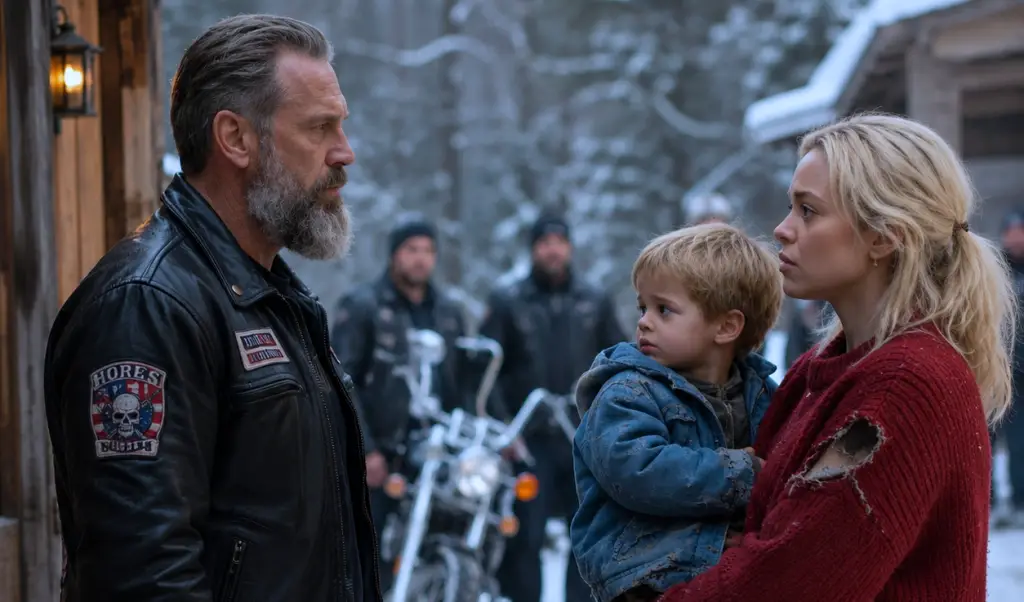
One by one, twenty-five men climbed off their idling machines. They were enormous figures, clad in heavy leather jackets adorned with large, intricate back patches she couldn’t quite decipher through the veil of falling snow. They were towering men with thick beards, long hair, and heavy boots. They moved with a terrifying, military-like precision, stomping the heavy snow from their boots, their broad shoulders hunched against the biting wind.
Keisha’s hands began to shake violently, and it had nothing to do with the temperature of the house. This was a quiet residential street on the east side. This wasn’t a random traffic stop. Someone had sent them. Her mind raced to the darkest corners—was this a collector? Did she owe money to someone she didn’t know about? But she never borrowed cash. She knew exactly what happened to people who borrowed money they couldn’t pay back.
One of the men, a giant of a figure with a thick gray beard that cascaded entirely down his chest, stopped moving. He turned his head slowly, looking directly through the snow, right at her living room window.
Keisha gasped and stumbled backward, letting the curtain fall shut.
Through the thin drywall, she heard the heavy crunch of boots marching up her front walkway. They were coming to her door.
Oh, God. Oh, God.
Behind her, Marcus stirred restlessly beneath his mound of blankets. “Mama?”
“Baby,” Keisha whispered, her voice cracking with pure terror. “Stay right there.”
The knock hit the front door. It was hard, loud, and demanding. Three heavy, terrifying strikes that rattled the hinges.
Keisha’s mind raced, spinning frantically through a catalog of impossible options. Call the police? With what? She reached into her pocket and pulled out her cell phone, the battery icon flashing a menacing sliver of red. Three percent. Even if she called 911, the dispatchers were overwhelmed with storm emergencies, and she had sold her only phone charger to a pawn shop last Tuesday to buy a bottle of pink amoxicillin for Marcus’s raging ear infection…
Also on Realish: Bikers Return to Thank Elderly Woman Who Sheltered Them During a Snowstorm
To read the rest of the story – CLICK the NEXT button 👇👇👇