


The courtroom smelled of institutional floor wax and the stale, recycled breath of a dozen failed marriages. At fifty-eight years old, after thirty-three years of keeping another man’s house and carrying another man’s name, Ruth Macklin sat in a rigid wooden chair and listened to her life being legally disassembled. The presiding judge read the settlement terms into a cheap microphone that compressed his voice, making the monumental dissolution of a family sound like a fast-food drive-through order echoing from a tin can.
Dennis, of course, was not there. Dennis abhorred the messy logistics of consequence. He had dispatched his attorney, a man named Felton wrapped in an aggressive charcoal suit, who spent the duration of the hearing discreetly checking his heavy silver watch. Some men take your home, Ruth thought as she watched Felton’s cufflink catch the fluorescent light. Some men take your youth. Dennis Macklin took thirty-three years of unwavering compromise and called the resulting devastation a fair split.
Felton tapped a manicured finger against the paperwork. Ruth took the offered pen. Four signatures. Two sets of initials. With the dry, abrasive scratch of a ballpoint rolling across paper, her marriage was officially reduced to a stack of heavily redacted documents sliding into a manila folder.
“This is the finalized asset schedule,” Felton stated, his tone devoid of anything resembling human empathy as he slid a single sheet of paper across the polished mahogany table. “The Briar Creek property, all associated vehicles, the retirement accounts, and the comprehensive investment portfolio remain with Mr. Macklin, strictly per the terms of the agreed settlement. You retain the Ford pickup truck, your personal effects, and the real property located on Route 11 in Goshen County.”
The real property. It was a sterile, bloodless term for her father’s gas station. It was a cinder-block building on a winding mountain road she hadn’t laid eyes on in over a decade, tucked away in a valley she could barely remember how to navigate. Dennis’s legal team had appraised the crumbling structure at fourteen thousand dollars. They had allowed her to keep it without a single word of argument, treating her only remaining inheritance like a rounding error on a corporate balance sheet. Dennis kept the sprawling Briar Creek estate. He kept the joint savings. He kept the woman he had been quietly seeing for the better part of three years.
Ruth stood up. She reached beneath the heavy mahogany table and hoisted a medium-sized cardboard box against her hip. It contained everything Dennis had deemed hers, left deliberately on the granite kitchen island for her to collect. A velvet jewelry box her late mother had given her. A faded, heavy photo album detailing her daughter Connie’s childhood. A ceramic coffee mug bearing the words ‘World’s Best Mom’ in cheerful, fading font, complete with a jagged chip on the rim. Three decades of shared existence, and this was what fit inside the cardboard.
She walked out of the heavy double doors, down the courthouse steps, and into the blinding afternoon sun of the parking lot. She set the box carefully in the rusted bed of the Ford. It was a 2006 model pushing one hundred and sixty thousand hard miles. The dashboard was cracked from a decade of sun exposure, and the passenger side door was notoriously prone to sticking shut.
Dennis had purchased it years ago for a private landscaper who had abruptly quit after two weeks of dealing with Dennis’s micromanagement. The truck had sat in the wide, paved driveway of the Briar Creek house gathering leaves until Ruth finally started using it for grocery runs and hardware store errands. When the divorce proceedings reached their bitter end, Dennis had grandly informed Felton that his ex-wife could keep the vehicle. Generous to a fault.
Ruth slid behind the cracked steering wheel and simply sat. The vinyl seat was hot against her back. She had absolutely nowhere to go. The beautiful, sprawling house on Briar Creek was legally Dennis’s now, though, if she were being honest with herself, it had ceased being hers long before the first legal petition was ever drafted. She had no leased apartment waiting for her. She had no career to return to. She had no social circle that wasn’t inextricably linked to Dennis’s country club associates. She possessed exactly two hundred and eleven dollars in a freshly opened checking account that would soon bear only her maiden name.
She reached over and pulled the deed from the manila folder resting on the passenger seat. The heavy paper was brittle and deeply creased from years of being wedged into a metal file cabinet at the county clerk’s office. Macklin Gas and Service, Route 11, Goshen County. Deeded to Ruth Ann Macklin per the last will and testament of Earl Robert Macklin, deceased. Her father had left the station to her when his heart finally gave out twelve years ago. She had driven down for the solemn, sparsely attended funeral, spent three frantic, grief-soaked days sorting through a lifetime of his possessions, locked the heavy front door, and simply never returned.
Dennis had smoothly reasoned that the rural property wasn’t worth the burden of the annual taxes, and Ruth hadn’t argued. She never argued with Dennis about property, about finances, about anything of substance. That was the unspoken foundation of their marriage. He yearned for things. She agreed to them.
Ruth turned the key in the ignition. The old Ford engine caught on the third desperate try, coughing a cloud of dark exhaust before finally settling into a rough, rattling idle. She shifted the truck into drive, pulled out of the sun-baked courthouse lot, and pointed the rusted hood south, driving toward the distant, hazy silhouette of the mountains.
The drive took four hours. The manicured, multi-lane interstate gradually surrendered to the two-lane Tulane Highway. The highway eventually narrowed into a rugged County Road, which finally bled into Route 11—a neglected ribbon of cracked, gray asphalt that wound its way aggressively into the Blue Ridge through towering tunnels of ancient oak and hickory. The season was just beginning to turn. The deep summer greens were giving way to sharp, bleeding edges of gold and brilliant copper.
Ruth rolled down the window. The passenger door rattled in its frame, but the mountain air rushed into the stale cab, filling her lungs. It smelled richly of damp, decomposing leaves and distant wood smoke. Beneath those fleeting scents was a foundation of something much older and more permanent. Wet rock. Rich soil. Uninterrupted time. She remembered the sharp curves of this road from her girlhood summers. Her mother used to drop her off at the station on the first day of June and return to collect her in the suffocating heat of late August.
Two solid months with Earl Macklin. Two months of learning how to properly pump fuel, how to count back exact change from a mechanical register, and how to read the dipstick to check oil levels. He had taught her the tactile art of reading a tire tread for uneven wear. He taught her to close her eyes, listen to a struggling engine, and diagnose a misfiring cylinder entirely by sound. She could confidently swap out a snapped fan belt by the time she was twelve years old.
Dennis had found those stories charmingly rustic when they were first courting. Later, as his development firm grew and their dinner parties became more sophisticated, he found her mechanical knowledge distinctly embarrassing. A rising real estate tycoon’s wife had no business knowing her way around a greasy carburetor. He never explicitly demanded that she stop tinkering. He just stopped asking about it, manufactured polite coughs when she brought it up, and eventually, she stopped doing it altogether. You stop doing anything when the person closest to you actively pretends that part of you does not exist.
Route 11 climbed steeper, the dense timber thickening and closing in around the cracked asphalt. Ruth passed a handful of isolated, weathered houses, a small white-steepled church with a deeply rutted gravel parking lot, and an old general store with a faded ‘Closed’ sign hanging crookedly in the window. The road banked sharply around a massive, jutting outcrop of gray granite.
And then, sitting exactly where it always had, was Macklin Gas and Service.
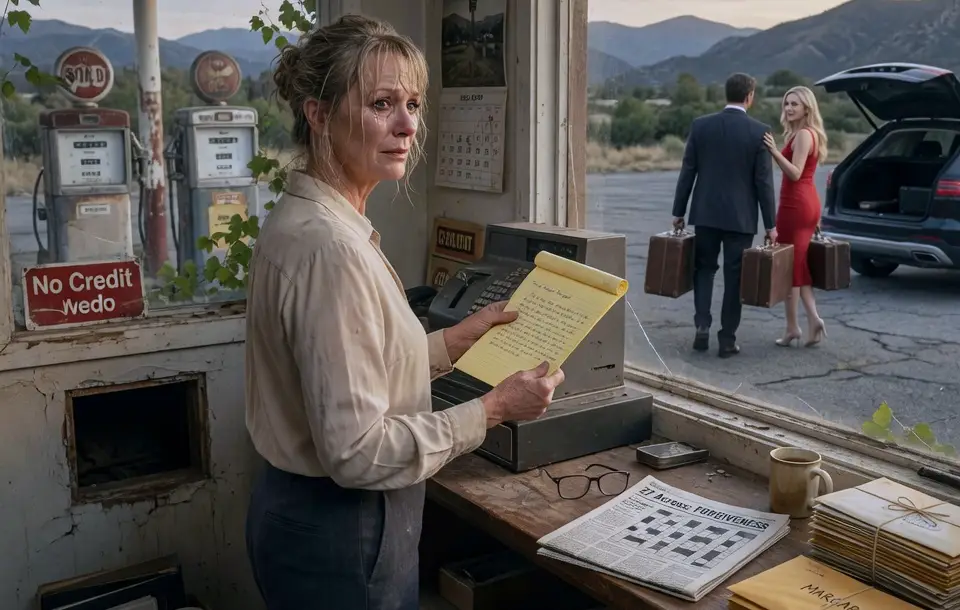
The structure looked dramatically smaller than it did in her childhood memories. It was a utilitarian, single-story cinder-block building topped with a flat, tar-paper roof. Two concrete gas pump islands sat out front like abandoned sentries. The pumps themselves were heavily rusted, secured with thick padlocks, their mechanical price displays permanently frozen on numbers that belonged to a bygone economic era. Aggressive, leafy kudzu had crawled violently over the entire south wall and was actively reaching its tendrils toward the roofline.
The wooden sign mounted above the main entrance, painstakingly hand-painted by Earl himself decades ago, had faded entirely to ghosts of white letters against flaking green paint. One of the large front display windows bore a massive, jagged crack running from corner to corner, sealed haphazardly with strips of silver duct tape that had long since dried, curled at the edges, and turned yellow in the sun.
But the building was still standing. The cinder-block walls were thick and unquestionably solid. When Ruth walked up and pulled the handle of the front door, it was locked tight against the world.
She walked back to the truck, fished through the cardboard box in the bed, and pulled out the heavy ring of brass keys from the manila folder. The second key she tried slid into the front door lock. The internal tumblers resisted fiercely for a moment, grinding against a decade of disuse, before finally yielding with a heavy, gritty click.
Ruth pushed the door open. The air inside the station was incredibly still, thick with suspended dust motes and the lingering scent of old motor oil. The late afternoon sunlight filtered weakly through the filthy, taped glass, casting long, pale rectangles across the scuffed concrete floor. A heavy, solid wood counter ran the entire length of the back wall. Directly behind it hung a massive expanse of pegboard, still dotted with the metal hooks that had once displayed foil snack bags and folded state roadmaps.
Sitting squarely in the center of the wooden counter was the cash register. It was a heavy, antique mechanical model with actual, physical buttons, its cash drawer resting open by a fraction of an inch. And resting right beside the register, occupying the exact spot where he had placed them twelve years ago, sat Earl’s reading glasses.
They were simple wire-rimmed frames, the left temple slightly bent out of shape. Positioned neatly next to the glasses was a yellowed, folded newspaper, opened precisely to the daily crossword puzzle. Twenty-seven across was filled in with Earl’s meticulous, unmistakable block lettering. Twenty-eight across remained entirely blank.
Ruth reached out and picked up the fragile wire frames. The glass lenses were coated in a thick layer of fine gray dust, but they were entirely unbroken. Operating on pure, deeply ingrained childhood reflex, she lifted the hem of her cotton shirt and gently polished the lenses. It was exactly what she used to do for him on those hot July afternoons when he had misplaced them for the third time before lunch. She set the clean glasses back down on the wood and took a slow look around the room.
The station consisted of one large primary room, with the long wooden counter acting as a barricade between the retail front and a small, cramped stockroom in the back. Off to the right, a heavy fire door led directly into the repair bay—a spacious, two-car garage permanently attached to the main cinder-block structure. To the immediate left of the counter, a narrow, steep wooden staircase climbed up into the shadows toward the second-floor apartment. It was the space where Earl had lived in solitary quiet for the last twenty years of his life, ever since Ruth’s mother had passed away.
Ruth approached the stairs and began to climb. The wooden treads groaned under her boots. The apartment above the station was aggressively cramped but perfectly intact. It held a simple iron bed frame topped with a bare, stained mattress, a battered wooden dresser, and a kitchenette barely large enough to turn around in.
The kitchen featured a two-burner electric stove and a rounded, retro refrigerator that immediately began to hum with a faint, rattling vibration the second she plugged the thick black cord into the wall outlet. The tiny bathroom housed a narrow stand-up shower stall and a rusted medicine cabinet. Inside the cabinet sat Earl’s blue plastic toothbrush and a half-empty bottle of generic aspirin that had officially expired eight years ago.
She walked over to the bed and forced open the single, painted-shut window positioned directly above the mattress. A sudden, powerful rush of cool mountain air immediately swept into the room, violently pushing out the heavy, trapped staleness of the past decade. Standing at the open window, Ruth possessed a commanding view of Route 11 curving sharply down the mountain. Beyond the asphalt lay endless, rolling ridge lines layered in deep hues of blue and slate gray, slowly fading into the hazy, distant horizon.
Ruth turned and sat down heavily on the bare mattress. The old metal springs shrieked in protest under her weight. She was fifty-eight years old. She was sitting in her deceased father’s abandoned apartment, positioned directly above a shuttered, rusted gas station on a rural mountain road that the modern world had completely bypassed. She possessed exactly two hundred dollars, a box of discarded memories, and absolutely no plan for the coming dawn.
She did not cry. She had completed all of her crying weeks ago, weeping into a silk pillowcase in the sterile guest bedroom of the Briar Creek estate while Dennis slept deeply in the master suite with the heavy oak door firmly locked against her. The tears were entirely spent. What she felt washing over her now in the fading mountain light was something infinitely quieter than grief. It was an absolute, ringing emptiness…
To read the rest of the story – CLICK the NEXT button 👇👇👇